Florida’s Registry: The Rules, Records and Money That Keep It Running
FLORIDA · PUBLIC RECORDS · RESEARCH
Florida’s Registry: The Rules, Records and Money That Keep It Running
How reporting duties, shared information, enforcement, and funding connect across Florida
October 4, 2026 · Updated October 5, 2026 · Research based on public records
Florida’s registry runs through sheriffs’ offices, state agencies, computer systems, paid employees, and public money. These parts connect through reporting duties, shared records, verification, and public notices. Together, they form the infrastructure that keeps registration and enforcement operating.
This is a long read because no single budget, database, or law tells the whole story. We start with one county’s records and follow the information and money outward. Each section takes one piece at a time and explains the terms along the way. It is still only part of a bigger puzzle.
For people required to register—registrants—and their families, the questions are simple: Who receives an update? Who can change a record? How is a mistake corrected? What does the money supporting this work accomplish?
What this article follows: The records, offices, paid positions, and services behind Florida’s registry—from registration and public notification to verification and enforcement.
These are selected examples, not a statewide cost estimate. County program costs and broader federal criminal-justice allocations measure different things.
FY means fiscal year: the accounting year used for a budget or grant. It can differ from the January–December calendar year.
What one county budget shows
Polk’s FY2025–26 budget book reports FY2023–24 spending on the tracking program of $295,099, support from the General Fund—the county’s general operating fund—and funded staffing equivalent to 2.1 full-time jobs.
For FY2023–24, Program 231500 reported 1,459 sexual offenders/predators verified and 233 arrests for violations resulting in criminal prosecutions. Its FY2025–26 adopted budget—the approved spending plan—lists $297,882 and a target of 200 arrests.
Polk measures performance partly through its arrests resulting in prosecution. Prosecution brings charges to court; it does not mean the person was convicted. The measure does not identify new sexual crimes or necessarily count different people. The public also needs to know what the violations involved, how cases ended, whether address errors were corrected, and whether people were able to comply. Case records and the program’s counting instructions would help answer those questions. Activity counts alone cannot show whether the work prevented harm.
OPPAGA, Florida’s legislative research office, reported in its 2024 review that registration-violation conviction rates were 60% for arrests in 2014 and 45% for arrests in 2022. It excluded 2023 because many cases remained open. An arrest count needs to be followed through the court process.
The budgeted staffing equals work hours, not a confirmed employee headcount; funded jobs may be vacant. The verification measure needs a clear counting rule. These figures do not establish payment per arrest.
Polk gives us one example of the people, money, and activity behind registry work. The next connection is the information itself: where it goes after someone reports it.
Information given at a Florida registration appointment can travel far beyond that office. Photographs, address updates, and reported moves can reach state agencies, other jurisdictions (such as states and territories), public searches, and email alerts.
The registry count needs context
OPPAGA—the Office of Program Policy Analysis and Government Accountability, Florida’s legislative research office—separated the registry into these groups in its October 2024 snapshot. The full total includes people outside Florida and people in custody, so it cannot be read as the number living in Florida communities.
| Status | People |
|---|---|
| Living in Florida communities | 30,907 |
| Confined: incarcerated or civilly committed | 20,742 |
| Non-Florida residents | 33,465 |
| Absconded; whereabouts unknown | 1,093 |
| Total, excluding deceased records | 86,207 |
This October 2024 snapshot is not a current headcount.
The same snapshot lists 24,135 community registrants as “Sentence Served – Required to Register.” Registration and probation are separate obligations. Completing a sentence does not necessarily end registration.
A program serving people in the community covers a different population from the full registry. That matters when comparing headcounts, workloads, and costs.
The connections begin in Florida’s statutes
Section 943.0435 directs sheriffs to send registration information, photographs, fingerprints, and palm prints to the Florida Department of Law Enforcement (FDLE). It also covers motor-vehicle information, verification, and notices about certain moves and travel.
Sections 944.607 and 944.606 connect courts, corrections, and county jails to registration and release reporting. Section 775.21 separately sets duties for people designated as sexual predators.
| Part of the framework | Documented connection |
|---|---|
| County sheriff’s office | Collects registration information and transmits specified materials to FDLE. |
| Driver-license and identification offices | Forward specified photographs and information to FDLE. |
| Courts, corrections, and county jails | Provide registration or release information through statutory channels. |
| FDLE and local law enforcement | Share verification responsibilities and authorized information tools. |
| Public notification services | Provide searches, maps, and automatic alerts using jurisdictional information. |
Several offices can be involved in the same person’s record. One may take the registration report, another may check the address, and another may handle supervision or investigate a possible violation. Knowing who did what matters when a record needs attention.
The system reaches identity documents and qualifying juvenile cases. Section 322.141 requires specified license and ID markings: “SEXUAL PREDATOR” or “943.0435, F.S.” Here, F.S. means Florida Statutes, the state’s written laws.
Section 985.4815 assigns duties to clerks, juvenile justice officials, and sheriffs, including electronic reporting compatible with the Florida Crime Information Center (FCIC). It applies only to the specific juvenile cases covered by the law.
CJNET: what the agency connection means for registrants
The Florida Criminal Justice Network (CJNET) connects authorized agencies to state and national resources. Florida’s Sexual Offender/Predator System (SOPS) is the agency registry application. The public website shows selected information; agency users may hold additional information within their permissions.
| Component | Documented function | Meaning for a registrant |
|---|---|---|
| CJNET | Network connecting authorized agencies to criminal-justice resources. | A connection route; access still depends on the resource and user’s authorization. |
| SOPS | Florida’s agency registry application, with record viewing and specified update functions. | Agency workflow extends beyond the public search page. |
| Cyber Communication System (CCS) | Online reporting of specified updates by eligible registrants. | A registrant reporting tool; distinct from authorized agency access through CJNET. |
| Public registry and National Sex Offender Public Website (NSOPW) | Public searches and selected published information; NSOPW searches participating jurisdictions. | Public results have accuracy limits and legal disclosure restrictions. |
| Florida Crime Information Center (FCIC) and National Crime Information Center (NCIC) | State and national criminal-justice resources; the national registry file is within NCIC. | A registry entry and a wanted-person entry serve different purposes. |
| FL LEMobile | Law-enforcement field tool for residence checks, maps, and field submissions. | Field verification information can be submitted through a mobile interface. |
Viewing a record and changing a record are different permissions
FDLE describes record viewing, limited field and address-check updates, enhanced searches, and national registry submissions through CJNET. Each function has its own permissions. Access to one tool does not give every officer unrestricted editing rights.
FDLE’s 2023 guide describes electronic signatures and fingerprints, transient-residence check-ins (a legal residence category that can include shelter locations without a street address), document uploads, and verification reminders. Some features require an appointed Agency Administrator. This dated workflow guide must be read alongside later laws and notices.
Limited Access users need eligible agency affiliation, training, an exam, and annual certification. Their searches depend on job duties, tools, and device restrictions; they cannot add hot-file entries—law-enforcement alert records, such as wanted-person entries. Certification does not grant SOPS editing rights. FBI policy also limits access to assigned tasks.
CCS is the registrant’s reporting tool
FDLE’s October 2025 guide allows registrants outside corrections or juvenile justice supervision to use the optional Cyber Communication System (CCS) for specified updates. They can report at the sheriff’s office instead. CCS does not replace scheduled re-registration.
For an employment update, users enter the information and save it. The CCS guide says “Pending Review” changes are generally reviewed and accepted within one business day. Sending an update, having it accepted, and seeing it on the public website are separate steps.
Field verification can feed the agency record
FL LEMobile connects fieldwork to agency records: due and assigned residence checks, maps, directions, and verification submissions. Its location permission concerns the official’s device and reported locations; it does not establish continuous tracking of a registrant’s phone.
FDLE’s notice effective October 1, 2025 distinguishes address verification from twice-yearly or quarterly re-registration. Neither replaces the other. Updates go through the sheriff, supervising agency, or CCS where applicable.
What is collected, what is published, and what can be corrected
Sections 943.0435 and 775.21 require identifying details, photographs, fingerprints, palm prints, residences, employment, vehicles, phones, email addresses, and Internet identifiers. They also cover campus connections, passports, immigration documents, professional licenses, moves, and international travel. Access depends on permissions; this list does not describe every CJNET screen.
Collection and public disclosure have different limits. FDLE publishes selected registration information unless exempt. Section 119.071 protects Social Security numbers, fingerprints, and palm prints. Section 943.043 restricts online display of vehicles owned by people not required to register. Each information category needs its own access and disclosure check.
Public records can be downloaded and copied
FDLE’s August 2025 memo permits automated downloads. The registration-list file updates every four hours and is “obsolete as soon as the file is generated.” Website amendments occur in real time.
A correction on the website leaves a practical question: did it also reach people holding an older download? Notices and updates should leave a trail that can be checked.
FDLE also warns that being listed does not indicate an individual’s risk level. That matters when interpreting a map or flyer.
FDLE says it compiles information from corrections, motor-vehicle officials, law enforcement, and registrants without independently confirming accuracy. Other agencies may verify it. Published errors can be reported to the Offender Registry Services Bureau: 888-357-7332 or [email protected].
When told someone is not at a reported address, FDLE describes adding a remark and, when appropriate, seeking a warrant. A field note alone is not an automatic arrest trigger.
The FBI says an NCIC match alone does not establish probable cause—the legal grounds needed for an arrest. Agencies must confirm information before official action.
A federal audit found gaps—and FDLE made corrections
OPPAGA reports that a 2022 FBI audit sampled 30 records; 27 had information missing from the national registry. FDLE corrected programming and reinforced training. More than 1,000 records also bypassed automated record checks; FDLE fixed that error. These findings concern missing information and a small sample, not a registry-wide error rate.
The public needs to know what failed, what was fixed, and how the fix was checked. Accuracy is one question. A record of who looked up the information is another.
What the access logs can tell us
FDLE’s training describes a five-year archive of FCIC/NCIC database searches and responses on Florida devices, called Transaction Archive Reports, and auditable transactions. FBI policy distinguishes logging capability from always activating it. Neither establishes SOPS’s exact logging or a complete history of views of one person’s record.
FDLE’s public-records page links a request portal and 2026 guide. Contacts: [email protected] or 850-410-7676. Requests cover existing records; FDLE need not create records or answer questions. Specify the record, event, and dates to help control costs.
A disputed address or status could be traced through existing registration forms, changes, verification records, and available access logs. Release depends on legal exemptions, redactions (removing protected information), and charges. Section 119.07 requires nonexempt portions and the legal basis for withholding information; a complete lookup history is not guaranteed.
County and city rules meet the statewide system
Local rules add another layer. OPPAGA counted 196 local ordinances (city and county laws) in jurisdictions across 52 counties as of September 2024. Depending on the place, state, county, and city requirements can meet at the same address.
Brevard’s registration and tracking unit handles registration, notification, verification, and investigations. Its courtesy address-review guidance directs people considering a home inside a city with its own police department to that department. One address can involve county and city offices.
The Justice Department’s SMART Office, which supports national registration and notification standards, describes notifications to law enforcement, prosecutors, supervision agencies, schools, and public housing, alongside public notices. Recipients have different access levels. FDLE says its website updates continuously as criminal-justice partners send information.
FDLE’s December 31, 2025 report lists 3,450 new public-registry entries and more than 5,900 travel notifications to other states and territories in 2025. It also describes programming, document, and website changes to implement legislation.
These figures show recordkeeping and communication. A website addition does not tell us that a new sexual crime occurred, and more than one travel notice may concern the same person. To assess safety, the public needs outcomes as well as activity counts.
The connection reaches into courts and corrections
A reporting violation can bring the work into court. Under Section 943.0435(9)(a), listed failures to register or report required information can be prosecuted as felonies. A charge about a registration requirement is different from a charge for a new sexual offense.
For felony violations covered by Section 943.0435(9)(b), committed on or after July 1, 2018, the court must impose community control with electronic monitoring if it does not impose prison. The minimum terms are 6 months for a first offense, 1 year for a second, and 2 years for a third or later offense.
Community control means intensive supervision with restrictions on a person’s freedom in the community. This connects reporting duties to court orders, supervision, and monitoring. Case and spending records would show the outcome and cost for a particular person; an arrest announcement cannot answer those questions.
Following outcomes also involves shared records. FDC—the Florida Department of Corrections—describes a longstanding agreement in its July 2026 recidivism report. It sends prison-release and probation-admission records to FDLE’s Statistical Analysis Center. FDLE matches criminal-history records and returns arrest and conviction information; FDC uses its own records to determine incarceration. That reporting process covers broader release and supervision groups, not just registrants.
The reasons for a return also matter. For probation and community-control proceedings, Florida law defines a technical violation as an alleged supervision violation that is not a new felony, misdemeanor, or criminal traffic offense. Registry violations can be criminal charges, so they should not all be labeled technical violations. A return to prison does not, by itself, tell us whether there was a new sexual offense, a registry charge, another crime, or a supervision violation.
Paid positions connect reporting duties to daily work
The money terms matter. A budget is a spending plan. An allocation assigns an amount to a recipient or purpose. An award approves a grant. Recorded expenses show costs entered in accounting records; confirming that a payment cleared the bank is a separate step. The Edward Byrne Memorial Justice Assistance Grant (JAG) is a federal program for a broad range of criminal-justice work. Its allocation formula is explained below.
All of this work depends on people. Job postings show duties and advertised pay. Payroll and spending records show which jobs were filled and what was actually paid.
Orange County Sheriff’s Office job 24-00315, opened February 25, 2025, advertised $36,171–$54,537 annually for an Investigative Service Officer in the Sexual Offender Surveillance Squad. Duties included databases, documents, agency and registrant communication, and registration support.
Brevard’s 2026 Registration Specialist posting advertised $17.50 an hour for work involving sexual offenders, sexual predators, and felons. Mixed duties limit how much of the salary can be assigned to one registration category.
A salary notice starts the question; payroll answers more of it. Filled positions, earnings, benefits, overtime, and time spent on mixed assignments would show the cost of the work.
FDLE’s 2025 legislative highlights identify $446,220 from the state’s general operating revenue and staffing equivalent to two full-time jobs for sexual-offender and predator enforcement. The Governor’s FY2025–26 announcement describes the same allocation: count it once. Payroll and spending remain separate questions.
FDLE’s annual registry maintenance and support
FDLE Cabinet reports identify annual software-support purchases. Florida Accountability Contract Tracking System (FACTS), the state’s contract-record database, separately shows maintenance vouchers (accounting entries for payments) for the Florida Offender Alert System (FOAS), its public email-alert service.
| Fiscal year | Selected registry computer-support purchase | FOAS maintenance recorded in FACTS |
|---|---|---|
| FY2023–24 | $170,000 · C21243 | $57,499.76 |
| FY2024–25 | $170,000 · C3D3CF | $59,224.74 |
| FY2025–26 | $170,000 · C5C687 | $60,099.96 |
Each selected computer-support purchase covers July 1–June 30. The first describes systems analysis and programming; later reports list 2,000 information-technology (IT) support hours. These are purchase amounts. FOAS vouchers are grouped by FACTS-assigned fiscal year under C0923 and already included in the vendor subtotal below.
These selected records cover part of FDLE’s registry support. The agency’s FY2025–26 budget summary lists $93,635,754 and 400 positions for the broader Criminal Justice Information program. Calculating a registry-only total would require payroll, contracts, expenses, and a defensible share of costs used by more than one program.
Pinellas shows local spending tied to statewide services
Pinellas’s Sexual Predator and Offender Tracking (SPOT) unit handles registration, paperwork, neighborhood notices, verification, surveillance, and suspected violations. It also handles career offenders, a separate registration category under Florida law, and links FDLE’s statewide searches, maps, and alerts.
SPOT’s career-offender work connects to Florida’s SB 1332 registration changes, effective October 1, 2026. Senate staff describe requirements “similar to those for sexual offenders and sexual predators.” Expanded reporting, annual registration visits, and penalties for specified failures add to the reporting and enforcement cycle. The legal designations remain separate.
| FY2024–25 measure | Amount | Evidence type |
|---|---|---|
| Adopted budget | $1,848,601 | Spending authority in the adopted column. |
| Reported actual expenditures | $1,621,403 | Personnel $1,616,249 plus operations $5,154. |
| Actual below adopted amount | $227,198 | Calculated comparison; not a verified final available balance. |
Reported spending was $227,198 below the adopted budget. Final or amended budgets and an explanation are needed to establish why. That difference alone does not show that grant money was returned.
SPOT’s mixed duties prevent treating its whole-unit cost as sexual-offender registry spending.
Pinellas grant letters report JAG awards for SPOT personnel: $105,000 under 2019-JAGC-3405 (October 10, 2019 letter; FY2018–19 amendment request) and $100,000 under 2020-JAGC-3625 (September 22, 2020 letter; FY2019–20). Payroll, approved amendments, and records assigning costs to the funded work would show how the awards were used.
Four adopted budgets for two county tracking programs
The next table follows the same two county programs across four adopted-budget years, FY2023–24 through FY2026–27. These amounts show approved spending plans, separate from actual costs.
| Program | FY2023–24 | FY2024–25 | FY2025–26 | FY2026–27 |
|---|---|---|---|---|
| Pinellas SPOT unit | $1,752,977 | $1,848,601 | $1,807,441 | $1,728,221 |
| Polk Sexual Offender/Predator Tracking | $271,047 | $276,984 | $297,882 | $302,674 |
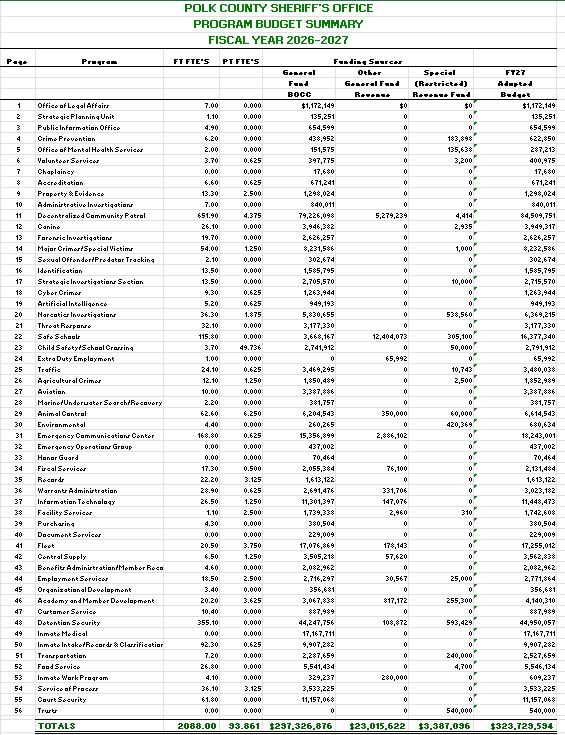
These two programs are examples, not a statewide cost ranking. Pinellas includes career offenders. Polk lists General Fund support and 2.1 funded positions. Their duties and accounting differ, so the totals cannot be treated as identical measures of registry work.
Grant agreements, funding-source ledgers, spending, and closeout records would show each program’s federal share and use of funds.
Vendor contracts maintain a public notification component
The software also has an ongoing cost. FDLE records identify Watch Systems LLC as a FOAS maintenance vendor. Contract C0923 describes custom-built proprietary software using OffenderWatch technology and FDLE’s stated support and warranty arrangement.
C2119 specifies $13,750 quarterly payments in arrears, meaning payment after the service period. Later C0923 terms specify $15,024.99 quarterly, with credits tied to availability.
| Official record | Entries | Recorded total after adjustments |
|---|---|---|
| C1413 / FDLE-014-13 | 32 | $329,533.42 |
| C2119 / FDLE-021-19 | 14 | $192,500.00 |
| C0923 / FDLE-009-23 | 14 | $205,149.46 |
| Purchase order C09A45 | 1 | $14,162.50 |
| Total of these extracted records | 61 | $741,345.38 |
These records span January 31, 2013–July 21, 2026: 57 positive vendor voucher entries and four signed reversal or accounting-adjustment entries. Voucher dates do not establish when a payment cleared the bank. The separate purchase-order voucher has different identifiers; agency confirmation would resolve possible duplication elsewhere.
Florida’s Department of Financial Services (DFS) lists a $15,024.99 warrant (a state payment order) to Watch Systems LLC under C0923, dated July 22, 2026. Document D7000027101 matches the prior day’s FACTS voucher. It corroborates an existing amount, not additional spending; no bank-clearing date is shown.
C0923’s original contract ceiling—the maximum authorized amount—was $175,099.48. An approved amendment raised it to $220,174.45. Its recorded accounting total is $205,149.46. These figures describe the same arrangement and must not be added together.
Jacksonville lists two finally closed purchase orders: 695125-25, June 30, 2025, $19,335.67 for an annual OffenderWatch subscription; and 673500-24, March 4, 2024, $6,100 for a sexual-offender mailout. Invoices, vouchers, and records of payments sent would help verify payments.
Local fees create another funding connection
Putnam Ordinance 2025-021, adopted August 26, 2025, sets $50 for new initial registrations, $25 per periodic re-registration, and $10 for address changes outside scheduled registration, with listed exemptions. People unable to pay must still be registered and receive an invoice. It takes effect upon state filing; that date was not recovered.
Jacksonville publishes a $25 registration charge. In OPPAGA’s 2024 survey, seven of 50 responding sheriff’s offices (of 67 statewide) charged fees: $15–$75 initially and $5–$25 for re-registration. Uses included general funds and registration costs.
Fees put some of the cost directly on registrants. Collection ledgers, waivers, unpaid balances, and fund transfers would show how much was collected and where it went.
The cost of following the rules
The cost of complying also includes time. OPPAGA’s survey found 57% of registration locations operated during regular business hours. For someone working those hours, a visit may require travel and time away from work.
Among responding offices reporting transient populations, 33% cited residency restrictions—rules limiting where someone can live—as a contributing factor to transience. Those responses do not establish why any particular person became homeless.
Florida law requires sexual offenders maintaining a transient residence to report in person at the sheriff’s office every 30 days. Each visit also creates information for the office to process. Housing stability, reporting duties, and verification work are connected.
Federal standards have a financial connection
Sections 943.0435(6) and 775.21(8) tie verification systems to applicable federal standards, including conditions attached to Florida’s receipt of federal funds.
Section 943.0436(1) records legislative concern that unmet federal requirements can jeopardize public-safety funding. Whether money was actually lost in a particular year requires the allocation and implementation records.
The Bureau of Justice Assistance (BJA) uses a baseline JAG formula that weights population and reported violent crime equally for states. Direct local allocations depend on the local share of reported violent crime. Registry-compliance adjustments are separate.
SORNA, the federal Sex Offender Registration and Notification Act, connects implementation to funding. SMART describes an annually assessed 10% reduction in the applicable state-side JAG allocation for nonimplementation, with specified exceptions. Separate direct local allocations are generally unaffected. Compliant jurisdictions can receive bonuses from those reductions.
OPPAGA reports a $491,477 Florida compliance bonus in federal FY2023; the Bureau of Justice Statistics (BJS) lists a $464,968 SORNA bonus allocation for FY2024. Award budgets and spending ledgers would show their use across JAG’s eligible purposes.
Implementation incentives do not establish payments per registrant, address check, or arrest. Additional local rules have separate authority.
SMART says SORNA’s minimum requirements depend on the offenses covered by the law. Risk assessment can inform supervision, treatment, and some notification decisions. This does not make every Florida rule federally required or identify a particular Florida assessment tool.
Four years of broader federal criminal-justice funding
Federal FY2023–FY2026 are the latest four published JAG allocation years. They show a broad criminal-justice funding stream. The allocation tables do not identify how much supported registry work.
Federal source: Congress approves JAG funding through federal spending laws. The U.S. Department of Justice (DOJ) administers it through the Office of Justice Programs (OJP) and BJA.
State-administered awards go through FDLE for approved state projects and local subawards—grants the state passes on to local recipients. Eligible counties and cities receive separate direct local BJA awards. Both routes are DOJ funding; allocation tables do not identify registry spending.
| Federal fiscal year | State-administered allocation | Direct local allocations | Combined Florida allocation |
|---|---|---|---|
| 2023 | $12,421,604 | $6,890,099 | $19,311,703 |
| 2024 | $10,717,097 | $5,808,926 | $16,526,023 |
| 2025 | $11,948,239 | $6,587,011 | $18,535,250 |
| 2026 | $10,944,598 | $5,846,520 | $16,791,118 |
| Four-year sum | $46,031,538 | $25,132,556 | $71,164,094 |
Florida’s combined four-year allocation is $71.16 million. The state column includes local pass-throughs, meaning funds the state passes on to local recipients. Signed grant awards, drawdowns (cash requested from an approved federal award), and spending records would verify receipt and use.
SORNA and Prison Rape Elimination Act adjustments may be included in published allocations; never add included bonuses again. Separate FY2025 and FY2026 SORNA bonus amounts were not independently verified.
The five largest county-government direct allocations
The table follows the five largest county-government direct allocations in FY2026 back through FY2023. Rankings in earlier years may differ.
| FY2026 rank | County government | FY2023 | FY2024 | FY2025 | FY2026 |
|---|---|---|---|---|---|
| 1 | Miami-Dade | $517,346 | $383,023 | $444,854 | $477,515 |
| 2 | Orange | $438,256 | $383,673 | $445,105 | $273,714 |
| 3 | Hillsborough | $168,612 | $148,372 | $172,129 | $160,998 |
| 4 | Escambia | $137,684 | $121,157 | $140,556 | $129,041 |
| 5 | Pasco | $134,699 | $118,530 | $137,509 | $126,243 |
These broad allocations are already in Florida’s direct local totals. County applications and approved budgets would identify any registry use.
BJA classifies Jacksonville as municipal, so its $510,251 FY2026 allocation is outside this county ranking. Joint-group totals are also excluded; all five selected counties are outside those groups. This ranks named county governments, not every federal dollar reaching their geographic areas.
Population and reported violent crime, eligibility, and annual congressional funding decisions affect JAG allocations. To see the size and spending of a registry unit, the public needs its program budget, payroll, and grant records.
Newer grant priorities include registry work
Executive Order 14321, July 24, 2025, directed departments to assess lawful discretionary-grant priorities, including SORNA compliance and mapping and checking registrants without fixed addresses.
BJA’s FY25 and FY2026 Public Safety and Mental Health Initiative notices use that criterion. Qualifying state applicants may request priority consideration; it does not guarantee funding.
Those initiatives also cover crisis response, treatment, housing access, and related services. A Florida award and approved budget would identify any registry share.
The FY25 SMART implementation-grant notice covers technology, collaboration, verification, and corrections to national records. Its measures include training, accessible records, transmissions, and information exchanges. The Florida award below shows planned work; the notice’s requirements for keeping that work going are discussed later.
A Florida award shows the planned work
The official federal award record for FDLE’s grant for registry work lists $399,993 committed for a project running March 1, 2026–February 28, 2029. Planned uses include 1 staff member, partner-agency training, software, supplies, and other registry support.
The project plans work across several years. The committed amount is not a verified payment total. Grant financial reports and FDLE’s accounting records would show what was paid and how it was used.
Palm Beach shows the difference between an award and spending
Palm Beach’s October 19, 2010 packet documents award 2010-WP-BX-0006: $150,000 for Comprehensive Approaches to Sex Offender Management. Its strategy included risk-based management, registration compliance, training, equipment, supplies, contracts, and overtime through the sheriff’s grant fund.
County audits list expenditures of $37,553 in FY2011, $41,820 in FY2012, $7,853 in FY2013, and $55,120 in FY2014: $142,346 combined.
The $150,000 award and $142,346 in expenses describe overlapping money. They cannot be added together. Amendments and closeout records would explain the remaining difference; the subtraction alone does not show unused or returned funds.
Federal support can also reach a local operation
An April 16, 2024 U.S. Marshals account describes an August 19, 2019 discussion about a sex-offender operation it was funding for St. Johns County. It gives no amount, award identifier, invoice, or payment date.
An agreement, reimbursement limits, claims, payroll or equipment records, and payment records would establish what the operation cost and who paid. An agency-wide budget cannot answer that operation-specific question.
What “use it or lose it” means for a grant
BJA’s August 2026 guidance requires JAG funds to be legally committed during the project period, which can span years. Properly incurred obligations—costs the grant recipient has legally agreed to pay—must be paid within 120 days afterward. Uncommitted or unspent funds, including interest, must be returned at closeout, the final accounting and reporting when a grant ends.
DOJ allows justified extensions without additional funding, but not solely to use an uncommitted balance.
That is the documented “use it or lose it” rule. To find out whether a deadline affected an operation, follow its award, project dates, approved activities, amendments, balances, obligations, extensions, and closeout reports. The rule does not establish that arrests are required to retain funding, or that county operating budgets follow the same deadlines.
Why the infrastructure keeps operating
The work does not end with one appointment, one employee, or one grant. Florida law assigns continuing duties, agencies maintain the systems, and later budgets and grant applications decide how the work will be supported. One person leaving the registry does not automatically end those wider functions.
The federal connection is recurring. SMART assesses SORNA implementation annually; failure to maintain substantial implementation—meeting SORNA’s implementation standard as determined by DOJ—can reduce the applicable state-side JAG allocation by 10%. JAG’s baseline formula uses population and reported violent crime, not registry headcount. A person leaving the registry is not a per-person deduction from that formula.
The separate FY2025 SMART funding notice asks applicants to explain how their program and grant-funded positions will continue after the award ends. That plan—called sustainability—carries 5% of the application review score. It concerns continuing the work and positions, rather than retaining a named employee. It supports planned continuity without guaranteeing permanent funding or jobs.
If a state declines JAG, the money has another route
Federal law expressly addresses a state choosing not to participate. Under 34 U.S.C. §10156(f), after the Attorney General makes the required determination, the state’s allocation—or the relevant portion—must be awarded to local governments within that state. Priority goes to jurisdictions with the highest annual numbers of reported Part 1 violent crimes over the three most recent available calendar years.
Withdrawal can change who receives the money and which projects it supports. Eligible local governments also have a separate direct JAG application route. Leaving the state-administered program does not automatically remove JAG funding from Florida’s geographic area. These remain broad criminal-justice funds; approved local budgets would identify any registry use.
Ending an existing award also leaves termination and closeout responsibilities: written notice, final reports, matching the accounting records to those reports, and returning excess cash received from the award. Unspent award balances are cancelled; costs found ineligible under the grant rules may have to be repaid. Leaving the program does not automatically require repayment of every properly spent dollar. Federal property rules and continuing audit responsibilities can also apply.
The legal duties are another layer. Florida’s registration law continues to assign work to FDLE and local agencies independently of accepting JAG. Federal SORNA rules can separately apply to covered individuals even when their jurisdiction does not substantially implement SORNA. State removal and federal duties therefore need separate examination.
This is a hypothetical funding route. It shows how the work can continue through different sources of money. The infrastructure can change, but ending a grant relationship alone does not change the laws assigning the work.
The public deserves clear answers
These records connect county offices, state agencies, national databases, and paid services. The public deserves to know who handles the information, how errors are corrected, where the money goes, and what the work accomplishes.
Florida requires OPPAGA to review registry effectiveness every three years and identify corrective options and projected costs when it finds deficiencies. That review should help show whether mistakes are corrected and people can comply.
This is still only the tip of the iceberg. More of this infrastructure needs to be traced, including registry-specific county costs, actual grant spending, correction notices, and enforcement outcomes. These records affect people’s homes, jobs, travel, and families. The people living under these rules deserve clear answers and dignity.
Research scope and calculation notes — click to open
The courts-and-corrections section uses 2026 Florida Statutes §§943.0435(9), 948.001(3), and 948.06(1)(c), plus FDC’s July 2026 quarterly report. The electronic-monitoring minimums apply to the violations and dates covered by §943.0435(9)(b), excluding subsection (13). The FDC–FDLE exchange is a broader criminal-justice reporting process, not proof of registry-only outcomes or unrestricted SOPS access. No unfinished cohort findings, statewide cost estimates, or forecasts are treated as established results.
Research dated October 4–5, 2026; factual, editorial, calculation, and link checks completed October 5. These are selected examples, not a statewide estimate. The findings are supported by research and the public records linked throughout this article.
“Direct local” in these tables means BJA’s federal route. FDLE’s separately named JAG Direct program belongs to its state-administered pass-through route.
JAG years are federal FY2023–FY2026. State-administered totals include pass-throughs: $46,031,538, plus $25,132,556 direct local, equals $71,164,094. County amounts and included bonuses overlap these totals. Separate FY2025/FY2026 SORNA bonuses remain unverified, not assumed zero.
County ranking: select the five largest of 39 numeric County Direct Allocation rows in BJA’s FY2026 list, then trace those counties back three years. Exclude municipalities and joint totals; all five are outside joint groups.
County program figures are adopted budgets for FY2023–24–FY2026–27. Pinellas’s cost center changed from 3041 to 3220. Mixed duties and shared costs limit comparison. Actuals, budgets, grants, fees, and pay retain separate labels.
The address-update illustration is hypothetical and follows documented functions; it does not describe a real case or every reporting duty. Population is an October 2024 snapshot. The audit was in 2022, with documented corrections. Download guidance dates to August 2025. The DFS warrant corroborates an existing voucher; it adds no spending.
CJNET findings use public laws, agency descriptions, dated guides, security policies, and the mobile-app listing. Internal permissions, actual logging, and complete individual access histories were not verified. The 2023 guide is separate from later reporting duties.
Calculated comparisons: Pinellas budget less actuals, $227,198; Palm Beach audits, $142,346; signed FDLE accounting entries, $741,345.38. These are separate, overlapping measures and are not combined into a registry-cost total.
FDLE support covers three completed fiscal years, FY2023–24–FY2025–26. Follow one selected computer-support purchase per year. FOAS uses FACTS-assigned fiscal years, including vouchers dated after June 30; four rows per year were recalculated. FOAS is already in the C0923 subtotal. The broader Criminal Justice Information budget is context.
FDLE award 15PSMA25GG02134AWAX was checked against the official USAspending record on October 5, 2026. Its award-level federal payment total (outlay) is missing; a separate account-level field reports zero. Neither establishes FDLE’s actual expenses. The $399,993 commitment is not treated as verified spending or added to payroll, contracts, or JAG allocations. Survey percentages describe responding offices or their registration locations. The historical conviction rates group arrests by year.
The infrastructure cycle summarizes documented relationships, not a claim that all JAG funds support registration. State withdrawal is hypothetical; §10156(f) addresses funding rerouting after a federal determination. State removal and federal SORNA duties are separate questions. Amounts are nominal dollars, meaning they have not been adjusted for inflation. This is descriptive research, not a causal analysis of funding and arrests. Sources are linked directly in the text and tables. Read laws and fee provisions in full.
Discover more from Florida Action Committee (FAC)
Subscribe to get the latest posts sent to your email.
Comment Policy