Predator Files: SOSA, ICAC and Sting Accountability
Watching the Sting: Decoys, Decisions and Accountability
By FAC Media | Opinion and Research
The private team, the filmed operation and the records needed to understand both.
A note to readers,
This article helps readers understand how a sting takes shape: creating a decoy profile, exchanging messages, arranging a meeting and coordinating with police. The timestamps and linked training documents let you follow that process and examine the decisions behind the arrest.
It also explores choices that some readers may see as grey areas: how contact began on an adult dating app, what age the profile displayed, who guided the conversation, and how police supervised the private team. People may interpret these choices differently. The selected footage leaves questions that require complete conversations, authorization records and the court outcome to assess fairly.
Children deserve protection, survivors deserve support, and the public deserves a clear understanding of these investigations.
Names and abbreviations used in this article
– FAC: Florida Action Committee.
– SOSA: Safe From Online Sexual Abuse, the private nonprofit organization.
– ICAC: Internet Crimes Against Children, the federally supported task-force program.
– OJJDP: Office of Juvenile Justice and Delinquency Prevention, within the U.S. Department of Justice.
– OSBI: Oklahoma State Bureau of Investigation.
– FBI: Federal Bureau of Investigation.
– HSI: Homeland Security Investigations.
Whatever the decision, remember the family waiting. What happens next reaches beyond one person.
Children deserve protection from abuse. Survivors deserve support. The public also deserves a clear understanding of how these investigations work.
SOSA explains on its own website that its team builds decoy accounts, communicates with adults, identifies those individuals and provides evidence to law enforcement. It says its operations require law enforcement approval. That makes the relationship between the private organization and the investigating agency an important part of the story.
The Predator Files clip follows Logan, a decoy presented as a 15-year-old boy, through messages, a planned meeting and an arrest. We can compare the footage with investigative guidance.
Roo’s team and the network behind the operation
SOSA helps these operations proceed through a documented network. On its operations page, it describes planning with ICAC teams and prosecutors, funding an operation house, running decoys and organizing communications and images for law enforcement. Police can follow the evidence as it is collected and carry out arrests. This places SOSA inside the investigative workflow.
A Shreveport Police Department release dated October 30, 2025 independently confirms a joint operation with SOSA. That corroborates a broader working relationship; it concerns a different operation from the Logan clip.
Coordination is visible at 01:06-01:43, when the sheriff’s office is alerted, and 03:39-04:29, as officers work toward the arrest. At 06:42-07:31, multiple team members work with decoys and catalog interactions. The story involves everyone handling communications, images and evidence, alongside Roo.
SOSA says Roo trains law enforcement at departments and ICAC conferences on decoy accounts, communication and case preparation. Accountability requires the agreement governing the private team’s work and records of police supervision and prosecutorial direction.
A traveling team, a county sheriff and a national network
06:19-06:38 A team member discusses coming to Oklahoma roughly 30 hours earlier. At 06:42-07:31, the narration describes a five-day Oklahoma City operation. Based in New Haven, Connecticut, SOSA says it operates nationwide. Its operations page describes sending a team to a partner’s county and renting an operation house with nonprofit funding.
02:53-02:55 The caption identifies Sgt. Brian Dawson, Canadian County Sheriff’s Office. The office is based in El Reno, Oklahoma. This identifies an Oklahoma county officer; it does not establish Canadian or other international involvement.
OJJDP, part of the U.S. Justice Department, funds ICAC, providing training and technical assistance to regional task forces and affiliates. Providers include Fox Valley Technical College and the National White Collar Crime Center. ICAC is a federally supported network involving federal, state, local and Tribal agencies. Local police and sheriff’s offices can be task-force members.
The Oklahoma State Bureau of Investigation hosts the state’s ICAC task force. An official 2025 agreement report connects it with the Canadian County Sheriff’s Office, addressing policy, supervision, planning, training and public relations. The listed term ended June 30, 2026. It documents that relationship without establishing the agreement governing this sting.
Our earlier Operation Cooked article examined national training, regional task forces and local officers. Here, SOSA describes supplying a traveling decoy and evidence team, while police conduct the arrest. Authorization and supervision records would help assess that cooperation.
The training’s reason for going undercover
The slide titled “Why We Do Online Undercover” appears on PDF page 2 of the 2019 Dallas CAC handout. It reproduces a 2015 Houston news report describing a Craigslist undercover investigation involving a reported four-year-old victim. The training uses that case to illustrate the child-protection purpose of this work.
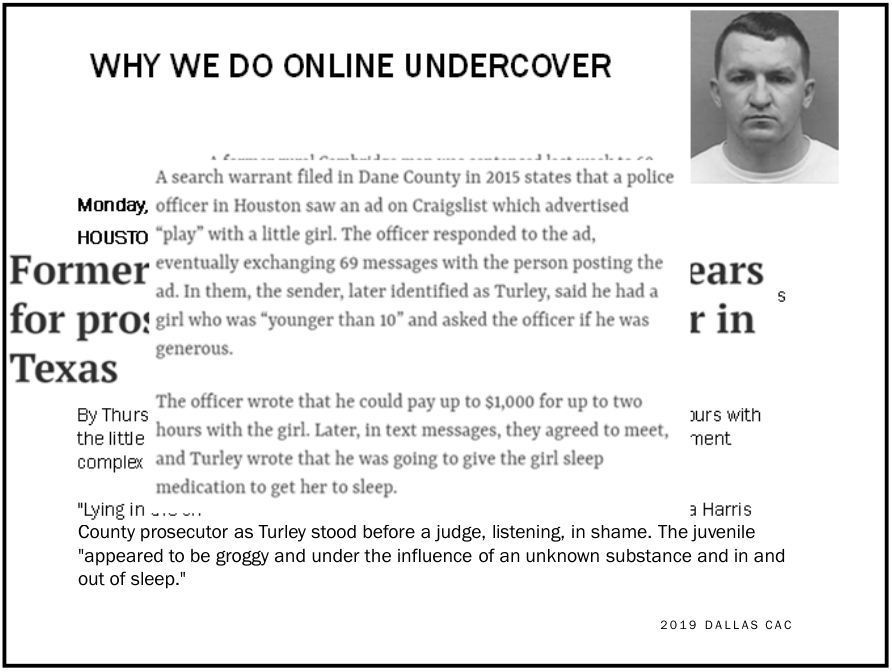 Source: “Why We Do Online Undercover,” 2019 Dallas CAC handout, PDF page 2. The overlapping article text appears in the original handout.
The same handout places its investigative standards slide below that example. The purpose and rules both matter. At 00:00-00:25, the Logan footage introduces an adult-run decoy presented as 15; at 04:45-04:58, it shows an arrest. It does not establish that an actual child was located or rescued. Readers deserve to know whether the operation identified a child in danger, investigated a decoy exchange, or did both, with the complete evidence and court outcome.
Supervision and the written standards
The 2019 Dallas CAC handout’s standards slide, PDF page 2, brings those questions into focus. It describes ICAC commander and prosecutor authority, direct police supervision of non-sworn investigators, documenting investigative work, and letting the suspect set the conversation’s tone, pace and subject. It also states a prohibition on cooperation with cyber vigilante groups.
The November 2023 national standards address police direction and authorized non-sworn participation in sections 8.2-8.4. Their defined vigilante category is not synonymous with nonprofit status. Section 8.4 also preserves civilian crime reports and authorized investigative methods. The clip establishes neither a policy violation nor compliance; the applicable rules and authorization records matter. Conversation provisions are discussed below.
A publicly posted Oklahoma ICAC agreement, PDF page 2, provides a local comparison. It assigns day-to-day operational supervision to an OSBI supervisor, keeps responsibility for personnel conduct with their own agencies, and requires appropriate officer training before online investigations.
PDF page 4 addresses records, evidence and media releases. It provides for agency-held records and evidence custody, and prior approval from all agencies with an immediate investigative or prosecutorial interest before operation information is released to the media. Releases concerning ongoing prosecutions are coordinated through Oklahoma ICAC command. Alongside the coordination at 01:06-01:43 and 03:39-04:29, this raises questions about who held the complete record, supervised the private team’s work, and approved filming and publication. The public Mangum copy is unsigned; it does not establish the agreement governing the Logan operation.
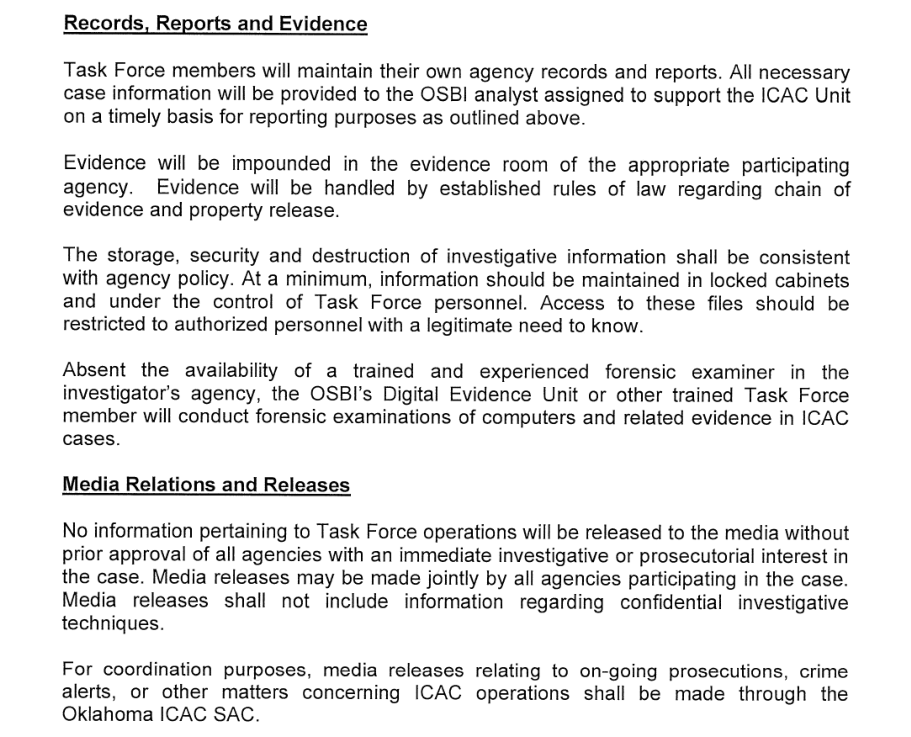 Source: Oklahoma ICAC agreement, PDF page 4. Excerpt from the unsigned Mangum public copy. This is an agreement page, with a revision footer dated February 1, 2024, rather than a training slide or proof of the rules governing this sting.
The framing starts with the title
Predator Files sets an expectation. In my view, the title appeals to viewers drawn to pursuing and catching a predator. The nickname “the enthusiast” can turn the man into a recurring character and encourage anticipation of his capture.
That framing can shape judgment before viewers see the complete evidence. A dramatic title, nickname and arrest can make guilt feel settled, although the video does not establish the court outcome. My concern is that this chase-story presentation can leave a misleading impression of what has been proved.
When I tried the YouTube upload, it would not play in my location. I have the video; I have not verified which countries can access that upload.
Timing note: The source site lists the film at 8:00. According to my recording notes, playback included a 23-second commercial, which I removed, and my copy misses only the first second of the film. Those recording details have not been independently checked against the source playback.
Follow along: These timestamps refer to my 7:34 copy. The commercial and missing opening second mean the source player’s timestamps may differ.
The profile, first contact and claimed age
00:00-00:25 To me, Logan’s story appears to begin partway through an exchange. The narration describes the account going live on a dating app and receiving messages, but the graphics omit the complete conversation from first contact. We cannot determine how far into the exchange this excerpt begins.
How did the two first connect, and where did that contact take place? What did Logan’s profile display, including its age? Who sent the first message, and did they move to another messaging service? The interview at 05:35-06:05 names Grindr. Its published terms reserve the service for adults aged at least 18, or the applicable older age of majority. That platform context belongs in the story alongside the later age disclosure.
The 2015 Bellevue training binder’s startup guide, PDF page 75, calls for recording the undercover profile. Its evidence checklist on page 77 again recommends preserving that profile to document what it showed. The undercover identity worksheet on page 81 records account details, birth date, age and linked accounts. Those records would help answer the questions left open at 00:00-00:25. The worksheet does not tell us what Logan’s profile actually displayed.
The 2019 Dallas CAC training handout, PDF page 12, includes a slide headed “Getting UC Accounts.” It describes a phone-number requirement and displays several services, including the Grindr logo. This puts account setup within the historical training material. The film does not show what registration information was entered for Logan, what age appeared on the profile, or whether special platform authorization existed.
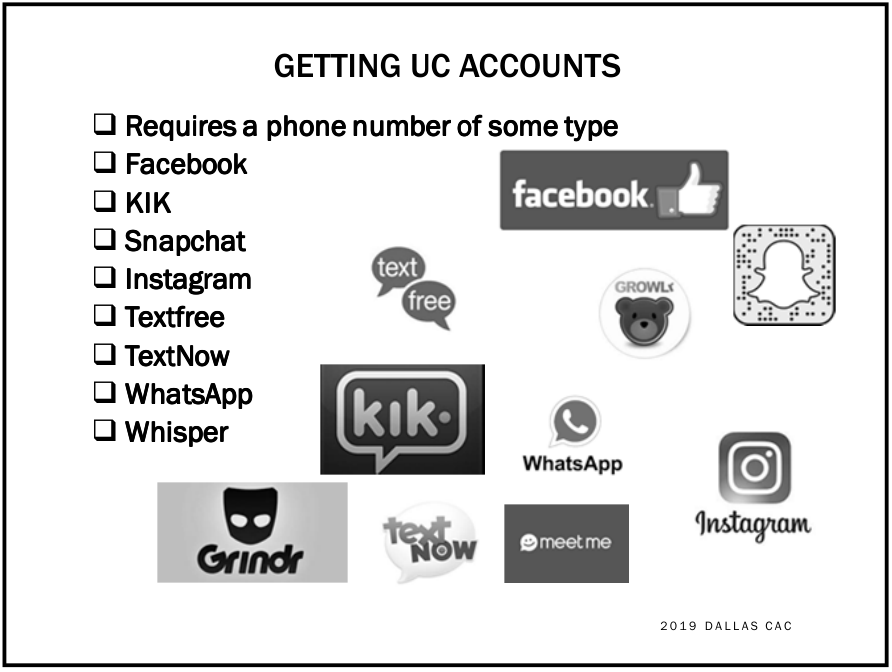 Source: “Getting UC Accounts,” 2019 Dallas CAC handout, PDF page 12. This is a detail rendered from the original page. The handout is historical conference instruction; it does not establish the policy governing the filmed operation.
00:15-00:25 The displayed exchange moves from ordinary small talk to age disclosure. Logan says he is younger than 18, then describes his age as three years less than 18. The next message shown asks about previous experience with a man. That sequence matters: readers should be able to see what age was communicated and what followed.
This selected clip does not explain Oklahoma’s age-of-consent rules. In my view, that leaves an important gap when age is central to the story. Oklahoma’s 2025 HB 1003 raised the under-age threshold in the rape statute from 16 to 18 and changed the close-in-age provision. Logan’s stated age of 15 is below either threshold. The clip does not identify the operation date, precise charge or law applicable then.
Age of consent does not answer every online-solicitation question. In Arganbright v. State, 2014 OK CR 5, paragraphs 27-30, Oklahoma’s criminal appeals court distinguished the then-age of consent of 16 from the under-18 definition for the technology-based offense. The statute discussed also covered a person believed to be a minor, as paragraph 18 explains. Viewers deserve the applicable statute, complete evidence and case outcome.
00:43-00:56 Another displayed exchange asks whether Logan is too young. The reply shown says the man is comfortable if Logan is. The decoy then asks what he wants to do, followed by explicit responses. The relevant question is how the complete conversation developed, including who introduced each subject. These television graphics show selected exchanges; they do not establish that every message is included.
The November 2023 ICAC standards generally require the target to set the conversation’s tone, pace and subject, absent contrary prosecutorial input. They also expressly permit initial messages, advertisements and posts. Those provisions must be read together. Sending the first message alone does not establish a violation. See sections 8.9-8.9.2, PDF page 19 of the full Olympia attachment.
The meeting and the decoy photograph
01:06-01:43 The narration says the meeting moves from a hotel to a nearby parking lot and the sheriff’s office is alerted. The team discusses where the decoy can be seen and how officers can approach safely, making the private team’s coordination with police visible.
The historical Net Nanny presentation helps explain that coordination. Its command-post slide, PDF page 29, identifies prosecutor involvement, legal review, personnel assignments and an event timeline. Page 35 addresses moving from an online platform to text and documenting the exchange; page 36 emphasizes communicating age early. These are useful comparisons with the age disclosure at 00:15-00:25 and police coordination at 03:39-04:29. They do not establish that this team used that presentation.
02:00-02:48 The man requests a current photograph as proof that the person he is communicating with is real. The team supplies an image consistent with the boy decoy. The standards’ imagery provisions offer a comparison, subject to identifying the policy that governed this operation.
Sections 8.7-8.8 of the 2023 standards permit specified employee imagery with written consent given at 18 or older, or non-explicit computer-generated imagery. “Employee” includes people under police direction and control. A separate exception requires FBI or HSI authorization and compliance with that agency’s guidelines. The 2015 binder contains a picture-consent form on PDF page 43. The clip does not show the consent, approval or governing policy records.
Fear, relief and the apparent rush
02:24-02:48 Roo describes the difficulty of an instant photograph for a boy decoy and expresses fear. Once the image is accepted, a colleague praises the selfie. To me, her expression and the team’s response suggest excitement alongside tension, an apparent adrenaline rush. That is my impression; it cannot establish what she feels or why she does this work.
05:12-05:26 After the arrest, Roo calls the experience nerve-racking and says she moved aside when officers went in. Both moments provide context beyond an isolated smile, fearful remark or expression of relief.
From the decoy to the arrest and interview
03:39-04:29 Officers report Roo is out of the car. The team shares the approaching vehicle’s description, continues communicating and awaits the arrest decision. 04:45-04:58 Officers take the man into custody. The arrest sequence does not establish the eventual court outcome.
05:35-06:05 The questioning turns to how the man arrived and identifies the dating app as Grindr. Historical Net Nanny training slides discuss linking a person to online communications and identifying further evidence or victims. That provides a comparison point, not proof that these officers trained from that particular presentation. The full interview and investigative records would be needed for a complete assessment.
06:42-07:31 Back at the house, the team talks about continued activity and staying on top of evidence. The film shows multiple decoys and people cataloging interactions. Documentation is central to the standards, and the 2015 binder’s checklist on PDF page 77 emphasizes preserving profiles and communications. The full record matters because a public video is only a selected view of an investigation.
The closing sequence presents the work as exhausting and urgent. In my view, calling it tireless work can leave sustained deception through decoy identities insufficiently examined. On an adult app, the starting profile and first contact deserve scrutiny alongside conduct after the claimed age of 15 is communicated. Assessment requires the full sequence.
I want to know which standards governed the operation, who approved the private team’s role, who reviewed the complete conversations and what followed the arrest. Actual victim support and court outcomes deserve clear reporting. A decoy arrest does not establish that a child was rescued.
Protecting children and supporting survivors are reasons to ask these questions. ICAC receives public funding; the clip does not itemize the operation’s costs. The public deserves to know where taxpayer money goes, what investigative work it pays for and what results it produces.
Research note: The linked teaching materials are historical public copies, including mirrors. The 2023 standards are the newest complete dated national edition located in this collection. The policy edition governing this filmed operation has not been established. Grindr’s published rules were checked October 10, 2026; they are current rules, rather than a record of the filming date.
Discover more from Florida Action Committee (FAC)
Subscribe to get the latest posts sent to your email.
I’m sharing this to raise questions, not to promote the channel or encourage anyone to join. SOSA—Safe from Online Sex Abuse—says its public episodes are free, while paid YouTube members receive full-length versions. It also says membership fees cover episode production costs.
That raises a fair question: could fear and suspense help attract viewers and encourage paid memberships? How do editing, titles, and thumbnails shape the audience’s understanding of the danger and the investigations?
SOSA says filming does not drive its operations. That statement deserves consideration, alongside questions about how the content is presented. Paid memberships alone do not prove fear is deliberately exaggerated, but asking about the relationship between public education, entertainment, and revenue is reasonable.
Why are they offering children for – s3x – to men online who are seeking consensual, casual, sexual encounters, while not offering that to others? There is ZERO evidence that men from the online hookup culture are anymore a higher risk to minors over any other group.
So, how is it even legal to recruit individuals from that group to then suggest to them and encourage them to commit felonies? Why not “offer the opportunity” to others, like for example, those who work with kids. That would at least make some sense as opposed to the stupidities they’ve been doing.
Roo Powell and her people, along with all others like Chris Hansen and others like them, need to be held accountable for the BS they’ve been doing and getting away with for way too long. They need to be held accountable for this scam.
There is another piece of this that deserves scrutiny: these platforms present themselves as spaces for adults, and some go beyond simply asking users to say they are 18.
Take Sniffies. In January 2025, the company announced enhanced verification involving government-issued ID, a live facial check, and screening against previously flagged fraudulent IDs. A Florida-specific Reddit discussion also reports that users could create an account, but explicit profile images remained blurred until they uploaded ID. That is evidence of an actual verification barrier, although it does not establish that every account passed it.
Sources: “Sniffies’ announced verification process” https://www.advocate.com/business/grindr-pornhub-sniffies-onlyfans-restrictions and “Florida users’ Reddit discussion” https://www.reddit.com/r/Sniffies/comments/1hxsehx/for_florida_people_how_to_bypass_id_verification/
Grindr also requires users to declare they are adults and provide a birth date. Its “published instructions” https://help.grindr.com/hc/en-us/articles/4417616146963-Confirming-your-age require government ID and supporting photos when an account is suspended for suspected underage use. That is different from mandatory ID verification for every Florida user.
These safeguards could help explain why someone initially expected to encounter adults. They do not establish what that person believed after a later underage claim. That is why the original profile, any verification status, the timing of the age disclosure, and the complete conversation matter. An arrest announcement alone cannot answer those questions.
This is awesome work that these types of undercover stings perfect to make sure our kids are kept safe and sound from the perverts, pedophiles rapist and killers of the world. I salute any organization that’s in the business of making this world a safer environment for the next generation of young adults.
Mr. D, we have to look at how these stings are conducted, including how many cases end in plea deals rather than going to trial. A high conviction rate alone does not tell us whether children are safer. What harm was prevented? Were actual children identified and helped? Are repeat offenses reduced?
I’ll do a separate post on “DeMare v. State” https://law.justia.com/cases/florida/second-district-court-of-appeal/2020/19-2959.html, a Sarasota County case listed in the Broward ICAC case-law index. The appellate court found entrapment, reversed the conviction and ordered discharge. Walking readers through the communications and the court’s reasoning will show why the complete record matters.
Children deserve protection, and taxpayers deserve evidence that these operations deliver it.
Unless your children are out actively soliciting men online to meet for sexual purposes, these fraudulent sting operations are not protecting them. These sting operations are an insult to real child protection.
http://youtube.com/post/UgkxOOOvIFZ_lx99flRpKuGYTOyQrV7Pw26D?si=FJiL2gQJ5y-gbTeX
Well over 90% of sexual abuse victims know their perpetrator. If police are spending so much time and resources on these sting operations what are they doing to prevent real harm happening to real potential victims? Have the number of sting arrests actually led to a decrease in victims that correlates to the number of arrests? No. Thats the tragedy of this. They are addressing a problem that does not exist. No one is on an adult 18+ or 21+ dating site hoping to find someone underage – they are there looking for other adults. This is just lazy police work. The result is innocent people have their lives ruined while the police have done nothing to prevent actual potential harm from happening to those at risk of abuse from someone they know.
Mr. D:
If people are so paranoid of online predation of minors, then it would be a thousand times easier and a million times more effective to simply bar minors from being online, for the same reasons as barring them from bars and casinos.
And while there is no doubt that there are some online predators, there is absolutely nothing to show that they are anywhere near as prevalent as these groups and the press claim. Actual child predators are not on adult sites going, “Too old, too old, too old…. HEY! Here’s a young one!”
The purpose of these stings has absolutely nothing to do with safety or protecting anyone from anything. Civilian stingers do it for Youtube viewership. LE does it for funding and easy felony arrests. The targets of these stings are only guilty of criminal stupidity. If not arrested on site, many would probably stay off of the adult sites., and none would ever again carry on with a chat after the supposed “age reveal” or attempt to accost a minor in real life because they weren’t looking for minors in the first place.
Like you, I also salute any organization that makes the world safer for all, especially children. But there are too many individuals and organizations that turn into money mills for providing nothing more than the mere illusion of safety and protection should be scorned, not praised.