Every Halloween, the Warnings Return. Let’s Check the Facts.
MEDIA BUZZ · FLORIDA ACTION COMMITTEE
Every Halloween, the Warnings Return. Let’s Check the Facts.
By Florida Action Committee Media
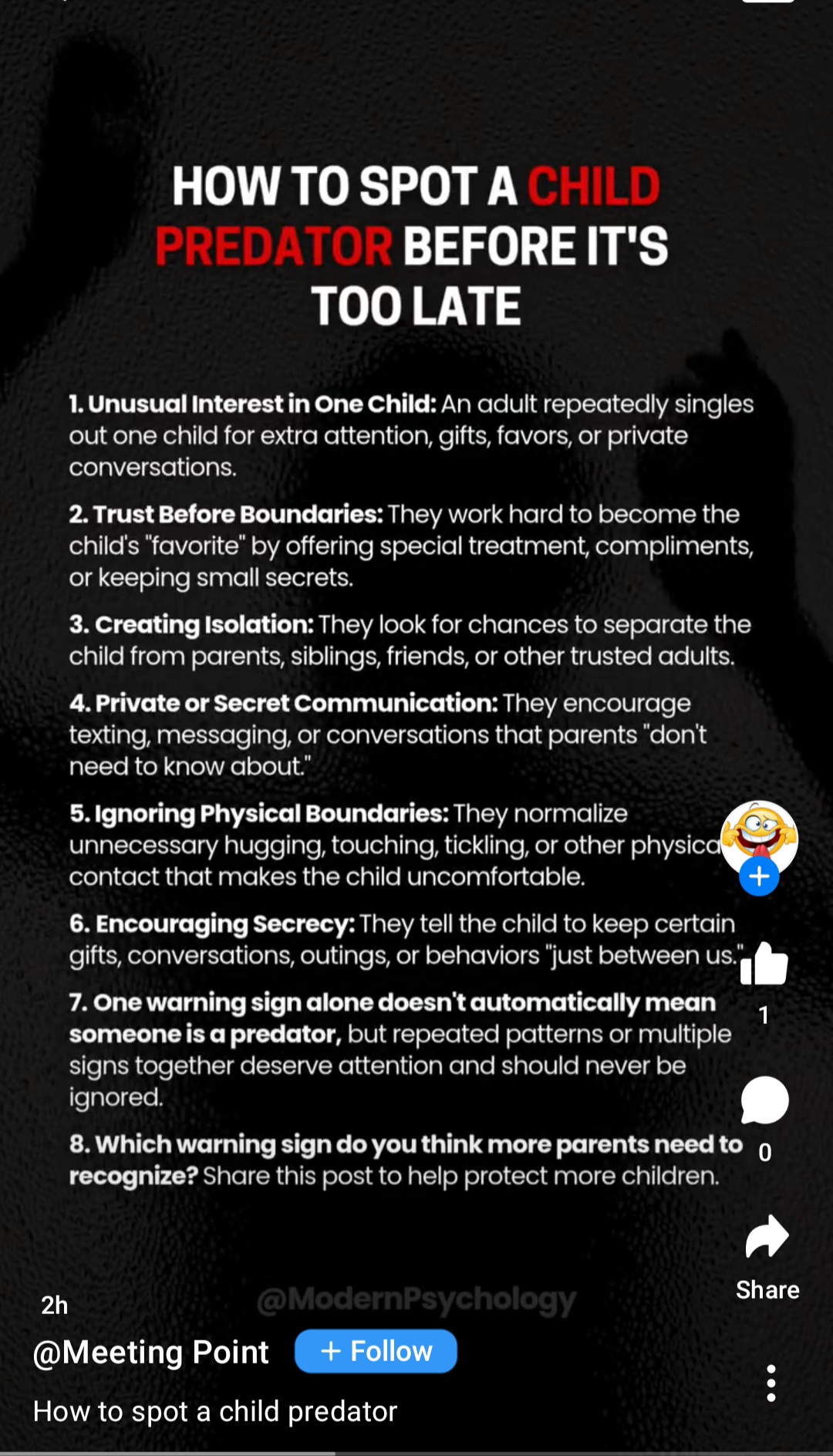 Editorial image with a headline excerpt from the post shared on NewsBreak by @Meeting Point. The original screenshot carries a @ModernPsychology watermark. Shown for commentary and fact-checking.
Of course, here we are again. Halloween is near, and another warning about “child predators” is making the rounds. Families deserve clear facts about child safety. They also deserve more than a scary headline.
As we said in It’s Halloween Hysteria Time Again!, this season brings familiar fears for people on the registry. This new post gives us another reason to slow down and check the facts.
A 15-second video shared on NewsBreak shows warning text with music-box-style music. The screenshot names @Meeting Point and has a @ModernPsychology watermark. That does not establish that NewsBreak made the video.
Its headline says, “How to spot a child predator before it’s too late.” The graphic shows no research links. It does not mention Halloween or the registry. Still, its timing gives us a chance to look at the familiar fear that returns each fall.
Checking all eight points
1. Extra attention toward one child
Attention or gifts alone do not prove abuse. Federal guidance lists gifts without a parent’s knowledge and special attention as possible concerns. Context matters. Read the guidance.
2. Building trust through special treatment
Trust itself is not proof of harm. Michigan’s guidance describes grooming as gaining trust, then isolating a child and moving toward abuse. Kindness alone does not prove that intent. Read the guidance.
3. Trying to isolate a child
This warning has support. Federal guidance flags efforts to be alone with a child. A single one-on-one activity does not establish abuse. Read the guidance.
4. Hidden messages and private talks
Private talk is not proof of abuse. Pressure to hide unsafe acts or messages deserves attention. Look at the full situation, not one message taken out of context. Read the guidance.
5. Ignoring a child’s physical boundaries
This is sound advice. Federal guidance hosted by Florida’s child welfare agency says children can refuse unwanted touch. Adults must respect their boundaries. Read the guidance.
6. Asking children to keep secrets
This warning has support. The same guide distinguishes safe surprises from unsafe secrets. Adults—not children—bear the duty to keep children safe. Read the guidance.
7. One sign alone does not prove someone is a predator
This is the post’s key caution. A warning sign is a reason to pay attention, not a verdict. Suspicion should not become a public accusation.
8. Share the post to protect children
This asks for shares. It is not a research finding. The graphic offers no evidence that sharing this particular video prevents abuse.
When facts are wrapped in fear
In our view, this style of message borders on propaganda: it uses real safety concerns in a way that can stir fear before thought. The dark image, alarming headline, and music set the mood. They do not prove the claims.
It would be wrong to call every point fiction. Several are useful warnings. The problem is the headline’s promise that a short list can tell us who is a predator. The post does not show that its list can do that. Point seven is more careful than the headline.
We cannot know the creator’s intent from this post. We can ask for sources, fair wording, and clear steps for parents.
The Centers for Disease Control and Prevention puts the duty where it belongs: “Adults are responsible for ensuring that children have safe, stable, nurturing relationships and environments.”
What does the Halloween research say
A 2009 study coauthored by Jill Levenson examined 67,045 reported sex crimes by nonfamily members against children age 12 or younger. It used data from participating areas from 1997 to 2005. It found no significant rise on or just before Halloween.
That does not mean zero risk. In her 2014 commentary, Levenson urged year-round safety rather than Halloween myths. This is her explanation of the research, not a new study.
To our members and their families
For people on the registry, these messages can hurt. You may worry about how neighbors see you, what your children might hear, or whether your family can have a quiet night.
You deserve safety and dignity, too. A label does not tell your whole story. We can support child safety while asking people to stop, check the facts, and treat each other with care.
The Florida Action Committee discussed these concerns in this week’s update. We support clear facts, safer communities, and respect for our members and their families.
Edward R. Murrow said, “To be persuasive we must be believable; to be believable we must be credible; to be credible we must be truthful.”
Please take our survey
Could you please take our survey? We’d like to hear what you think about how Florida news outlets cover registry issues.
If the survey does not appear, open it here.
Discover more from Florida Action Committee (FAC)
Subscribe to get the latest posts sent to your email.

The “warning” could easily describe a school counselor, coach, therapist, pastor, etc. Ironically, those who know and/or are close to the child are more likely to molest/abuse than a stranger on the public doxing list.
The source for that info-graphic is most likely Tic-Tok. As you know, they’re a bastion of credibility and a trusted source for up-to-date information. /s