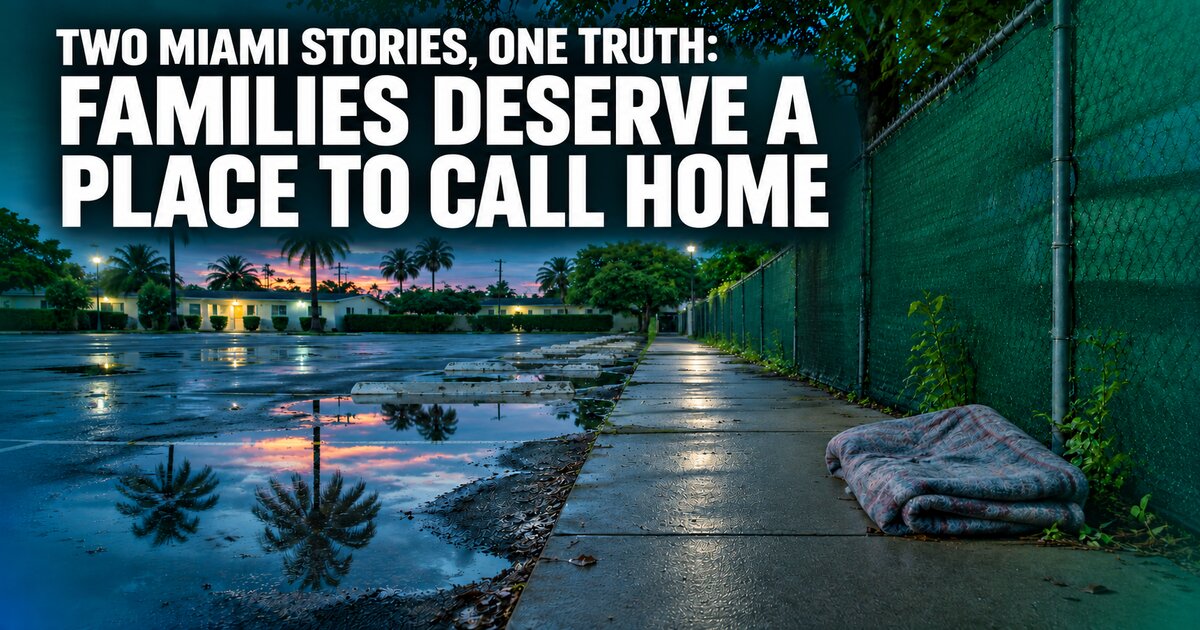
Two Miami Stories, One Truth: Families Deserve a Place to Call Home
I am truly humbled by how in-depth B. Scott McLendon’s new Miami New Times article is. LEPER is used and for good reason!
It shows the human lives behind Florida’s housing restrictions and the places people are forced to call home.
When Scott reached out, FAC’s committee members, county coordinators and advocates came together to help make this story possible. They worked with him and went into the community to take on the difficult task of showing what life looks like under these restrictions.
Most of all, we thank the people who shared their experiences. This is a life many never intended or could have imagined as their American Dream. It takes courage to share a story when the world has already placed a label on you. Their voices help the public see the people and families behind those labels.
As a veteran, I see this as a team mission. Our coordinators, members, supporters, advocates, journalists and the people who share their stories are on the front line. They help bring the truth to the public and open minds to conversations that can be difficult or uncomfortable.
If you are comfortable with the analogy, you are the foot soldiers in this effort. Every part of a mission matters. Even the smallest cog or gear helps keep the momentum moving forward. Every voice and every person willing to listen can help us move toward rehabilitation, dignity and a better future.
None of this should take away from Scott’s work. This article was carefully researched, written and brought together over months. Thank you, Scott, for taking the time to listen and tell these stories with the depth they deserve.
Less than a month ago, Amelia Orjuela Da Silva reported for The Miami Times on FAC’s federal challenge to Miami-Dade’s housing restrictions. FAC argues that overlapping rules push people into homelessness and amount to unconstitutional punishment. Ron Book disputed FAC’s position and argued that compliant housing exists.
We asked for a response to Ron’s comment. So far, crickets.
Scott’s Miami New Times story carries that conversation forward, taking readers to the parking lots and encampments behind the legal arguments. Its headline captures the feeling of banishment that so many people and families have described.
Please read the article. There is also a listening option that may be helpful while driving or at a group meeting.
At the bottom, you can sign in and join the conversation in the comments.
In my perspective, this reporting is as enlightening as “Banished” by The Marshall Project, which is Exhibit 7 in FAC’s lawsuit. Both show the human cost of being left with nowhere to go.
Want to share your story or help?
We have many opportunities for volunteers. You can help write or send letters, research and organize information online, make phone calls, or support our work in other ways. Every contribution helps.
If you would like to share your story or volunteer, email [email protected] or [email protected]. We would be grateful to hear from you.
Thank you to everyone who helped bring these stories to light. Lets face it lawmakers in Florida have hard time discussing these realities the caused or even change overbearing laws.
Sincerely,
Flordia Action Committee Media
Discover more from Florida Action Committee (FAC)
Subscribe to get the latest posts sent to your email.
Some Florida jurisdictions have adopted large exclusion zones, including 2,500-foot restrictions. Critics have argued that when these zones overlap, they can leave very little lawful housing available. A complaint that says: “This law makes it difficult for registered sex offenders to find housing” would generally face significant legal obstacles under federal fair housing law.
However, there are other theories that have been raised in various cases by advocates and scholars: if a registrant suffers from a qualifying mental or physical disability, and a housing policy disproportionately impacts disabled persons, HUD could potentially have jurisdiction because disability is a protected category. The stronger approach affecting the majority are constitutional ones: due process, equal protection, ex post facto (when restrictions are imposed retroactively), cruel and unusual punishment arguments. These are typically federal court challenges.
If government actions create homelessness, because thousands of people are legally barred from most housing, shelter access is unavailable, camping is criminalized, sleeping in vehicles is criminalized, and no realistic lawful place remains for them to sleep, a civil rights attorney might argue that the government is creating a condition where compliance with the law is impossible. That argument has been made in various homelessness cases around the country. Whether it succeeds depends heavily on the facts and the constitutional claims asserted. The strongest complaint would be: local and state policies have created a system in which certain individuals cannot realistically obtain legal housing, creating homelessness as a foreseeable and direct consequence of government actions. From a policy perspective, one of the most difficult questions courts face is whether a residency restriction is genuinely protecting children or whether it has become so broad that it effectively banishes people from lawful housing. Despite the fact that studies already exist on this question, it still is at the center of legal disputes involving these ordinances.
And that is basically what Sociology academics study in their research, dissertations, and grant work. That is why in my opinion we need to energize academia in this area. Graduate students are always looking for thesis and dissertation topics, and grant-writers, and we need to be offering up our “real world” needs for this renewed study.
As far as affordable housing goes, affordability is not so affordable to those that are experiencing homelessness. Also one of the things that hurts those that are experiencing homelessness in finding housing is, credit scores. I feel credit scores are necessary and buying a house. However, it is a tremendous burden for those just renting and on fixed incomes. It should be a crime for housing to set empty while people sleep in the street, And I’m not meaning the crime being of the people sleeping in the street. But those that has housing sitting empty while they wait for a perfect credit score renter.
Ron Book was an absentee father who didn’t pay the minimum amount of attention to know his daughter was being horrifically abused for years. Fast forward to the current mess he has created trying to atone for his neglect and it has only made things worse for victims, the public, and offender’s children and families. And ironically, the registry did not, and would not have, prevented his daughter’s abuse. But if he had been a little more attentive maybe he could have.
Until I see the Epstein island Elites on the registry or the Congress members caught repetitively using taxpayers funds for s3x crimes and hush money I will be very hard pressed to believe anything the government does is to protect the children.. That being said a deeper look perhaps is needed into exactly who really does benefit from shaming and banishment..