Florida’s Registry Keeps Growing. Public Safety or Overenforcement?
INVESTIGATIVE REPORT
Florida’s Registry Keeps Growing. Public Safety or Overenforcement?
What are taxpayers getting?
An arrest makes a headline. What happens afterward is harder to see. Florida’s registry grows, reporting rules accumulate, and public money supports enforcement. But the public still needs clearer answers about costs, outcomes and the families living with the consequences. Arrows are Drop Downs Please Click
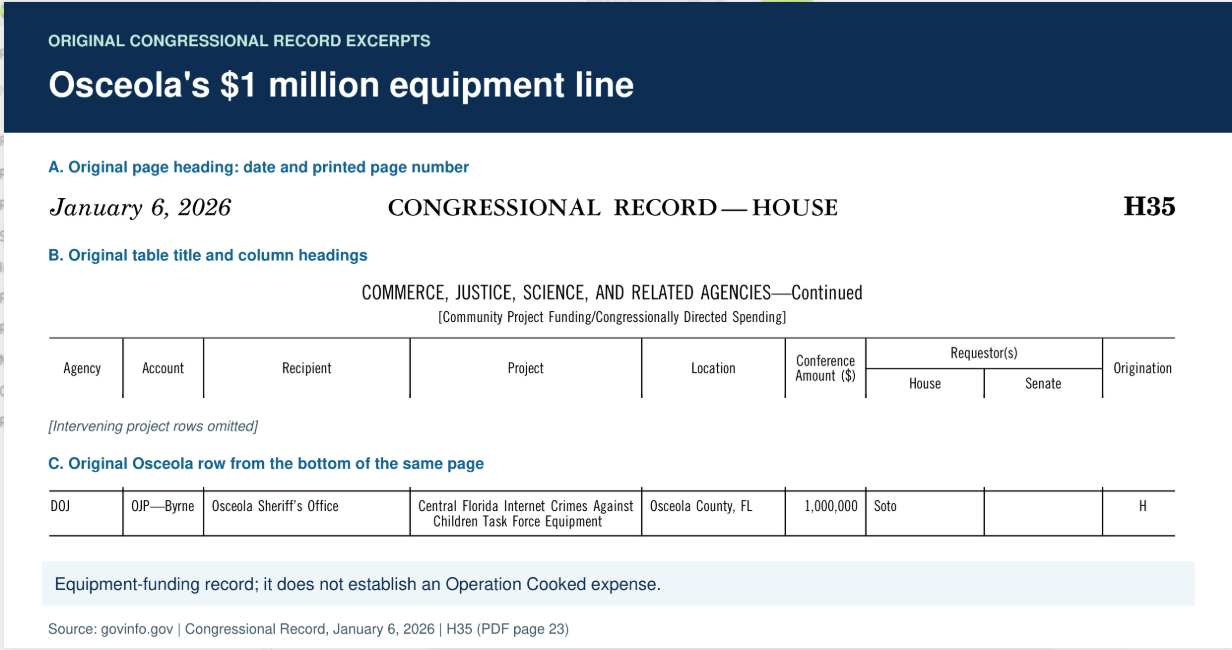 Congressional Record, January 6, 2026, H35 (PDF page 23). Original headers and Osceola row: $1 million for Internet Crimes Against Children (ICAC) equipment, not a verified Cooked expense. Other rows omitted. Tap to enlarge; full PDF.
Children deserve protection, and survivors deserve lasting care and support. The public deserves evidence that the work being done delivers on those promises.
Who conducted the investigation? Was the person online a child or an adult decoy? What happened in court, what did it cost, and what happened to the families?
Records of Florida operations connected to Internet Crimes Against Children (ICAC) task forces, Chris Hansen’s productions and Safe from Online Sex Abuse (SOSA) help make the activity visible. Careful counting matters.
The registry has grown. What does that number mean?
Population scope: All registry figures here concern Florida’s sexual offender and sexual predator registry, including covered juvenile registrants. The separately labeled Florida resident estimates describe the state’s general population. Community registry counts include only registered people living in Florida communities; full-list counts also include other statuses, as labeled.
Florida’s Office of Program Policy Analysis and Government Accountability, known as OPPAGA, gives us another way to examine the system. Its reviewed reports put the number of registered people living in Florida communities at 26,845 in 2015 and 30,907 in 2024. That is 4,062 more people, an increase of about 15.1% across nine years. Over the same period, the total registry grew from 66,523 to 86,207, about 29.6%.
Put the growth in perspective: 2015–2024
Florida resident population: +15.8%
Registrants in Florida communities: +15.1%
Full registry, excluding deceased: +29.6%
2024 community benchmark: 0.134% of Florida’s resident population, about 134 per 100,000. The comparable 2015 benchmark was about 135 per 100,000.
Community registrants grew slightly slower than Florida’s overall population over these nine years. These same-year benchmarks pair April 1 population estimates with September/October registry snapshots; they are not counts taken on the same day.
Population comparison: four snapshots and calculation limits
| Year | Florida residents, April 1 | Full registry, Sep/Oct | Community registrants, Sep/Oct | Community / residents |
|---|---|---|---|---|
| 2015 | 19,879,230 | 66,523 | 26,845 | 0.135% |
| 2018 | 20,854,945 | 73,004 | 28,548 | 0.137% |
| 2021 | 21,898,945 | 78,357 | 30,180 | 0.138% |
| 2024 | 23,014,551 | 86,207 | 30,907 | 0.134% |
Florida resident totals used in these calculations: Florida BEBR/EDR estimates, February 2025 conference. Registry counts: OPPAGA reports 15-16, 18-08, 21-10 and 24-11. All registry counts exclude deceased records here. The community group includes covered juvenile registrants, so the resident population used for comparison includes all ages. These ratios measure listed populations, not offending or risk. No 2026 ratio is calculated from the FDLE full registry CSV uploaded October 6, 2026; the upload date does not establish its generation date.
The full 2024 registry divided by Florida’s resident population is 0.375%, or about 375 records per 100,000 residents. That is only a scale comparison: the registry includes nonresidents and confined people. It is not the percentage of Florida residents who are registered.
Registry totals and community counts, 2015–2024
Snapshots from Florida’s Office of Program Policy Analysis and Government Accountability (OPPAGA), excluding deceased records. These measure listed populations, not crime rates.
Sep 2015
Oct 2018
Sep 2021
Oct 2024
Both series cover registered sexual offenders and sexual predators, including covered juvenile registrants. Community residents are part of the total, not an additional population. Totals exclude deceased records and include confined, nonresident and absconded categories. Sources: OPPAGA 2015, 2018, 2021 and 2024. Different snapshot months; no interpolation or 2026 estimate.
The distinction between the registry and the community population is essential. OPPAGA’s October 2024 total of 86,207 excludes another 1,521 deceased records. The chart uses that same exclusion. These are historical snapshots, not live 2026 counts.
Operation announcements and registry snapshots measure different things. Neither establishes how much offending occurs or how many crimes a policy prevents.
Two community-supervision figures need reconciliation
OPPAGA’s October 2024 FDLE table yields 6,050 people under FDC community supervision (4,421 + 1,629), while its FDC narrative reports 6,079. The report does not reconcile the 29-person difference. Neither figure counts registered people held in FDC prisons.
These are separately reported measures, not evidence of manipulation or an established error by one agency. Sources: OPPAGA 24-11, narrative, printed page 3 and Exhibit 3, printed page 5.
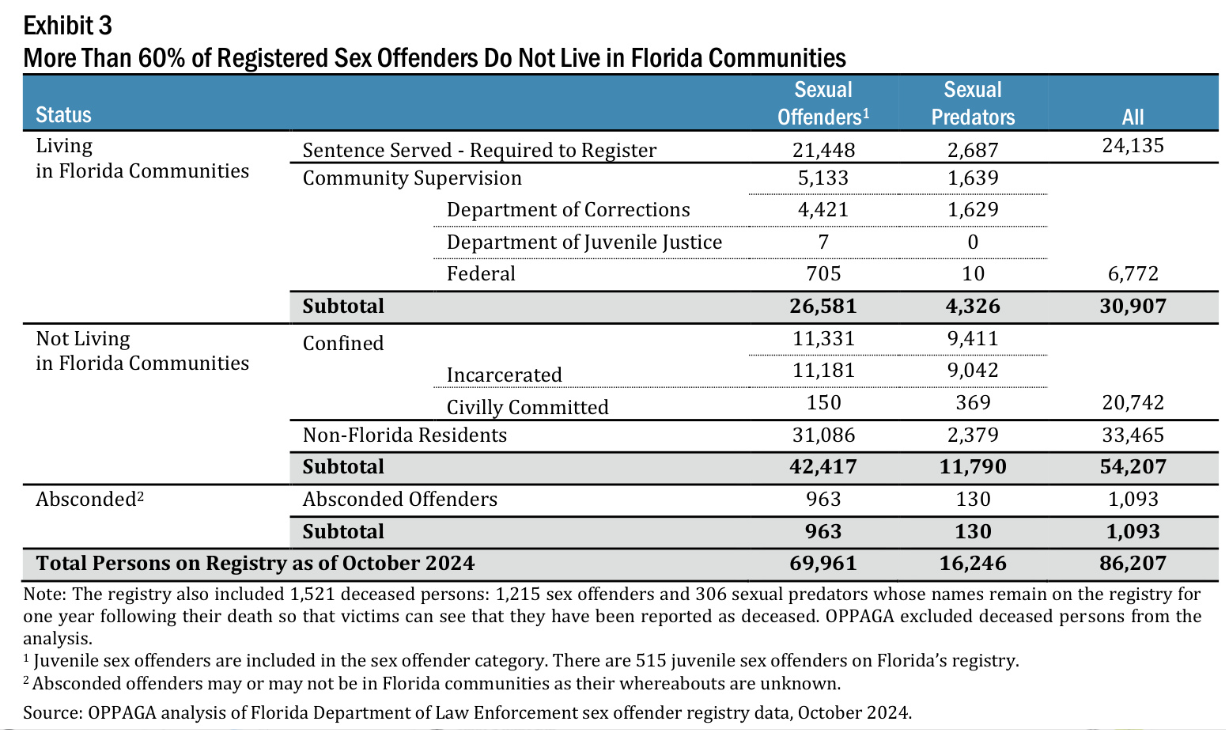 OPPAGA 24-11, Exhibit 3, printed page 5. This is a direct crop of the original PDF, with its notes and source line preserved. Open the original exhibit and surrounding report.
Where the more recent increase appears
Where the 2021–2024 increase appears: category-by-category figures
| Registry category | 2021 → 2024 | Net change |
|---|---|---|
| Non-Florida residents | 28,646 → 33,465 | +4,819 |
| Confined | 18,507 → 20,742 | +2,235 |
| Florida community residents | 30,180 → 30,907 | +727 |
| Absconded; location unknown | 1,024 → 1,093 | +69 |
| Total, excluding deceased | 78,357 → 86,207 | +7,850 |
Calculated from matching categories in OPPAGA 2021, Exhibit 4 and OPPAGA 2024, Exhibit 3. Confined includes incarceration and civil commitment. Absconded people may or may not be in Florida communities.
From September 2021 to October 2024, only 727 of the 7,850 net increase, about 9.3%, appears in the Florida community category. The rest appears in other categories. This is an accounting comparison between two snapshots, not a count of new crimes, a record of individual movements, or proof of what caused the changes.
FDLE full registry CSV, uploaded October 6, 2026
92,456 unique FDLE record numbers
1,841 marked deceased · 90,615 not marked deceased
The 90,615 figure is the total minus records marked deceased. It is not a Florida-resident count or an independently verified count of living people.
Aging on the list: 20,149 age 65-plus · 2,921 age 80-plus.
Ages as of October 11, 2026, across the full file after excluding records marked deceased or absconded. Age 80-plus is included in age 65-plus. These are not Florida-resident counts.
Older registrants: how the ages and address groups were counted
Ages were calculated from recorded birth dates as of October 11, 2026. The source is the FDLE full registry CSV uploaded October 6, 2026; an FDLE generation timestamp was not supplied. Age 80-plus is part of age 65-plus; the two columns must not be added. These counts exclude the exact statuses “Deceased” and “Absconded,” so their exclusions differ from the 90,615 figure above. They still include nonresidents and people in custody, and do not independently confirm living status or current residence.
| Recorded group | Age 65-plus | Age 80-plus |
|---|---|---|
| Full file, after exclusions | 20,149 | 2,921 |
| At least one recorded Florida address, after exclusions | 11,003 | 1,302 |
| Full file: released or supervised | 15,962 | 2,529 |
| Full file: confinement or civil commitment | 3,396 | 268 |
The Florida-address row includes any permanent, temporary or transient address marked Florida. It is not a verified count of current Florida residents. Released or supervised combines “Released – Subject to Registration,” Florida Department of Corrections supervision and United States probation. The full-file remainder is recorded as deported. Address and status rows overlap; do not add them.
Age alone does not establish anyone’s risk or health. These figures raise a practical question: how do reporting rules account for people growing older while they remain on the list?
Source: FDLE full registry CSV, uploaded October 6, 2026. The copy retained October 9 was byte-identical. October 6 is the upload date, not an established FDLE data-generation timestamp. The counts are not a fresh October 11 FDLE snapshot, and “not marked deceased” does not establish current residence or independently verified living status. We keep them separate from OPPAGA’s dated snapshots because we have not established that their dates and counting methods match.
Could the structure itself keep the list growing?
Yes. Keeping people on the list for many years is a documented part of the explanation. OPPAGA’s 2021 review identified lifetime registration as a primary contributor to growth. It also explained that Florida retains information about registrants who visited the state after they leave. Florida law generally requires lifetime registration, with limited ways to seek removal for people who meet the legal conditions.
How entries, time on the list and removals affect growth
| Part of the count | How it can affect growth | Records still needed |
|---|---|---|
| Entries | People newly required to register add to the list. | Unique new entries and qualifying reasons. |
| Retention | Long listing periods allow old entries to remain as new ones arrive. | Years listed; resident/visitor status; eligibility for relief. |
| Exits | Removals reduce the total; category transfers alone do not. | Annual removals and reasons, with corrections separated. |
A new enforcement operation may eventually lead to people being required to register, but we need court outcomes to establish how many. A registration-violation case involving someone already listed can increase enforcement and custody activity without adding a new person to the registry. Transfers between community and confinement categories also need to be separated from new entries.
Our question is straightforward: how much annual growth comes from new cases that require registration, people arriving or visiting, long periods on the list and limited ways off it? The current operation catalogue cannot answer that. A yearly account of who entered, who left and why could.
The costs stretch across agencies
Follow the Osceola money: award, request and unanswered cost questions
The equipment award establishes public support for the task force’s tools. The records below distinguish that support from the cost of a particular operation. FY means fiscal year.
| Record | Amount and status | What it establishes |
|---|---|---|
| October 6, 2026 official announcement; January 6 Congressional Record | $1,000,000 · FY2026 award | Osceola County Sheriff’s Office received a DOJ Byrne Discretionary Community Project grant for Central Florida ICAC software, equipment and technology, following Soto’s funding request. The January table lists the matching equipment project under DOJ OJP–Byrne, with Soto as requestor. These are two records of the same funding line, not two $1 million awards. |
| FY2027 request in the same release | $998,200 · request only | Additional resources were requested. The release does not establish an award, payment or expense for this amount. |
| DOJ FY2024 ICAC award table, page 2 | $561,018 · FY2024 award | DOJ’s FY2024 table lists broader Osceola regional ICAC support under award 15PJDP-24-GK-04191-MECP. This is a different program line and fiscal year from the FY2026 Byrne equipment award. The table supplies no Operation Cooked allocation. |
Do not add these amounts into an Operation Cooked total. The FY2027 request is not an award; neither award identifies what Cooked actually cost. Announced funding, grant obligations and money spent are different stages.
A funding history, not a finding about motive
The equipment line appears at the bottom of printed page H35, PDF page 23, of the January 6, 2026 Congressional Record. The court-stamped FAC complaint, page 1, records an August 11, 2026 filing. Soto’s award announcement followed on October 6. The January entry establishes that this funding line was already public months before the lawsuit. It does not establish when Cooked was planned, when equipment was bought or whether any particular purchase was used in that operation.
No reviewed record establishes that Cooked’s planning or publicity was a response to FAC’s lawsuit. Dates alone cannot answer that question.
What would turn a funding announcement into an account?
The next evidence would be the signed award and approved budget, purchase orders and invoices, grant payments, and an operation-level spending record showing any payroll, overtime, equipment use or reimbursements charged to Cooked. Dated planning records would answer a separate question: who approved the operation and when. Those records were not located in this review; no records request is represented as having been sent.
Being eligible for funding, or having funds set aside, does not establish that a particular jail received a grant or that a sting was paid for with it. Those records also do not show agencies increasing arrests to obtain money. To follow dollars responsibly, we need award agreements, approved project budgets, actual spending and the costs of any resulting jail stays.
Funding sources checked October 12, 2026. The Congressional Record and October announcement document an equipment-funding line. They do not verify Operation Cooked’s expenditure or its funding source.
Jail and registry funding: three records and their limits
There is a documented route back to custody. In the historical FY2014–15 figures, OPPAGA reported 878 registration-violation convictions, with 499 prison sentences and 195 jail sentences. These figures describe that year’s case outcomes, not today’s caseload or new sexual-offense convictions.
| Funding record | What the record says | What it does not establish |
|---|---|---|
| FY2024 Edward Byrne Memorial Justice Assistance Grant (JAG) Countywide | Local governments may seek funding for eligible projects, including corrections. | A county allocation is not proof of jail spending or a sting payment. |
| Marion agenda, April 1, 2025 | $56,686 in JAG grant revenue identified for jail camera equipment. | The agenda request alone does not verify disbursement or completed spending. |
| FY2024 Sex Offender Registration and Notification Act (SORNA) bonus | The Bureau of Justice Statistics (BJS) lists a $464,968 Florida compliance bonus allocation. | Compliance-linked funding is not payment per registrant or arrest. |
The Bureau of Justice Statistics describes Justice Assistance Grant formulas based on population and reported violent-crime offenses. SORNA bonus eligibility is tied to substantial implementation. Do not add these figures to other JAG totals without reconciling overlapping components.
More fiscal records: appropriations, actual expenses and fees
FY means fiscal year. ICAC means the Internet Crimes Against Children task-force program; FDLE is the Florida Department of Law Enforcement.
A full registry-related cost account needs spending from FDLE, sheriffs, corrections, other agencies and the courts. A prison per-day figure alone cannot supply that total.
Audited public spending records exist. Financial compliance and measurable safety benefits need separate evaluation; the fiscal detail below distinguishes actual expenses from allocations and proposals.
| Record | Amount or mechanism | Interpretation |
|---|---|---|
| Broward audited FY2024 expenses | $641,243 federal ICAC; $427,221 state South Florida ICAC. | Year ended September 30, 2024; distinct regional program expense streams, not a cost per sting. |
| FY2024 Edward Byrne Memorial Justice Assistance Grant (JAG) Countywide | $6,403,156 allocated across Florida local governments. | Eligible justice projects; not a dedicated registry or jail-spending total. |
| Online-sting appropriation | $2.5 million in FY2024–25; $1,745,426 carried into FY2025–26. | Carry-forward is not additional money to add to the original appropriation. |
| Gainesville approval | $800,000 FY2025–26 regional award/budget. | A component of the state funding pool; approval is not verified expenditure. |
| July 1, 2026 allocation law | 80% divided equally among recognized task forces; 20% to FDLE. | Not a per-arrest or per-registrant formula; authorized uses include scoped overtime, travel and training. |
Fees also vary. Okeechobee’s sheriff lists registration as no fee. A Hernando ordinance adopted in 2023 authorizes a sheriff-set fee, but no current amount or collections were verified here. Fee authority does not establish profit.
Federal Sex Offender Registration and Notification Act (SORNA) rules are minimum standards; the Justice Department’s registry-policy office distinguishes local residence and activity restrictions from those federal requirements. A compliance bonus does not establish that every added Florida or local burden is federally required.
FDLE grant reports track such items as arrests, children rescued, victims identified and devices examined. Those are useful operational measures; the reporting requirements do not establish an arrest quota or measure crimes prevented by themselves.
Publicly operated state prisons: December 31, 2023
Custody pressure is measurable in a dated official comparison. Florida’s publicly operated state prisons held 74,138 people against reported operational capacity of 66,158, or 112.1%.
This measure excludes private prisons, local jails and people held in other states. It is not a 2026 occupancy figure and does not measure how much registry enforcement contributed.
Operational capacity reflects staffing and services; it is not Florida’s statutory total-capacity threshold. Calculation: 74,138 ÷ 66,158 × 100 = 112.062%. Bureau of Justice Statistics, Prisoners in 2023, Table 21, pages 35–36; operational-capacity definition on page 3.
In a February 2022 response published by FAC, the U.S. Department of Justice’s Office of Sex Offender Sentencing, Monitoring, Apprehending, Registering, and Tracking (SMART) said the number of people on a registry is not used to decide funding under either the Adam Walsh Act implementation-grant program or the bonus under the Sex Offender Registration and Notification Act (SORNA) through the Edward Byrne Memorial Justice Assistance Grant (JAG) program. That answers a specific funding question; it does not provide a complete account of public spending.
A prison population report has a defined custody count, and Florida corrections reports publish inmate per-day costs. A full registry-related cost account would need spending from FDLE, sheriffs, corrections, other agencies and the courts. A prison per-day figure alone cannot supply that total. Sheriff budgets separate law enforcement, detention and court services, with building costs handled separately. Following all those costs means looking across several agencies’ accounts. The reviewed records do not establish that registry administration costs more than imprisonment.
What the numbers actually show
The records reviewed show nine documented local ICAC-linked operations in 2024, 5 in 2025 and 10 in 2026 through October 11. Those are the operations located in this review, and the choice of comparison year matters. They do not establish how much actual statewide activity changed: source coverage is stronger in 2026, older records are uneven, and this is not a complete state reporting system.
For Hansen-linked operations, we located three in 2025 and three in 2026 through October 11. All six fall within the January 1–October 11 window in their respective years. This part of the record does not show a 2026 increase over 2025.
Annual operation chart and matching-window comparison
2018
2019
2020
2021
2022
2023
2024
2025
2026*
Documented operations located. 2018–2025 are full calendar years; *2026 covers January 1–October 11. ICAC includes decoy, child sexual abuse material and mixed operations. Coverage is incomplete and uneven. Affiliations overlap. “None located” means none in this catalogue, not proof that none occurred. SOSA’s deployment count remains unestablished.
For a matching January 1–October 11 window, the ICAC counts are 2, 3, 4, 2, 4, 4, 8, 4 and 10 for 2018–2026. The source-discovery limitation still applies. See annual data and operation sources below.
We ran the numbers we could verify. We still need more complete records. What follows is our analysis and the questions it raises about public safety, public spending and the people living with these policies.
Across all years covered by this review, we identified 83 distinct operations: 71 ICAC-linked and 13 Hansen-linked, with one operation involving both. This is a documented minimum, not a complete statewide total.
These counts describe operations, not arrests, convictions, television episodes or children protected. A single operation can generate many cases and broadcasts. One operation may also involve more than one organization, so the columns cannot simply be added together.
ICAC, Hansen and SOSA: different roles and overlapping records
Internet Crimes Against Children (ICAC) is a law-enforcement task-force program whose work includes investigations, digital evidence, training, victim services and public education. Its operations can involve adult decoys, investigations of child sexual abuse material (CSAM), actual victims, or a combination. Treating every ICAC announcement as the same kind of sting would hide important differences.
Hansen’s role brings a media production into the picture. The records reviewed identify 13 distinct Florida operations involving him or his productions, beginning with two in 2006. The modern entries include Polk, Martin and Marion counties. Those are documented operations located, not a claim to have found every Florida production.
SOSA, Safe from Online Sex Abuse, describes itself as a nonprofit working with police and prosecutors. It says its team creates decoy accounts, communicates with suspects, organizes evidence and helps arrange meetings; police make the arrests. These are SOSA’s descriptions of its practices. They do not independently establish what happened in every case.
SOSA’s 2024 annual report names four operations, but their locations remain unverified. They cannot be counted as four Florida operations. Separately, records connect SOSA to an Orlando police case that resulted in an arrest on May 6, 2021. This is evidence of an actual investigation, beyond training, but one case does not tell us how many separate operations took place. The total number of SOSA operations in Florida remains unknown, so SOSA has no numerical bar in this chart.
Different organizations, different roles: verified names and links
This directory has 73 entries covering organizations, people, shows, channels, name variants and relationships documented at particular times. It is not a count of 73 separate organizations or operations. A shared subject, interview, police response or similar name does not by itself establish a partnership. Five independent creator brands have reported Florida activity in the reviewed sources; the other creator entries do not establish Florida operations.
Government funding, nonprofit donations, subscriptions and paid media can overlap. A funding source does not establish who controlled an investigation, how much was earned, or anyone’s motive.
Direct website and channel links are limited to Chris Hansen and SOSA. Other entries retain government records or independent reporting where available. ICAC means Internet Crimes Against Children; FDLE means Florida Department of Law Enforcement; FBI means Federal Bureau of Investigation. Listing a name does not endorse it.
Independent creators with reported Florida activity
EDP Watch
Independent confrontation/sting video producer
TruBlu publisher identifies EDP Watch as a Schlep video collaborator; this does not establish a joint Florida Hansen operation.
Florida connection: Reported Florida activity
Brand names do not establish guilt. Police response to a creator encounter does not itself establish a formal partnership.
Operation 17:2
Independent sting/confrontation producer
Official site self-describes as nonprofit; tax status not independently verified. No formal ICAC affiliation established. Florida location is Palatka, not Jacksonville.
Florida connection: Reported Florida activity
Brand names do not establish guilt. Police response to a creator encounter does not itself establish a formal partnership.
Predator Poachers
Independent sting/confrontation producer
Website directly links @PPSETX; do not assume every similarly named channel belongs to the group. TruBlu release identifies Schlep collaborations, not a joint Florida Hansen operation.
Florida connection: Reported Florida activity
Brand names do not establish guilt. Police response to a creator encounter does not itself establish a formal partnership.
Dads Against Predators
Independent sting/confrontation brand
Current official about page profiles Joshua Mundy. Historical news association of Carnicom is not proof of every current organizational relationship. Reporting includes charges against the creator; charges are not convictions. DAD Cares nonprofit language is a site claim, not an independently audited tax finding.
Florida connection: Reported Florida activity
Brand names do not establish guilt. Police response to a creator encounter does not itself establish a formal partnership.
Protect The Innocent (PTI)
Independent sting/confrontation group
Local report says sheriff personnel were called after the encounter. This does not establish a formal law-enforcement partnership. Current branded website and historical group name match; no private operator identity investigated.
Florida connection: Reported Florida activity
Brand names do not establish guilt. Police response to a creator encounter does not itself establish a formal partnership.
Independent creators with Florida activity unverified
Skeeter Jean / Skeet Hansen
Independent sting/confrontation videos; Hansen impersonation persona
First-party Locals post October 22, 2023 describes Chris Hansen impersonation. This is not evidence of employment by or operational partnership with Hansen.
Florida connection: Florida operation not verified
Brand names do not establish guilt. Police response to a creator encounter does not itself establish a formal partnership.
Trilogy Media
Produces scam investigations and sting/confrontation content; also hosts interviews
Podcast listing contains an Incogni promotional code/link; this verifies a promotional mechanism, not the compensation contract or amount. Agency-cooperation claims need episode-specific agency corroboration.
Florida connection: Florida operation not verified
Brand names do not establish guilt. Police response to a creator encounter does not itself establish a formal partnership.
Colorado Ped Patrol
Independent sting/confrontation producer
Official Linktree verifies both YouTube handles and podcast branding. Calling police does not itself establish formal partnership. No catch/arrest totals adopted from promotional claims.
Florida connection: Florida operation not verified
Brand names do not establish guilt. Police response to a creator encounter does not itself establish a formal partnership.
CC Unit
Independent sting/confrontation producer
Public alias retained; no attempt to identify anonymous operators. Police response in an individual case does not prove formal partnership.
Florida connection: Florida operation not verified
Brand names do not establish guilt. Police response to a creator encounter does not itself establish a formal partnership.
Schlep
Independent exposure/confrontation videos; documentary contributor
Publisher explicitly says Hansen engaged Schlep for Dangerous Games and identifies Schlep video collaborations with Predator Poachers and EDP Watch. This establishes a documentary relationship, not a Florida joint sting. Florida Attorney General citation of a creator video is not proof of a Florida operation.
Florida connection: Florida operation not verified
Brand names do not establish guilt. Police response to a creator encounter does not itself establish a formal partnership.
Scaling Up Catches
Independent sting/confrontation videos
Interview description plus matching first-party membership page verify the entity. No Florida or agency affiliation established; no private surname inferred for Tanner.
Florida connection: Florida operation not verified
Brand names do not establish guilt. Police response to a creator encounter does not itself establish a formal partnership.
Podcasts and interviews
Trilogy Media Podcast
Podcast interviews/commentary; same parent creator brand as Trilogy Media
Do not count as an additional independent sting group. Guest appearance does not imply shared operations.
Florida connection: Podcast, not additional Florida operator
Brand names do not establish guilt. Police response to a creator encounter does not itself establish a formal partnership.
CPP: Behind The Catch Podcast
Creator-linked podcast format
Verified podcast listing only; no separate operational entity inferred.
Florida connection: Podcast, not additional Florida operator
Brand names do not establish guilt. Police response to a creator encounter does not itself establish a formal partnership.
Predators I’ve Caught
Podcast series; Retrospective cases, updates and commentary
Continues within the renamed Have A Seat podcast feed
Florida connection: Revisits Florida cases; podcast publication does not establish a new operation
Series continues on Mondays while the new interview series runs Wednesdays. This is two series sharing a feed, not two independent sting organisations.
Have A Seat with Chris Hansen (2025 podcast feed/interview series)
Umbrella podcast feed and interview programme; Interviews plus the continuing Predators I’ve Caught series
Feed rebrand and new interview show announced by Hansen
Florida connection: Florida subject matter and guests are not necessarily sting operations
Distinguish from Hansen’s earlier 2019 YouTube use of the same title; do not collapse the whole period into a 2025 launch.
Have a Seat with Chris Hansen / Chris Hansen YouTube channel
Hansen’s own online interview/investigation brand, earlier use distinct from 2025 podcast-feed rebrand; Hansen’s own online interview/investigation brand, earlier use distinct from 2025 podcast-feed rebrand
A June 1, 2020 original interview with Hansen calls Have a Seat his current YouTube program and links directly to channel UCgKTJAN-IrVyX-jIJ5INEhA, which resolves as Chris Hansen. This securely establishes early use before the later podcast rebrand. Contemporary November 2019 coverage confirms the title; a university dissertation cites an October 16, 2019 first interview video, but the video could not be fetched. The exact October 9 start date remains secondary-only.
Florida connection: No Florida sting established by early brand sources.
See relationship/source qualifiers.
Hansen media brands and documented relationships
Chris Hansen
Public media personality; Produces/presents sting-related media; also interviews and commentary
TruBlu co-founder; Takedown executive producer and host
Florida connection: Verified participation in the 13-event Florida lower-bound ledger
Personal brand, programmes and companies remain separate entities; programme appearances do not create additional operations.
TruBlu / TruBlu Streaming Network
Streaming-network brand; Produces/distributes original sting programmes and other crime media
Founded by Hansen and Shawn Rech; carries Takedown
Florida connection: Company’s June 14, 2023 release explicitly identifies Polk County/Grady Judd collaboration
Release describes business/production relations, not a Florida payment or a count of deployments.
TruBlu legal-name variants
Names published by brand and app stores; the exact legal identities have not all been matched; App seller/developer and site publisher
App developer is TruBlu Factual Streaming Network, LLC; website copyright says TRUBLU STREAMING, LLC
Florida connection: Associated with the same public streaming brand; legal contracting entity for individual Florida operations not established
Do not merge differently styled LLC names into one legal entity without registry or contract evidence. Trademark aggregator’s TruBlu Factual Streaming LLC is an additional unverified legal-name lead.
True Blue / TrueBlue / Tru Blu
Context-dependent spelling/transcription variants; Search terms only
Some interviews/transcripts render the TruBlu name phonetically
Florida connection: No extra Florida entity or operation established by spelling variants
Unrelated True Blue companies, Tru Blu Productions businesses or domains must not be treated as Hansen affiliates solely from their names.
TruBlu Plus
Subscription/product label; Subscriber access
Hansen’s official link page uses this label for the TruBlu subscription service.
Florida connection: Product label; no independent Florida operation
Not evidence of a separate company or law-enforcement partner.
Takedown with Chris Hansen
Programme title; Original recorded confrontations/interviews from police collaborations
Hansen hosts and executive-produces; TruBlu distributes
Florida connection: Eleven modern operations in existing Florida ledger: Polk8, Marion2, Martin1
Episodes, seasons, YouTube uploads and free previews are not operational events.
TruBlu Streaming Network YouTube
Official distribution channel; Full and partial programme releases, previews and promotion
Linked directly from TruBlu’s official website
Florida connection: Carries Florida footage already represented in the operation ledger
A channel posting a later video does not identify a later sting date; do not count unofficial reupload channels.
Shawn Rech
Public producer/executive; Production and streaming-network management
TruBlu co-founder/CEO/director; Transition Studios co-founder/CEO/director
Florida connection: Discussed Florida production in 2022 interview; no additional dated Florida deployment established
Shared leadership does not by itself establish identical legal entities or ownership percentages.
Transition Studios
Independent production company; Film/television production
Rech describes Transition as a vendor used by TruBlu
Florida connection: Rech said the company had a Destin office and described Florida production; this is business presence rather than a new sting location
Published interview transcript places vendor discussion at 24:18 and Destin-office discussion at 14:05; timings not audio-reverified. Separate from similarly named UK audio-mastering business.
American Sheriff Network (ASN)
Acquired streaming network; Law-enforcement media programming
Founded by Mark Lamb; acquired by TruBlu
Florida connection: Acquisition release mentions TruBlu’s existing Polk collaboration, but establishes no separate ASN Florida sting
An acquisition relationship, not merely a new name for Takedown; no disclosed deal value or Florida sheriff compensation.
Red Seat Ventures
Media-services/ad-sales company; Podcast sponsorship and advertising representation
Lists Hansen and both Have A Seat / Predators I’ve Caught; official feed directs ad inquiries to RSV
Florida connection: Commercial media link; no operational role in Florida stings established
Advertising representation does not establish ownership of TruBlu or involvement in decoy conversations/arrests.
Dangerous Games: Investigating Roblox — A Chris Hansen Special
Documentary title; Documentary investigation and interviews
Hansen/TruBlu documentary; Schlep engaged as independent collaborator
Florida connection: Marion case coverage discussed in interviews; no additional distinct undercover event established
Documentary reporting on arrests is not a new sting merely because it is a separate title.
Our Rescue
Nonprofit support organisation; Claims training/equipment support for participating law-enforcement teams
Says it supported FDLE ICAC/trafficking-trained teams that participated in Seek and Ye Shall Find Out
Florida connection: Reported support of teams on an event independently linked to Hansen; indirect co-event association
Not proof Our Rescue directly hired/worked with Hansen, supplied decoys, or funded that production. Do not add another July 2025 operation.
Ascending Media Group
Distribution/representation company; free ad-supported streaming-channel/content distribution
Distribution representative describes helping TruBlu reach platforms and identifies TruBlu as a client
Florida connection: No operational Florida role established
Distribution is separate from production or undercover work. No deal terms or revenue allocation established.
Chris Hansen / NBC News / Dateline NBC / To Catch a Predator / Perverted Justice
NBC reporter / program and segment / independent online-decoy organization / parallel police operation; NBC reporter / program and segment / independent online-decoy organization / parallel police operation
Hansen’s sworn June 27, 2006 congressional testimony identifies him with Dateline NBC, describes Perverted Justice volunteers as online decoys, and describes Fort Myers Police conducting a parallel investigation. These are separate roles, not interchangeable aliases.
Florida connection: Yes, Fort Myers testimony; no new operation beyond baseline. This testimony does not provide exact April dates.
See relationship/source qualifiers.
Perverted Justice / NBC News / Flagler Beach Police Department / Chris Hansen
paid civilian decoy partner and police-approved television coverage; paid civilian decoy partner and police-approved television coverage
A June 14, 2010 jurisdictional party brief, citing stipulated facts and testimony, says Flagler Beach PD engaged PJ, approved NBC filming, and PJ received $150,000 from NBC at $75,000 per broadcast hour. The brief reports PJ representatives were not sworn police. This establishes paid civilian assistance, not an NBC employer or a police-unit alias.
Florida connection: Yes, Flagler Beach baseline only
Do not promote December 8-10 to the definitive entire operation range: parent has NBC’s four-day description. Use December 2006 unless independently reconciled.
Hansen News Network / Hansen vs. Predator / Chris Hansen / Fairfield Police Department
attributed independent production company and show; parallel law-enforcement collaboration; attributed independent production company and show; parallel law-enforcement collaboration
CTPost identifies Hansen News Network as Hansen’s production company and Fairfield as the revival’s first site. Original reporting with direct Hansen and deputy-chief interviews dates the four-day operation from October 1. Contemporary original reporting is strong but no corporate registry was checked; do not equate this legal entity with later TruBlu.
Florida connection: No; Connecticut. TNR explicitly says Hansen had no involvement in the Florida police stings being discussed in that 2015 article; do not generalize beyond that contemporary context.
See relationship/source qualifiers.
Hansen vs. Predator / Crime Watch Daily / Crime Watch Daily with Chris Hansen / Telepictures Productions / Warner Bros. Domestic Television Distribution
segment / host-program rebrand / producer / distributor; segment / host-program rebrand / producer / distributor
The program’s own announcement names Hansen as new host and Hansen vs. Predator as a signature series within Crime Watch Daily with Chris Hansen. It names Telepictures as producer and Warner Bros. Domestic Television Distribution as distributor. Neither the show title nor distributor is a decoy organization.
Florida connection: No additional Florida event established; the cited HvP story is Fairfield, Connecticut.
See relationship/source qualifiers.
Tetrad Core / Chris Hansen / Hansen vs. Predator
civilian child-protection and online-sting collaborator; civilian child-protection and online-sting collaborator
An original radio-interview article with Hansen identifies local authorities and Tetrad Core as his collaborators. An EXPLOITED: Crimes Against Humanity episode featuring Tetrad Core’s Donna Staples identifies its law-enforcement assistance and educational work and specifically places its Hansen vs. Predator collaboration in Connecticut. No verified contract, incorporation record, alias relationship, or Florida collaboration located.
Florida connection: Not established
Episode notes claim 11 arrests/convictions while local reporting describes 10 arrests. Do not use this podcast description as a precise operation count. Do not call Tetrad a paid contractor without a contract/payment source.
Crime Watch Daily / True Crime Daily
explicit digital continuation/rebrand; explicit digital continuation/rebrand
The team’s own announcement states the fourth television season was not picked up and some of the same team continued its existing stories and new reporting under True Crime Daily. Archived HvP uploads on this brand do not represent a separate producer-led sting event.
Florida connection: No operation implied by brand change.
See relationship/source qualifiers.
True Crime Daily / True Crime News
current publisher identity / digital archive continuation and television launch; current publisher identity / digital archive continuation and television launch
The original True Crime Daily 2018 rebrand URL redirects to the same article at True Crime News. The current publisher’s July 10, 2024 announcement describes its existing YouTube, Facebook and podcast audience and new television show hosted by Ana Garcia. Direct evidence supports archive continuity; exact digital rename day was not located.
Florida connection: No operation implied by brand change.
See relationship/source qualifiers.
Have a Seat with Chris Hansen / Genesee County Sheriff’s Office / Shiawassee County Sheriff’s Office / GHOST
reporter embedded in police-led Michigan sting; law-enforcement task force; reporter embedded in police-led Michigan sting; law-enforcement task force
Original local reporting and sheriff statements tie Hansen’s early Have a Seat show to the October 2020 Michigan police operation. GHOST is identified as Genesee Human Oppression Strike Team. It is not evidence of a civilian Guardians organization or a Florida event. A contemporaneous press conference link exists but video extraction failed.
Florida connection: No, Michigan.
See relationship/source qualifiers.
Polk County Sheriff’s Office
Public law-enforcement agency; Police-led investigations/arrests and media collaboration
TruBlu named Grady Judd/Polk as a sting collaborator in its June 14, 2023 company announcement.
Florida connection: Eight verified modern Florida deployments,2022–2026
Neither appearing together nor agency participation establishes payment, production control, or that all arrestees were interviewed by Hansen.
Marion County Sheriff’s Office
Public law-enforcement agency; Police-led investigations/arrests and media collaboration
WFTV identifies Hansen in sheriff-supplied Operation Bad Habits video; the earlier event is separately crossmatched in the existing ledger.
Florida connection: Two verified modern Florida deployments: July2025 and June2026
Neither appearing together nor agency participation establishes payment, production control, or that all arrestees were interviewed by Hansen.
Martin County Sheriff’s Office
Public law-enforcement agency; Police-led investigations/arrests and media collaboration
Hansen and the sheriff appear together in the May 8, 2026 announcement of Operation Undercover Chatter.
Florida connection: One verified modern Florida deployment: May2026
Neither appearing together nor agency participation establishes payment, production control, or that all arrestees were interviewed by Hansen.
SOSA brands and documented relationships
SOSA — Safe from Online Sex Abuse, Inc
Independent nonprofit; the organization itself
Legal name verified; nationwide organization based in New Haven, Connecticut. Existing Florida case remains one case, not a deployment count.
Florida connection: Yes: one documented Orlando case; deployment count undetermined
One documented Florida case; distinct Florida deployment count remains unknown.
Roo Powell / Sloane Ryan
Public professional pseudonym; person, not separate group
Bark updated its February 2020 FAQ to identify Sloane Ryan as Roo Powell; SOSA identifies Powell as founder/CEO.
Florida connection: Yes through documented SOSA Orlando case
Brand, programme and case counts must remain separate.
Bark Special Projects Team
Former professional relationship; separate business
Bark identifies Ryan/Powell with its special projects work in 2020. ABC editor update says Powell parted ways with Bark and started SOSA. No continuing corporate identity or Florida deployment inferred.
Florida connection: Florida operation unverified
Brand, programme and case counts must remain separate.
Undercover Underage
Documentary brand; not independent operation unit
SOSA says two seasons on Investigation Discovery, streaming on HBO Max.
Florida connection: Florida case shown; episodes do not establish distinct deployments
Brand, programme and case counts must remain separate.
SOSA Undercover / @sosaundercover
SOSA-owned documentary channel/brand
SOSA identifies continuation of Undercover Underage, same producers, own YouTube channel. SOSAU shorthand is a search variant, not independently established legal name.
Florida connection: Florida deployment unverified for this continuation
Brand, programme and case counts must remain separate.
Predator Files
UK distribution title; not new entity
SOSA states its series airs in UK as Predator Files on Crime & Investigation.
Florida connection: Florida deployment unverified
Brand, programme and case counts must remain separate.
SOSA Undercover Operations / LE Training
Programs of canonical SOSA entity
Program labels do not create new organizations or operations. Training, inbound cases, prevention and survivor support are distinct activities.
Florida connection: Florida case and proposed training; completed statewide program unverified
Brand, programme and case counts must remain separate.
Public page 1 · Supporting source 2 · Supporting source 3 · Supporting source 4 · Supporting source 5
Orlando Police Department
Documented law-enforcement case partner
May 6, 2021 arrest in one SOSA-supported online-decoy case. Case repeated in later media/training does not establish additional deployments.
Florida connection: Yes: Orlando, Orange County
Brand, programme and case counts must remain separate.
Canadian County Sheriff’s Office
Documented law-enforcement operation partner
Official releases identify SOSA decoy partnership in a four-day operation reported Feb28,2023 (5 arrests), February2024 three-day operation (3), and Aug29–Sep2,2024 operation (9). Agency explicitly identifies Oklahoma ICAC membership.
Florida connection: No Florida evidence in these records; Oklahoma
Brand, programme and case counts must remain separate.
Public page 1 · Supporting source 2 · Supporting source 3 · Supporting source 4 · Supporting source 5
Shreveport Police Department Vice Unit
Documented law-enforcement operation/training partner
Agency confirms SOSA operations March24–30,2025 (6 arrests), October23–26,2025 (5). SOSA 2024 annual report separately describes on-the-job training.
Florida connection: No Florida evidence in these records; Louisiana
Brand, programme and case counts must remain separate.
ICAC public agencies and support relationships
North / Northern Florida Internet Crimes Against Children Task Force; North Florida ICAC; NFICAC
Regional ICAC task force
Hosted by Gainesville Police Department. December 2004 city record says established December 2003 and then covered northern 38 counties.
Florida connection: Florida relationship documented: Northern Florida
Historical county count is a dated snapshot; do not assume fixed boundaries. NFICAC is a search abbreviation, not a separate organization.
Gainesville Police Department
Current regional host
National ICAC directory identifies Gainesville as Florida – Northern host.
Florida connection: Florida relationship documented: North Florida
Central Florida Internet Crimes Against Children Task Force; Central Florida ICAC; CFICAC
Regional ICAC task force
Polk County Sheriff received $265,000 to form a new regional task force.
Florida connection: Florida relationship documented: Central Florida
Grant-to-form announcement is not an exact operational start date.
Polk County Sheriff’s Office → Osceola County Sheriff’s Office
Historical host transition
North Port renewal explicitly says previous written partnership agreement was with Polk and Osceola is now lead agency.
Florida connection: Florida relationship documented: Central Florida
Transition verified by February 2019; exact handover day unresolved. 2018 award identifier and secondary reporting support 2018, not an exact date.
Osceola County Sheriff’s Office
Current regional host
National ICAC directory identifies Osceola as Florida – Central host.
Florida connection: Florida relationship documented: Central Florida
Central Florida ICAC 2018 service area
Dated jurisdiction definition
OJJDP competition specifies 17 counties for Central Florida applicants.
Florida connection: Florida relationship documented: Sarasota, Manatee, Highlands, Hardee, DeSoto, Okeechobee, Pinellas, Hillsborough, Pasco, Sumter, Citrus, Hernando, Lake, Polk, Osceola, Orange, Seminole
Service region is not proof that every agency or operation in those counties is an affiliate.
South / Southern Florida Internet Crimes Against Children Task Force; South Florida ICAC; Broward ICAC
Regional ICAC task force
Broward ICAC unit oversees the regional task force and manages its grant and National Center for Missing & Exploited Children (NCMEC) tips; page says more than 65 affiliate agencies.
Florida connection: Florida relationship documented: South Florida
Current membership total cannot establish historical affiliation; SFICAC is an unverified shorthand, not a separately established entity.
South Florida ICAC web aliases
Officially linked regional web aliases
Broward Sheriff’s Office safety pages explicitly link these names to South Florida ICAC. Use Broward Sheriff’s Office page as authoritative directory endpoint.
Florida connection: Florida relationship documented: South Florida
Other official Broward Sheriff’s Office page links .com: https://www.sheriff.org/sextortion/ . Do not treat two domains as two task forces.
LEACH; Law Enforcement Against Child Harm
Historical and continuing task-force label
Broward budget describes federal ICAC funding administered by its LEACH task force.
Florida connection: Florida relationship documented: South Florida / Broward
LEACH existed before national ICAC. Earlier LEACH activity is not automatically ICAC activity.
Child Pornography Task Force → Child Abuse Intelligence Network → LEACH
Pre-ICAC predecessor chain
OJP-hosted Joining Forces Against Child Sexual Exploitation traces this sequence, pp18–19. It expands LEACH as Law Enforcement Effort Against Child Harm.
Florida connection: Florida relationship documented: South Florida
Report is a federally funded study based on visits/interviews, with authors’ views disclaimer. A 1999 FSA account says LEACH active since 1994; preserve differing milestones rather than forcing one start date.
Broward LEACH early partners
Dated investigative partnership
Study identifies Broward, Manatee sheriff, FDLE and U.S. Customs participation; describes outreach to Postal Inspection.
Florida connection: Florida relationship documented: South Florida
Historical relationship only. U.S. Customs is the historical agency label, not identical to current Homeland Security Investigations (HSI).
National Center for Missing & Exploited Children (NCMEC)/Florida branch
Nonprofit support and education partner
FSA reports National Center for Missing & Exploited Children (NCMEC)/FL support for LEACH, jointly hosted training and prevention education.
Florida connection: Florida relationship documented: South Florida
Training/support does not make National Center for Missing & Exploited Children (NCMEC) an arresting agency.
North Port Police Department
Dated partner under a written agreement
Approved renewal with Osceola, replacing prior Polk written partnership agreement.
Florida connection: Florida relationship documented: Central Florida
Does not establish every North Port case as a regional operation.
Eustis Police Department
written partnership-agreement record
City packet contains Osceola–Eustis written partnership agreement to join CFICAC and apply ICAC standards; Osceola distributes tips to jurisdictional affiliates.
Florida connection: Florida relationship documented: Central Florida
Agenda document establishes proposed agreement terms; final execution date not inspected.
Florida Attorney General Child Predator CyberCrime Unit; CPCU; CyberCrime Unit
State investigative unit and ICAC affiliate
FBI explicitly identifies Attorney General unit as North Florida ICAC and Jacksonville FBI Cyber Taskforce member.
Florida connection: Florida relationship documented: Florida; Jacksonville office specifically
Unit is neither synonym nor fourth regional ICAC task force. Individual case used for relationship evidence, not new operation count.
Florida Attorney General CyberCrime regional offices
Historical expansion plan / funding relationship
Attorney General plan describes planned July 2008 office expansion and North Florida ICAC-administered training/equipment funds; FBI partnership equipment support.
Florida connection: Florida relationship documented: Jacksonville, Tallahassee, Pensacola, Orlando, Tampa, Fort Lauderdale/Miami, Fort Myers/Sarasota
Plan is not proof all proposed offices opened on schedule.
Project Safe Childhood; PSC
Distinct federal coordination/prosecution umbrella
DOJ describes ICAC, U.S. attorneys’ offices, Child Exploitation and Obscenity Section and federal agencies as partners; later scope includes all federal child exploitation and failure-to-register offenses.
Florida connection: Florida relationship documented: National including Florida
PSC label alone does not prove ICAC participation or a multi-person operation.
Project Safe Neighborhoods; PSN
Distinct violence-reduction umbrella
USAO-coordinated violent-crime initiative, not another name for ICAC or Project Safe Childhood.
Florida connection: Florida relationship documented: National including Florida
Never classify an operation as child exploitation solely from PSN label.
FBI / Homeland Security Investigations (HSI) / FDLE / Broward State Attorney / local police
Operation-specific partners
Broward Sheriff’s Office indexed release names federal/state/local partnership with South Florida ICAC for Red Card.
Florida connection: Florida relationship documented: Broward
Specific event evidence; not a complete membership list. Direct page currently returns 502; indexed primary text and NBC corroboration available.
Fox Valley Technical College; FVTC; National Criminal Justice Training Center
Training/technical-assistance provider
OJJDP identifies FVTC as ICAC investigative/undercover training provider. Broward Sheriff’s Office FY2016-17 budget names FVTC training support.
Florida connection: Florida relationship documented: National; Florida training relationship
Florida evidence: https://www.sheriff.org/media/utvddlhj/fy-2016-17-proposed-budget-book.pdf printed p166. Provider is not another operation or arresting task force.
National White Collar Crime Center; NW3C; Innocent Justice Foundation SHIFT; TLO
Dated training support providers
Broward Sheriff’s Office lists these organizations among support sources for quarterly ICAC training.
Florida connection: Florida relationship documented: South Florida
Documented training role only; no inference they participated in arrests, currently contract with Broward Sheriff’s Office, or endorse every operation.
Child Rescue Coalition; CRC
Nonprofit technology-support provider
County-hosted 2017 grant application describes proposed server support for Broward and South Florida ICAC. CRC’s February 2026 account reports its technology used in a Broward Sheriff’s Office ICAC investigation. SOSA cites a CRC statistic. That citation does not establish an operational partnership. CRC provides investigative technology/training to law enforcement; not established here as a SOSA-style online-decoy group. Hansen delivered keynote and Q&A supporting CRC at its ninth annual gala
Florida connection: Florida relationship documented: Broward / South Florida
Application is not proof of grant disbursement. 2026 case support is self-reported at . Single investigation is not an added multi-person operation. Fundraiser/speaker link. Do not label CRC a Hansen decoy contractor or add a sting to the operation ledger.
Follow the money: what the SOSA proposal establishes
Public funding deserves the same care. SOSA’s Florida proposal changed as the budget process moved forward. FY means the government’s fiscal, or budget, year:
| Budget stage | Amount shown | What it establishes |
|---|---|---|
| December 19, 2023 request | $750,000 | Requested funding for FY2024–25 training and decoy operations. |
| January 24, 2024 committee proposal | $350,000 | Proposed nonrecurring amount; not a payment. |
| February 28, 2024 conference Offer 2 | No funding shown | Both House Offer 2 and Senate Offer 2 show no funding for this item. |
SOSA also solicits donations and describes paid YouTube memberships offering full-length cuts. Those are separate sources of support and media income. They do not establish the amount received, profit, or how any particular Florida case was funded. An independent nonprofit can collaborate with police and receive different kinds of support; “government-funded” and “independent” are not mutually exclusive labels.
We have not verified a final award or payment. A request, a committee proposal and money actually spent are different things. Neither $750,000 nor $350,000 can be treated here as established taxpayer spending.
For any publicly supported operation, residents should be able to see the actual spending, participating agencies, outside agreements and eventual case outcomes. When filming is involved, that includes who controls the footage and what financial arrangements exist. It also means separating public investigative costs from a producer’s or nonprofit’s separate accounts.
Arrest totals can describe activity. Evaluating child protection also requires asking whether children were identified and helped, whether investigations produced reliable evidence, whether cases held up in court, and what support survivors received afterward.
The rules have accumulated, with some changes easing compliance
The records show repeated additions over decades, including more reporting duties and local housing restrictions. OPPAGA counted 196 local ordinances in 52 counties in 2024, with 19 additional ordinances since its 2018 review. Which rules apply depends on the conviction, the person’s legal classification, whether they are under supervision, and where they live.
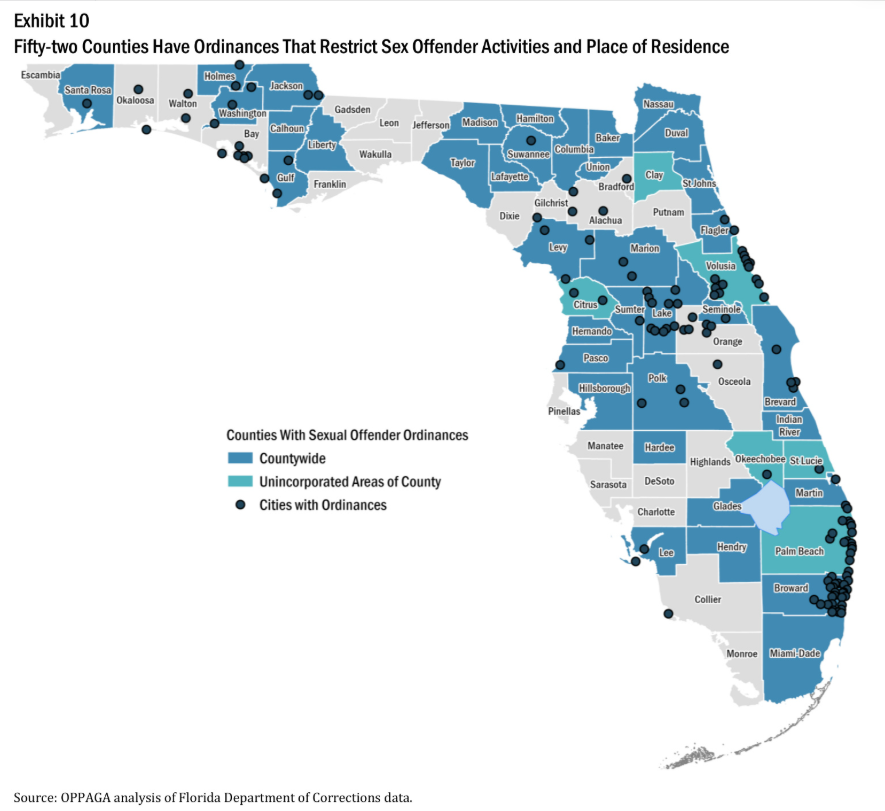 OPPAGA 24-11, Exhibit 10, printed page 15. The map records local ordinance coverage in 2024; it does not measure effectiveness or mean every ordinance applies to every registrant. Open the original exhibit and surrounding report.
Requirements have expanded repeatedly over the past decade. In our view, the cumulative burden on people required to register and their families has become increasingly harsh. Simplifying one procedure does not erase the weight of the remaining restrictions.
Ten complete calendar years, 2016–2025: six years with substantive additions
This covers January 1, 2016, through December 31, 2025, not state fiscal years. Six qualifying years were 2016, 2018, 2021, 2023, 2024 and 2025. Four involved registry reporting, coverage, penalties or continued listing; 2021 and 2023 involved supervision for specified offenses. This does not mean six years of added duties for every registrant.
We compared enacted laws with prior enacted laws, counting each year once when a substantive addition took effect. Core sections were 943.0435, 775.21, 775.215, 856.022 and 948.30; the review also checked related relief, qualifying-offense and supervision provisions. Clarifications, agency-only changes, relief-only changes and failed bills were not counted.
The 2017 law narrowed and replaced an earlier Internet-reporting definition blocked by a court. Against the earlier enacted text, it is not counted as a second expansion. Against the older rules that remained enforceable after the court order, its practical effect can look different. No addition was identified in the reviewed core sections for 2019, 2020 or 2022; that does not establish that no other state or local rule changed.
| Year | Enacted record or identified gap | Who is affected; relief and limits |
|---|---|---|
| 2016 | Adds quarterly reporting and exclusion from ordinary 25-year removal for specified lewd or lascivious battery of an elderly or disabled person; adds court-qualified sexual racketeering predicates. Effective: 2016-10-01. Ch.2016-104 ss.1–4,30; Ch.2016-24 ss.9–12,70. 2016-104 §3 pp.22–24 and §30 p.56; 2016-24 §§9–12 pp.11–15, §70 p.56 |
Specified offenses and statutory findings; not every registrant. The Internet-definition expansion was enjoined before its scheduled effective date and is not the basis for counting this year. Online reporting channels for specified changes; Internet-definition injunction separately identified. Additional official source 1 Additional official source 2 |
| 2017 | Replaces the enjoined 2016 Internet definition with social-communication identifiers and express site/app pairing; permits online reporting and gives nonsupervised registrants 48 hours after use. Effective: 2017-06-26. Ch.2017-170, ss.1–2. §§1–2 pp.2,4–8,11–14; §15 p.32 |
Compared with enacted 2016 text, pairing was already included. Compared with the surviving court-enforceable 2014 baseline, 2017 can represent an operative expansion. Do not double-count the same pairing expansion. Narrower covered communications; supervised reporting remains before use. Final body permits online paired reporting despite inconsistent in-person wording in the act title. Additional official source 1 |
| 2018 | Residence threshold falls 5 to 3 days; felony registration violations trigger minimum community control with electronic monitoring if no prison sentence imposed. Effective: 2018-07-01. Ch.2018-105. §§1–2 pp.1–5; §3 p.5 |
Covered registrants; sanction applies upon felony violation, subject to statutory exclusions. Minimum 6 months/1 year/2 years for first/second/third-or-later offense. |
| 2019 | No 2019 amendment in 943.0435,775.21,775.215,856.022 or 948.30 histories. Effective: Not applicable. Core statute histories; local example separate. History notes of all five core sections |
This does not prove no change anywhere in Florida law or local ordinances. Clay County adopted a local restriction in November 2019; do not relabel that statewide. Additional official source 1 Additional official source 2 Additional official source 3 Additional official source 4 Additional official source 5 |
| 2020 | No 2020 amendment in the five reviewed core sections. Effective: Not applicable. Core statute histories. Core-section history notes; OPPAGA21-10 Appendix A p.23 |
Local enactments not comprehensively inventoried for this year. OPPAGA 2021 described no substantial registration-law changes since 2018. Additional official source 1 Additional official source 2 Additional official source 3 Additional official source 4 Additional official source 5 |
| 2021 | Mandatory sex-offender probation/community-control conditions extended to specified human-trafficking offenses. Separate law clarifies release from a sanction/no-sanction registration trigger. Effective: 2021-07-01 (supervision); 2021-06-22 (registration clarification). Ch.2021-189 s.4; Ch.2021-156. 2021-189 §4 pp.5–9, §11 p.14; 2021-156 §§1–2 pp.1–3, §32 p.21 |
Supervision expansion applies to specified offenses committed on/after July 1, 2021; not all registrants. OPPAGA’s no-substantial-change statement concerns its registration-law review; it cannot erase a separately verified supervision amendment. Additional official source 1 Additional official source 2 |
| 2022 | No added obligation identified in the reviewed core histories. SB1932 proposed changes but died March 14, 2022. Effective: Not enacted. SB 1932(2022). Core-section history notes; SB1932 final bill history |
No 2022 amendment in the five reviewed core sections. A printed proposed effective date is not evidence of enactment. Additional official source 1 Additional official source 2 Additional official source 3 Additional official source 4 Additional official source 5 |
| 2023 | Expanded specified probation/community-control conditions and electronic-monitoring coverage to attempts, solicitations and conspiracies; expanded incentive-gain-time exclusions. Effective: 2023-07-01. Ch.2023-146 (HB 537). §§1–3 pp.1–3; §4 pp.3–8; §5 p.8 |
Specified attempted, solicited or conspired offenses and statutory date, age and victim conditions. Does not impose these supervision conditions on all registrants. HB 1085 red-license-text proposal is not established as enacted by its analysis; do not count it. |
| 2024 | Adds specified minor-victim human-trafficking crimes to first-offense sexual-predator designation criteria. Extends the three-week response duty to county/local address-verification correspondence. Effective: 2024-07-01 (Ch.71); 2024-10-01 (Ch.73); 2024-07-01 (terminology Ch.84). Ch.2024-71 ss.2,19; Ch.2024-73 ss.1–2,11; Ch.2024-84 ss.10,14,53. 2024-71 §2 p.2, §19 p.11; 2024-73 §§1–2 pp.19–20,30, §11 p.39; 2024-84 §§10,14 pp.9–15, §53 p.40 |
Designation requires the listed offense, degree and minor-victim criteria. Correspondence duty concerns covered registrants receiving qualifying verification correspondence. Day-count clarification and online vehicle updates; removal-petition notice is procedural. Separate-instance offense language is identified as clarification, not independently counted. Contractor-operated facility terminology is not a new registrant duty. Additional official source 1 Additional official source 2 Additional official source 3 |
| 2025 | Adds employment fields and change reporting, including occupation and business information. Separate law adds the new capital-human-trafficking predicate. Effective: 2025-10-01 (both substantive chapters). Ch.2025-134 ss.1–3; Ch.2025-156 ss.4,7,10–12,97. 2025-134 §§1–2 pp.1–13, §3 p.13; 2025-156 §§4,7,10–12, §97 p.69 |
Address-verification frequency is an agency duty, not automatically extra registrant visits. A new predicate does not establish how many additional people are covered given overlapping offenses. Online reporting of qualifying in-state temporary travel and removal of duplicate driver-license-office travel reporting. Mixed additions and relief. Additional official source 1 Additional official source 2 |
OPPAGA’s 2021 statement about no substantial registration-law changes since 2018 does not erase the separate supervision amendment for specified offenses enacted that year. Local ordinances are a separate layer; this is not an exhaustive local-law calendar.
Separate update: 2026 through October 11
Chapter 2026-17, effective July 1, 2026, adds public-pool housing buffers for specified groups and changes child-contact and school-notice rules, including a 500-foot loitering/prowling zone. Offense, victim, date and exception requirements differ. This is not a universal park or pool entry ban; family, school-event and existing-residence exceptions require careful treatment. Some older covered people who move permanent residence can become subject to the pool buffer. This incomplete year is outside the ten-year count.
Selected changes, 1993–2026: additions, qualifications and relief
This is a selected legislative history, not a claim that a new burden appeared every year. A statutory snapshot identifies the rule at that time, not necessarily its first enactment. Different rules cover different groups.
| Date | Documented change or baseline | Scope and qualification |
|---|---|---|
| 1993 | Florida began sexual-predator registration. | Predator classification is distinct from the later broader offender classification. |
| 1995–1996 | Limited newspaper community notification was added in 1995; broader notification followed in 1996. | These are notification expansions, not counts of additional registrations. |
| 1997-10-01 | Public Safety Information Act broadened coverage beyond predators and enabled public Internet/hotline information. | Eligibility depends on statutory criteria and release/sanction rules, not every past sex-related allegation. |
| 1998 | Statutory snapshot specifies lifetime registration with a discretionary petition route after 20 years. | 20 years ran from release from confinement, supervision or sanction, whichever later; no intervening arrest and other conditions. This is a verified historical baseline, not proof every provision originated in 1998. |
| 2005 | Jessica Lunsford Act added twice-yearly in-person sheriff re-registration and strengthened enforcement. | Do not treat lifetime GPS or 25-year prison minimum as applicable to every registrant. |
| 2007 | Quarterly reporting for predators, specified offenders and qualifying juvenile registrants; removal waiting period increased 20 to 25 years for eligible offenders. | Same act created special-circumstance relief; this was not uniformly restrictive. Adult offense exclusions limit 25-year relief. |
| 2007 | Email/instant-message reporting and distinctive driver-license/ID information added. | Reporting an online identifier is distinct from a ban on Internet use. |
| 2009 | Required home/cellular telephone numbers; corrected registration coverage for traveling-to-meet-minor convictions. | Coverage correction and additional data fields, not an across-the-board new sentence. |
| 2010 | Added transient-residence registration and specified child-proximity restrictions; holiday-event limits for certain supervised offenders. | Holiday restrictions do not automatically apply to every person on the registry; relief eligibility also expanded for a specified offense. |
| 2012 | Expanded qualifying offenses involving commercial-sex human trafficking and specified video voyeurism. | Broadens eligibility rather than establishing a new reporting frequency for everyone. |
| 2014 | Expanded reported identifiers, vehicles and other data; added 30-day in-person transient check-ins and international advance notice. | Monthly checks are additional to periodic re-registration. International rule and online identifier timing were subsequently amended. |
| 2016 | Phone/employment changes due within 48 hours; some online reporting expanded; specified elderly/disabled-victim battery moved to quarterly registration. | Includes an easier reporting channel, not solely added burden. |
| 2017 | Internet identifiers tied to social communication and corresponding website/app; nonsupervised registrants allowed 48 hours after use instead of before use. | Narrowed definition/timing alongside site/app reporting. Do not describe as a blanket social-media ban. |
| 2018 | Residence reporting threshold reduced 5 to 3 days; felony registration violations carry minimum community-control/electronic-monitoring terms when no prison term imposed. | Minimums:6 months first,1 year second,2 years third/subsequent; not automatic imprisonment for any paperwork error. |
| 2021 | Clarified that release from a sanction triggers coverage; no sanction means deemed release at conviction. | Legislature responded to an interpretation involving unpaid fines; this is coverage clarification, not a new routine check-in. |
| 2024-10-01 | Clarified residence-day counting and travel reports, allowed online vehicle updates, added FDLE notice/opposition role in removal petitions. | First arrival day excluded in counting residence days. Court-ordered travel-reporting relief is a separate development. |
| 2025-10-01 | Required occupation/business/employment-address/telephone details and changes; defined in-state travel reporting and removed DHSMV duplicate travel reporting. | In-state travel may be reported online or through specified in-person channels. New employment omissions can constitute third-degree felonies. |
| 2026-07-01 | Added public swimming pools to 1,000-foot housing buffers for specified groups; broadened certain child-contact rules and 500-foot loitering/prowling zone. | Not a universal ban on entering any park or pool. Contact, housing and supervision provisions have different definitions and exceptions. |
Some reporting procedures were simplified, but other duties expanded. Florida’s 2025 changes removed a duplicate reporting trip and allowed online in-state travel reporting, while adding employment-reporting details. Easier paperwork in one area does not, by itself, establish a lighter overall burden. A review of core registration laws and related provisions found substantive additions in six of the ten complete calendar years, 2016–2025: four years involved registry duties or coverage; two involved supervision for specified offenses. Several laws also reduced burdens. The annual record separates those changes and shows 2026 year-to-date separately.
What does research say about added safety?
A study of Jacksonville’s historical expansion from 1,000- to 2,500-foot residence buffers found no statistically significant reduction in sexual rearrests. It tested one older local policy, not every Florida requirement. A Florida study of 23,523 registrants found that more restrictive housing rules were associated with living without a fixed address. That link does not, by itself, prove the rules caused the housing instability.
Broward and Miami-Dade accounted for 940 of Florida’s 2,351 transient-only registrants in October 2024, about 40%, but 2,891 of its 30,907 community registrants, 9.4%. Transient-only means a recorded transient address without a permanent one. These figures show concentration, not what caused it. OPPAGA’s county figures provide the comparison.
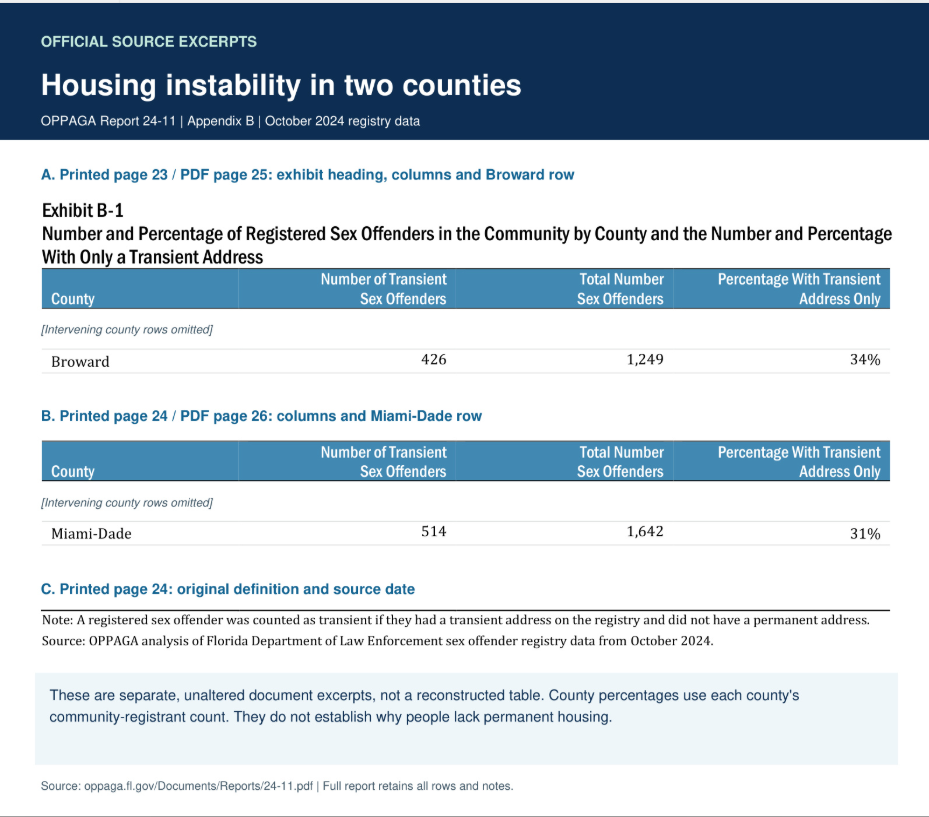 OPPAGA 24-11, Appendix B, October 2024. Selected county rows and definitions, printed pages 23–24. Tap image to enlarge. Original report.
Housing concentration: two counties, two statewide denominators
Both bars describe Broward and Miami-Dade together in October 2024. Each uses its own statewide population; neither describes all people experiencing homelessness.
| Recorded group | Broward | Miami-Dade | Combined | Florida total |
|---|---|---|---|---|
| Transient-only registrants | 426 | 514 | 940 | 2,351 |
| Community registrants | 1,249 | 1,642 | 2,891 | 30,907 |
Source discrepancy: the report prints 4% statewide, while 2,351 ÷ 30,907 = 7.61%. We retain the counts and flag that unresolved difference. Transient-only records are part of the community population, not an additional group to add. Concentration alone cannot establish the effects of housing rules or other causes. OPPAGA 24-11, Appendix B, printed pages 23–24 (PDF pages 25–26).
The findings are mixed. The research below includes studies reporting benefits, studies finding no reliable reduction, and important limits.
Required state review and seven outcome studies: what each can tell us
Florida law already requires OPPAGA to review registration and public notification every three years. It directs the review to examine information-sharing and accuracy, supervision and monitoring, and whether notification keeps communities informed. When deficiencies are found, the report must offer correction options and their projected costs.
Oversight therefore exists. The question is what that review establishes about the safety benefit and cost of each added rule, and how officials act on its findings. A required review alone does not answer every question about the system’s combined effects.
| Research | Finding | Important limit |
|---|---|---|
| Zgoba & Mitchell, Review of 18 studies | No statistically reliable change in reoffending under the researchers’ preferred method. | Published online in 2021; other statistical methods gave different results. The combined findings do not establish zero benefit for every policy. |
| Jacksonville buffers, 2012 study | No statistically significant sexual-rearrest reduction after the historical 1,000-to-2,500-foot expansion. | One city and older policy; compared policy changes without randomly assigning people to groups. Official profile is archived, not current-law guidance. |
| Florida housing instability, 2015 study | Among 23,523 registrants, restrictions were linked with living without a fixed address. | Housing markets and other factors may contribute; a link does not prove cause and effect. |
| Prescott & Rockoff, 2008 working paper | Evidence of police-registration benefits and mixed public-notification effects. | Compared policies and outcomes across states; does not evaluate today’s complete Florida system. |
| Minnesota notification, 2008 study | Targeted high-risk notification associated with a lower estimated likelihood of sexual reoffending during follow-up. | Historical groups that were not randomly assigned; different from universal Florida public listing. |
| South Carolina adult evaluation, 2010 report | Initial program associated with fewer first-time sex-crime arrests; no detected reduction in repeat offending. Failure to register did not predict new sexual offending. | Older observational program. Compliance violations are not automatically harmless, and arrest measures are incomplete. |
| Matched juvenile study, 2008 | Only two sexual reconvictions among 111 matched pairs. | Too few events for a valid comparison of repeat sexual offending; inconclusive is not proof of no effect. |
Police registration, public notification, housing exclusion and reporting frequency are different policies. Rearrest, reconviction, rule violations and victimization are different outcomes. A research assessment commissioned by the Justice Department’s Office of Sex Offender Sentencing, Monitoring, Apprehending, Registering, and Tracking (SMART) also cautions against weak comparisons and broad conclusions from limited samples. No study reviewed here measures the combined net effect of Florida’s entire current system.
A review combining 18 studies found no statistically reliable change in reoffending under the researchers’ preferred method. Other statistical methods produced different results, so this is not proof that every measure has zero benefit.
The evidence is not uniformly negative. Prescott and Rockoff found evidence of benefits from police registration, alongside mixed effects from public notification. A Minnesota study found lower sexual reoffending under targeted high-risk notification. Those findings deserve attention too. They do not establish the value of every later restriction or the combined effects of Florida’s current system.
For Florida’s required three-year review, ask: what does this added requirement achieve, for whom, at what cost, and compared with what alternative?
Watch the policy question being debated
Florida House Criminal Justice Subcommittee · November 5, 2025
During the HB45 discussion, a member asks whether greater homelessness would make people harder to track; the sponsor responds that she does not foresee that outcome. See approximately 22:48–23:19. These are legislative arguments, not measured findings, and this earlier proposal is not the final 2026 law.
More compliance activity also deserves follow-through
OPPAGA reported that convictions followed 60% of 2014 registration-violation arrests and 45% of 2022 arrests. These are compliance cases, not counts of new sexual victimization. The different case outcomes deserve examination; they do not by themselves prove that arrests were unjustified.
Registration-violation arrest events: 1,612 in 2014 → 2,220 in 2023, a 37.7% increase between those endpoints.
The series fluctuates. It counts arrest events, not unique people; it cannot establish the percentage of registrants arrested or the rate of new sexual offending.
Annual registration-violation arrests and year-to-year change, 2014–2023
| Year | Arrest events | Change from previous year |
|---|---|---|
| 2014 | 1,612 | — |
| 2015 | 1,469 | -8.9% |
| 2016 | 1,509 | +2.7% |
| 2017 | 2,068 | +37.0% |
| 2018 | 2,171 | +5.0% |
| 2019 | 2,234 | +2.9% |
| 2020 | 1,832 | -18.0% |
| 2021 | 2,193 | +19.7% |
| 2022 | 2,261 | +3.1% |
| 2023 | 2,220 | -1.8% |
Original OPPAGA Exhibit 13. Percentages are changes in event counts, not percentages of registered people. The exhibit reports 2,220 for 2023; nearby prose says 2,200, an unresolved source discrepancy. Later years were not available in this verified series. To calculate what share of registered people were arrested, we would need to count each person once and know who was subject to the rules during the same period. Case outcomes would still need a separate follow-up.
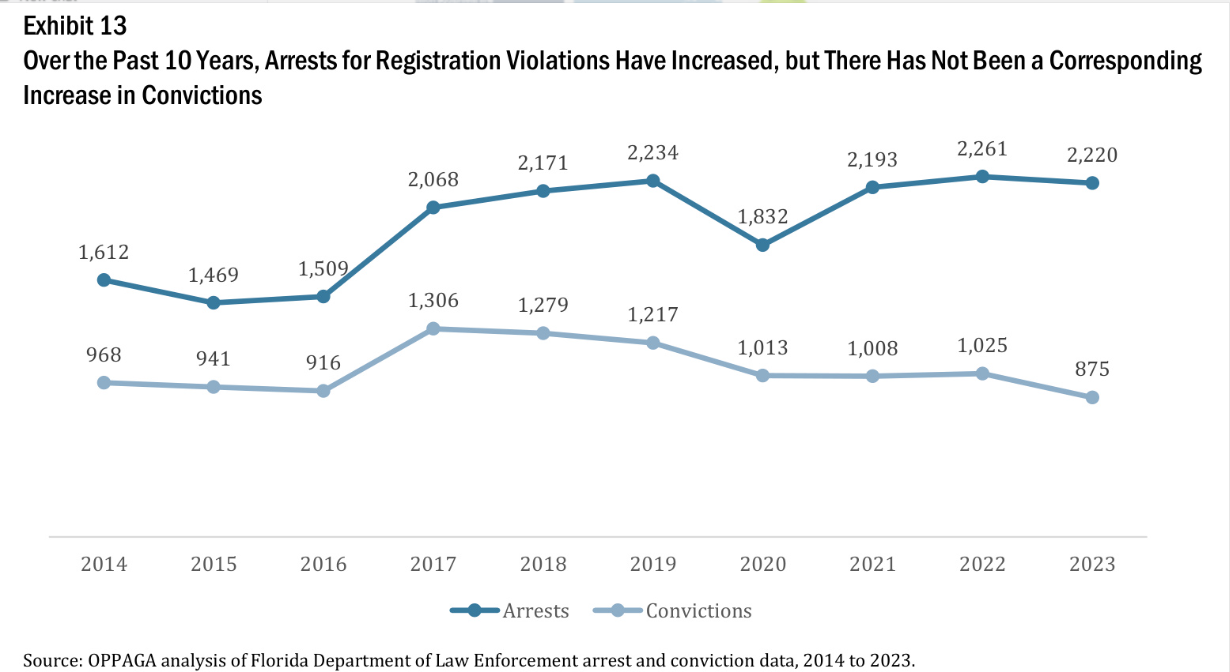 OPPAGA 24-11, Exhibit 13, printed page 18. Many 2023 cases were still open; OPPAGA excluded that year from its conviction-rate comparison. The chart shows 2,220 arrests for 2023 while the preceding text says 2,200; that discrepancy is unresolved. Neither line measures new sexual victimization. Open the original exhibit and surrounding report.
An audit found problems in a small sample of federal registry records
Meeting minutes published by the Florida Department of Law Enforcement (FDLE), July 14, 2025, page 3, summarize a February 2025 Federal Bureau of Investigation (FBI) audit of National Sex Offender Registry records, a federal law-enforcement system.
- 18 of 30 sampled records contained inaccurate information.
- 7 of 30 were incomplete.
- 4 of 30 were described as invalid because removal had not occurred within three days after receipt and verification.
These categories may overlap and must not be added together. This small sample is not a statewide error rate or an audit of Florida’s public website. The minutes do not say why those removals were due. The three-day federal-record process is different from FDLE’s one-year public-site death-removal policy and does not explain any particular deceased person’s listing.
The minutes say the FBI accepted FDLE’s responses. That is important, but it does not independently verify every correction was completed. Accuracy and timely correction deserve measurement alongside arrest totals.
Administrative improvements matter too: 24 of 26 sheriffs’ offices using FDLE’s LEMobile mobile app reported more efficient address verification. Efficient recordkeeping and preventing harm are related but different questions.
Returning to prison does not, by itself, tell us what happened. Was there a new sexual offense, another criminal offense, a registration violation or a supervision violation? Public reporting should make those distinctions clear before return totals are used to justify additional restrictions.
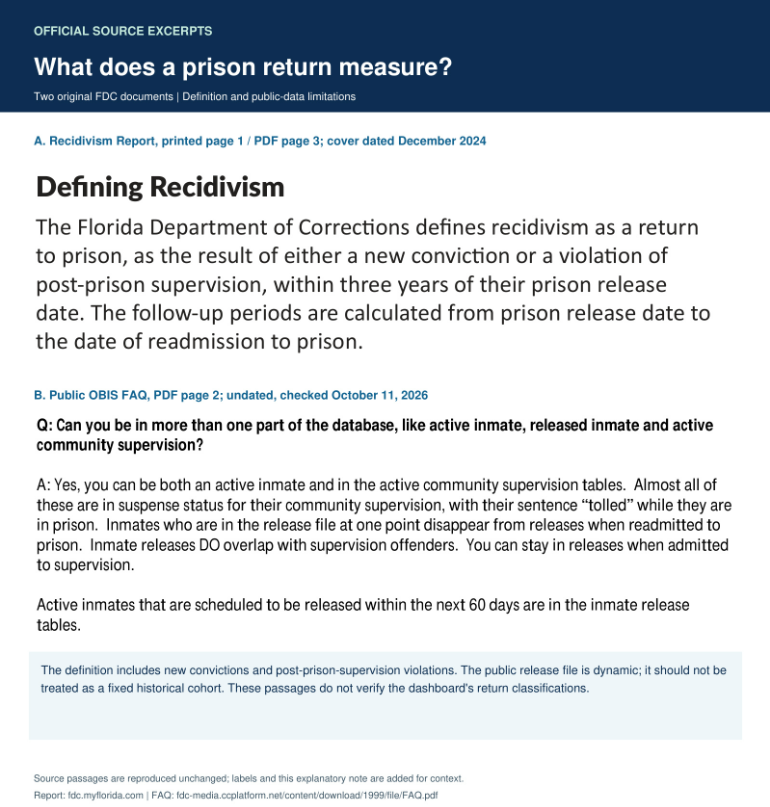 FDC definition, printed page 1 (cover: December 2024), and undated FAQ, page 2. Labelled excerpts. Tap image to enlarge. Report · FAQ.
Prison returns: source audit, 2021 illustration and public resources
In a supplied dashboard’s 2021 released-sentence sexual-offense group, 346 of 1,388 people (24.9%) returned to Florida Department of Corrections (FDC) prison within three years. These are prison-return classifications, not sexual-reoffending rates.
The group is defined by the released sentence’s offense category. It is not a count of all registrants or everyone with any sexual-offense history. “No recorded return” does not establish that no offending occurred.
All 1,388 releasees are the denominator below.
| Dashboard classification (not a verified return reason) | People | Share of all 1,388 releasees |
|---|---|---|
| No recorded FDC prison return within three years | 1,042 | 75.1% |
| Technical-proxy return | 237 | 17.1% |
| Registry-labelled return (unverified) | 54 | 3.9% |
| Other-new-offense-proxy return | 55 | 4.0% |
| All returns, comprising the three return rows | 346 | 24.9% |
The technical-proxy and registry-only categories together contain 291 people: 84.1% of the 346 returnees, or 21.0% of all 1,388 releasees. The different denominators answer different questions. Rounded category percentages may not sum to exactly 100%.
Classification and replication limits: “technical-proxy” is a derived category, not a verified official technical-revocation reason. Missing offense dates and classification priority can affect it. “Other-new-offense-proxy” is not limited to sexual offenses. The aggregate CSV counts reconcile, but the raw event classification and original transformation code were not available for independent replication.
Source: the supplied Florida Criminal Justice 101 dashboard and its retained aggregate CSV. The dashboard is not an official FDC publication, and access may require an invited account; that link does not by itself make the analysis publicly reproducible. This figure uses the mature 2021 group only, separate from provisional 2023. The earlier 1,740-person study uses a different, incompletely specified cohort; selection code is needed to explain the difference.
What the new audit verified
The October 11 review independently reproduced 396 category-sum checks across 36 annual subgroup summaries, with no differences. It also reproduced both denominator calculations. This checks aggregate arithmetic, not why anyone returned to prison. The annual subgroups overlap and cannot be added as unique people. The four recidivism CSVs contain aggregates, not the person-and-event rows needed to recreate the selection and classification.
What still needs to be established
The combined 84.1% must not be described as returns without a new crime. It is the share of 346 returnees assigned to two dashboard categories. Registration violations can themselves be crimes under section 943.0435(9)(a) and section 775.21(10)(a). Neither the combined percentage nor the other-new-offense category is a sexual-reoffending rate.
For its own purposes, section 948.06(1)(c) treats a technical supervision violation as one that does not involve a new felony, misdemeanor or criminal traffic offense. A date-based proxy does not establish that legal ground.
- Missing offense rows: the FDC public-data FAQ identifies delays, immediate releases and database inconsistencies. An unlinked charge may mean the reason is unknown, rather than technical.
- Offense dates and custody spells: an older offense can lead to a later admission. Multiple incarceration periods can share an initial ReceiptDate, so that date alone is not a unique return-event key.
- Changing file membership: readmitted people leave the release file, while some people scheduled for release within 60 days appear in it. Snapshot dates and actual release events matter.
- Missing classification fields: the retained public dictionary has no explicit admission/revocation reason or unique custody-visit key. A person-level match alone cannot reliably link each offense to the correct prison stay.
- Registry-only and mixed returns: verification needs a dated statute/charge crosswalk, a confirmed return-event link, and a rule for other qualifying offenses. Keep mixed registry, supervision and other-crime flags before applying any display hierarchy.
A stronger analysis would retain verified technical-only, verified registry-only, mixed grounds, verified other-new-offense and unresolved categories alongside the original dashboard labels. It should publish unmatched cases and missing-date counts rather than assigning unknown reasons to a category. First return, worst return and any return are different outcomes.
Original raw-data replication remains incomplete: the source snapshots, executable transformation code and linked official return reasons were not available. Current raw-file retrieval was not completed in this review; that does not establish that the advertised public files are unavailable.
Keep official statewide figures separate
The official FDC report gives 5,325 returns among 24,971 people released in 2020 (21.3%). The dashboard’s all-release 2020 group gives 6,214 among 27,808 (22.35%). These broader statewide groups are separate from the sexual-offense group illustrated above.
FDC omits deaths/executions, release-time detainers and certain atypical or outside-direct-custody releases, and counts only each person’s first release in a calendar year. Equivalent dashboard exclusions and snapshots have not all been established. A reconciliation table is needed before attributing the difference to any one exclusion or calling it a change over time.
The linked report’s cover says December 2024, while the publication index labels it December 2025. We preserve that date discrepancy and the reported values. The dashboard’s 2023 follow-up remains provisional and is excluded from mature-year comparisons here.
Public source resources and next checks
- FDC public OBIS FAQ, pages 1–2: person keys, offense sequences, receipt dates and changing file membership.
- FDC public OBIS data page: official download and dictionary resources.
- FDC prison recidivism report: printed pages 1–2 and Appendix B for definitions, exclusions and the official 2020 figures.
To resolve the remaining questions, freeze the original input versions and dates; reproduce cohort eligibility and exclusions; identify actual release/readmission spells; apply an exact three-year follow-up; link charges and official reasons to each return; and publish an aggregate comparison of proxy versus verified reasons. The earlier 1,740-person study’s current, prior or later offense eligibility remains incompletely specified. No assumption about that selection resolves its difference from the dashboard.
How many people successfully leave the registry?
Most reported removals were deaths
OPPAGA reports 2,282 deceased people removed between October 1, 2021, and September 30, 2024. Removal after death is not the same as a person gaining relief during their lifetime.
Death does not mean immediate removal. FDLE’s FAQ says a deceased person’s record should leave the public website one year after the death date documented on the death certificate. The FDLE full registry CSV uploaded October 6, 2026 contained 1,841 records marked deceased. That count alone does not tell us which records were publicly visible, whether a removal was overdue, or whether the policy was followed.
OPPAGA states 2,554 total removals, but its listed categories add to 2,485, a difference of 69. Deaths are the majority under either total; we do not use the report’s disputed percentage.
One record that needs an explanation
A funeral-home obituary for James Terrill Zillioux reports that he died on November 25, 2021. On October 11, 2026, his flyer was still available through FDLE’s public search, marked “Deceased.”
 FDLE public flyer, checked October 11, 2026, at 18:04 UTC. This privacy-limited crop shows only the name and status; date of birth, address and family information are omitted. Open FDLE’s official search; enter first name James, last name Zillioux, and select Both under state.
That appears inconsistent with FDLE’s published one-year public-removal policy and deserves an explanation. The public record does not tell us what death documentation FDLE holds, what date it recorded, or why the page remained available. It does not establish deliberate inflation of the registry. This example concerns removal from the public website, not destruction of every underlying agency record.
Readers on FAC’s website have described family requests as part of getting deceased people removed: a May 2018 comment and a February 2020 comment raise that concern. Those comments are unverified and do not establish a requirement to hire a lawyer or petition a court. Even after death, removal may not be straightforward. FDLE publishes a one-year removal policy, yet the verified example here shows a deceased person still publicly listed years later. Who must follow up when the promised removal does not happen?
How often living people obtain removal is still unclear from the public sources we reviewed. We did not locate statewide annual counts for 2008–2025 or January 1–October 11, 2026. Missing data must not be read as zero successful removals.
Verified removal figures covering longer periods
| Period or cutoff | Reported figure | Measure |
|---|---|---|
| By July 2011 | 241 | Total court-granted Romeo-and-Juliet petitions reported by that date. |
| By August 2, 2012 | 283 | Total people granted relief by that date, in OPPAGA’s Romeo-and-Juliet discussion. |
| October 1, 2021–September 30, 2024 | 26 | FDLE completed removals under Romeo-and-Juliet provisions. |
| October 1, 2021–September 30, 2024 | 22 | FDLE completed removals after the relevant convictions were set aside. |
A granted petition and a completed FDLE removal are different measures. Death-related removal is different again. These figures cover totals accumulated over time or periods longer than one year, so we cannot turn them into annual results or calculate a success rate without comparable application and denial counts.
Year-by-year successful-removal figures were not found in the public sources reviewed
For 2008–2026, NA means an annual statewide figure was not located in the official sources reviewed. It does not mean zero, and it does not prove the administrative data do not exist.
| Calendar year | Court-granted petitions | Completed FDLE court-relief removals |
|---|---|---|
| 2008 | NA | NA |
| 2009 | NA | NA |
| 2010 | NA | NA |
| 2011 | NA | NA |
| 2012 | NA | NA |
| 2013 | NA | NA |
| 2014 | NA | NA |
| 2015 | NA | NA |
| 2016 | NA | NA |
| 2017 | NA | NA |
| 2018 | NA | NA |
| 2019 | NA | NA |
| 2020 | NA | NA |
| 2021 | NA | NA |
| 2022 | NA | NA |
| 2023 | NA | NA |
| 2024 | NA | NA |
| 2025 | NA | NA |
| 2026 through October 11 | NA | NA |
Reviewed: OPPAGA reports 08-60, 12-12, 15-16, 18-08, 21-10, 24-11, and the 2011 Senate issue brief. The 2018 report supplies only a three-year average for all-cause removals, which cannot fill individual years.
We need FDLE to resolve the difference in the reported removal totals and publish annual counts by reason. Families deserve to know how often eligible people gain relief while they are alive, as well as how records are handled after death.
People still have lives after the cameras leave
An arrest does not establish guilt or automatically place someone on a registry. The evidence, charges and legal outcome matter. Reporting should leave room for that process and should follow up when a case changes, rather than leaving the original accusation as the only public account.
Behind every arrest and registry entry is a person and a family. Whatever the accusation, people in custody deserve safety, medical care and humane treatment. Accountability means examining both public-safety outcomes and what happens to people after an arrest. Children and survivors also need lasting care, privacy and support.
In OPPAGA’s October 2024 snapshot, 24,135 of 30,907 community registrants (78.1%) were classified “Sentence Served – Required to Register.” This describes sentence status, not risk. FAC members describe lasting barriers to housing, work, travel and family life. These are reported experiences, and they deserve attention alongside evidence about public safety. They do not establish that every person or every sting case has the same outcome.
More oversight, or more overreach?
FAC has stated that its ultimate goal is to abolish the registry, while supporting practical reforms that reduce harm in the meantime. That stated goal provides context for this opinion column; the research above still needs to be judged on what each study actually tested and found.
Florida needs effective protection for children, meaningful support for survivors and fair, reliable investigations. Our opinion is that officials should explain how the spending and restrictions advance those goals, using outcomes that the public can check. Over the years, changes to registration laws and local ordinances have added layers of obligations and restrictions. Who measures whether each added burden improves public safety, and who examines their combined effect on families? At what point does oversight become overreach? These records raise that question; the counts alone cannot answer it.
Ryan Anderson describes repeated unanswered requests from personal experience. The correspondence reviewed gives a narrower picture: FDC supplied referrals and a no-responsive-documents response, while FDLE acknowledged two requests. No substantive FDLE production was located in the mailbox reviewed through October 11, 2026; live portals and other correspondence channels were not checked. Families and policymakers still need information connecting registration status, custody, outcomes and spending.
Records access: personal experience, documented replies and unanswered questions
Media and member personal accounts : “In my experience, several individuals and organizations have sought this information without receiving a response.” This is his account, not an independently verified finding about every requester or agency.
The retained correspondence supports a narrower documentary conclusion: a reply can acknowledge a request, point to another source or report no responsive documents without supplying the requested tabulations. Those outcomes must be distinguished from silence.
| Agency and topic | Documented outcome | What remains unestablished |
|---|---|---|
| FDC: Pasco detention data; September 16 request | September 23 report referral and partial information route | Delivery of the underlying machine-readable submissions and field documentation was not established. |
| FDC: prison counts and sexual-offense histories; September 23 inquiry / September 25 formal request | September 30 no-responsive-documents response and referral to public OBIS files | Requested tabulations were not supplied. The overlapping inquiries are not counted as two ignored requests. |
| FDLE: Pasco registry-file request; September 16 | Acknowledgment and referral | No substantive production located in the scoped mailbox review. |
| FDLE: youth/young-adult statistics; September 17, supplemented October 8 | Receipt and September 21 docket confirmations | No substantive production located in the scoped mailbox review. |
Scope: this is a review of retained agency correspondence, not a statewide survey or live-portal certification. Other channels were not checked. Unsent draft requests were excluded. No-responsive-documents does not establish that all underlying data are nonexistent. These records do not establish unlawful withholding or deliberate concealment.
To assess registry-related imprisonment and spending, the public needs dated registration status, custody episodes, the grounds for detention, clear offense and violation definitions, and aligned spending records. Acknowledgments, referrals, partial production and substantive answers should be reported separately.
We need to examine the activity being counted, the legal and financial demands placed on people, and whether stable, lawful housing is realistically available. Then ask what safety the spending produces.
Publish annual entries and exits, case outcomes, actual spending and evidence of safety benefits. Then Floridians can judge the system on its results, its costs and its effects on real people.
Explore the annual counts and source record
This review found 83 distinct operations: 71 documented ICAC-linked operations and 13 Hansen-linked operations, with one verified overlap. Some categories overlap, so they cannot simply be added together. We used operation dates where available and clearly labeled announcement dates when field dates were not reported. Statewide and multistate umbrella announcements were not counted as extra local operations. Individual SOSA cases, unverified leads and registry-compliance sweeps were not added to these operation totals. ICAC work is broader than decoy stings. Sources include government records, agency releases, news reporting and organizational descriptions; a linked source is not automatically an official government finding.
| Year | ICAC-linked | Hansen-linked |
|---|---|---|
| 2006 | None located | 2 |
| 2007 | 2 | None located |
| 2008 | None located | None located |
| 2009 | 1 | None located |
| 2010 | 1 | None located |
| 2011 | 1 | None located |
| 2012 | 7 | None located |
| 2013 | 2 | None located |
| 2014 | 4 | None located |
| 2015 | 2 | None located |
| 2016 | 4 | None located |
| 2017 | 3 | None located |
| 2018 | 2 | None located |
| 2019 | 3 | None located |
| 2020 | 4 | None located |
| 2021 | 2 | None located |
| 2022 | 4 | 1 |
| 2023 | 5 | 2 |
| 2024 | 9 | 2 |
| 2025 | 5 | 3 |
| 2026 | 10 | 3 |
Years with no located entries are evidence gaps, not confirmed zero activity. A publication or broadcast date is not automatically an operation date. Some source dates are approximate or announcement-based. Source coverage varies by year and agency, so neither full-year nor same-cutoff comparisons establish a statewide rate of change.
Flagler · Traveler-decoy or mixed child-sting initiative
Tags: Hansen. Dates: December 2006; four-day operation; Month; court documents corroborate December 9 activity. Source 1 Source 2 Source 3
Lee · Traveler-decoy or mixed child-sting initiative
Tags: Hansen. Dates: April 2006; three-day operation; Month; exact start/end unverified. Source 1 Source 2
Escambia · traveler decoy sting
Tags: ICAC. Dates: 2011-06-20/26. Source 1 Source 2
Broward · mixed CSAM / prostitution
Tags: ICAC. Dates: 2012-05/06. Source 1
Osceola · traveler decoy sting
Tags: ICAC. Dates: 2014-10. Source 1
Polk · CSAM-led mixed sweep
Tags: ICAC. Dates: 2015-02. Source 1
Duval · undercover fictitious minor
Tags: ICAC. Dates: 2018-08; operation month/date. Source 1 Source 2 Source 3
Walton · undercover fictitious minor
Tags: ICAC. Dates: 2018-02-28; field date/month unless noted. Source 1 Source 2
Volusia · undercover fictitious minor
Tags: ICAC. Dates: 2019-09-26; operation month/date. Source 1
St. Johns · undercover fictitious minor
Tags: ICAC. Dates: 2019-04; operation month/date. Source 1
Duval · undercover fictitious minor
Tags: ICAC. Dates: 2019-06-19; operation month/date. Source 1
Osceola · undercover fictitious minor
Tags: ICAC. Dates: 2020-01-09; operation month/date. Source 1
Volusia · undercover fictitious minor plus compliance
Tags: ICAC. Dates: 2020-08; operation month/date. Source 1
Clay · undercover fictitious minor
Tags: ICAC. Dates: 2020-01-24; operation month/date. Source 1
Duval · mixed decoy CSAM
Tags: ICAC. Dates: 2021; year; summer field dates unspecified. Source 1
Okaloosa · undercover fictitious minor
Tags: ICAC. Dates: 2021-08; operation month/date. Source 1 Source 2
Marion · undercover fictitious minor
Tags: ICAC. Dates: 2022-03-28; operation start date. Source 1 Source 2 Source 3
Volusia · undercover fictitious minor
Tags: ICAC. Dates: 2022-08; operation month/date. Source 1
Polk · Traveler-decoy or mixed child-sting initiative
Tags: Hansen. Dates: Late August–early September 2022; documented chats August 29, arrivals August 31–September 3, later warrants September 6–8; Case dates; full operational start/end not expressly established. Source 1 Source 2
Okaloosa · undercover fictitious minor
Tags: ICAC. Dates: 2022-02; operation month/date. Source 1
Walton · undercover fictitious minor
Tags: ICAC. Dates: 2022-01-26; operation month/date. Source 1
Citrus · undercover fictitious minor plus unrelated drug
Tags: ICAC. Dates: 2023-03; operation month/date. Source 1 Source 2 Source 3
Marion · mixed decoy CSAM
Tags: ICAC. Dates: 2023-05; field date/month unless noted. Source 1 Source 2
Polk · Traveler-decoy or mixed child-sting initiative
Tags: Hansen. Dates: February 2023; two-week initiative; sting arrivals February 6 and 7; Month for umbrella; exact dates for linked encounters. Source 1
Polk · Traveler-decoy or mixed child-sting initiative
Tags: Hansen. Dates: September 19–25, 2023; End date derived from stated seven-day operation beginning September 19. Source 1 Source 2 Source 3
St. Johns · undercover fictitious minor
Tags: ICAC. Dates: 2023-04; operation month/date. Source 1
Escambia · undercover fictitious minor
Tags: ICAC. Dates: 2023-02; field date/month unless noted. Source 1 Source 2
Marion · CSAM
Tags: ICAC. Dates: 2023-12; announcement month. Source 1
Volusia · mixed decoy CSAM registration
Tags: ICAC. Dates: 2024-04; field date/month unless noted. Source 1
Indian River · mixed CSAM online solicitation
Tags: ICAC. Dates: 2024-04; field date/month unless noted. Source 1 Source 2
Flagler · undercover fictitious minor
Tags: ICAC. Dates: 2024-07-11; field date/month unless noted. Source 1
Polk · Traveler-decoy or mixed child-sting initiative
Tags: Hansen. Dates: October 2–6, 2024; End derived from five-day operation beginning October 2. Source 1 Source 2
Polk · Traveler-decoy or mixed child-sting initiative
Tags: Hansen. Dates: February 22–29, 2024; Exact range in agency release. Source 1 Source 2
Bay · mixed decoy CSAM
Tags: ICAC. Dates: 2024-07-17; field date/month unless noted. Source 1 Source 2
Manatee · undercover fictitious minor
Tags: ICAC. Dates: 2024-07; field date/month unless noted. Source 1 Source 2
Hernando · undercover fictitious minor
Tags: ICAC. Dates: 2024-07-17; field date/month unless noted. Source 1 Source 2
Marion · undercover fictitious minor
Tags: ICAC. Dates: 2024-07; announcement month. Source 1 Source 2
Columbia · undercover fictitious minor
Tags: ICAC. Dates: 2024-12; field date/month unless noted. Source 1
Duval · undercover fictitious minor
Tags: ICAC. Dates: 2024-04; operation month/date. Source 1
Okaloosa · undercover fictitious minor
Tags: ICAC. Dates: 2025-10; operation month/date. Source 1
Volusia · undercover fictitious minor
Tags: ICAC. Dates: 2025-03; operation month/date. Source 1 Source 2
Polk · Traveler-decoy or mixed child-sting initiative
Tags: Hansen. Dates: May 2–10, 2025; Exact range in agency child-sting release. Source 1
Polk · Traveler-decoy or mixed child-sting initiative
Tags: Hansen. Dates: September 8–14, 2025; Exact range in agency release. Source 1 Source 2 Source 3 Source 4
Marion · undercover fictitious minor
Tags: Hansen. Dates: July 2025; six-day operation announced July 30; Month; exact start/end not verified. Source 1 Source 2 Source 3 Source 4 Source 5 Source 6
Leon · undercover online exploitation
Tags: ICAC. Dates: 2025-04-10; operation month/date. Source 1
Franklin · undercover fictitious minor plus compliance
Tags: ICAC. Dates: 2025-07-10; operation month/date. Source 1
Volusia · mixed decoy CSAM
Tags: ICAC. Dates: 2025-06; operation month/date. Source 1
Osceola · undercover fictitious minor
Tags: ICAC. Dates: 2026-03-18; operation month/date. Source 1
Duval · undercover fictitious minor
Tags: ICAC. Dates: 2026-04; operation month/date. Source 1 Source 2
Osceola · undercover fictitious minor
Tags: ICAC. Dates: 2026-09-02; operation month/date. Source 1 Source 2
Alachua · undercover fictitious minor
Tags: ICAC. Dates: 2026-07-30; operation month/date. Source reviewed: agency public-information post by Lisa Sacaccio identifying North Florida ICAC; direct personal-account link omitted.
Clay · undercover fictitious minor
Tags: ICAC. Dates: 2026-07-15; operation month/date. Source reviewed: agency public-information post by Lisa Sacaccio identifying North Florida ICAC; direct personal-account link omitted. Source 1
Volusia · undercover fictitious minor
Tags: ICAC. Dates: 2026-02; operation month/date. Source 1 Source 2
Marion · undercover fictitious minor
Tags: ICAC, Hansen. Dates: June1–6,2026; announced June11; Exact range in Florida AG release. Source 1 Source 2 Source 3 Source 4 Source 5 Source 6 Source 7
Polk · Traveler-decoy or mixed child-sting initiative
Tags: Hansen. Dates: April 20–26, 2026, as reported by the Lakeland Ledger from the sheriff’s briefing; Contemporary news report of sheriff’s briefing; separate contemporary report corroborates April 20 start and week-long duration. Source 1 Source 2 Source 3 Source 4
Broward · Child-sex solicitation/travel sting within trafficking enforcement
Tags: ICAC. Dates: Announcement July 2, 2026; exact operation dates not stated in primary release. Source 1 Source 2
Martin · Traveler-decoy or mixed child-sting initiative
Tags: Hansen. Dates: Three days ending May7,2026; announced May8; End and duration reported by TCPalm; exact range not independently documented. Source 1 Source 2 Source 3 Source 4 Source 5
Leon · undercover online exploitation
Tags: ICAC. Dates: 2026-03-12; announcement date. Source 1
Volusia · undercover fictitious minor
Tags: ICAC. Dates: 2026-07-09; operation month/date. Source 1
Registry figures and calculation notes
| Snapshot | Registry total | Florida communities |
|---|---|---|
| Sep 2015 | 66,523 | 26,845 |
| Oct 2018 | 73,004 | 28,548 |
| Sep 2021 | 78,357 | 30,180 |
| Oct 2024 | 86,207 | 30,907 |
Total growth: (86,207 − 66,523) ÷ 66,523 = 29.59%. Community growth: (30,907 − 26,845) ÷ 26,845 = 15.13%. These are changes in listed populations, not offense rates, repeat-offending rates or estimates of sting effectiveness. The operations and registry series have different units and observation periods; these counts do not show that one caused changes in the other.
Discover more from Florida Action Committee (FAC)
Subscribe to get the latest posts sent to your email.
You know what’s so funny? That these people are worried about their property value because of registered sex offenders. Not realizing that if the registry keeps growing, there will soon be a registered sex offender on every single corner of every single neigborhood in the whole state of Florida. They’re not far thinkers and one day it will all back fire on them.
This involves the use of public funds, which carries long-term implications for all stakeholders. The inefficient allocation of these resources represents a significant concern. We require transparency regarding project outcomes to evaluate cost-feasibility and determine whether a strategic shift from the current enforcement-heavy approach is warranted.