Friday Lookout: A Spot Check Should Not Leave a Family Afraid
THIS WEEK’S MAIN STORY
This is a tough month for all of us
This is a tough month for all of us. Halloween brings extra checks and harsh words aimed at people forced to register, or PFRs. Those words can come from the public and from officials. For families already trying to live in peace, it can feel like the pressure is coming from all sides.
We looked at that language and its effects in Florida Registry Laws: From the Capitol to the Parking Lot. Words matter. They can shape how people treat their neighbors.
This week, an older Florida Action Committee member and veteran shared an account that stayed with me.
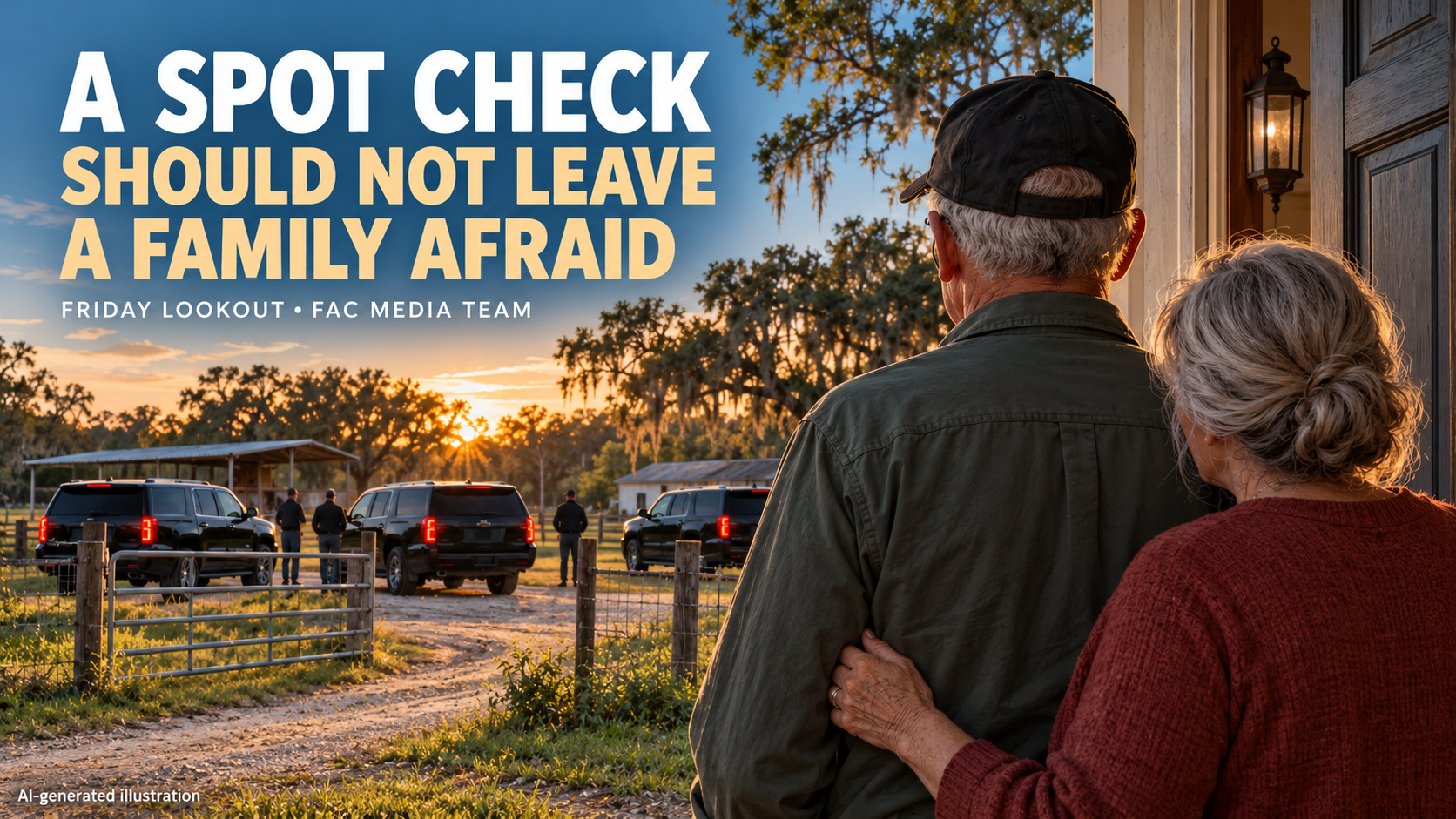
He told me officers came for a home visit to conduct a spot check during what he called Operation 6–7. The check itself was not his concern. It was how they arrived.
He described three SUVs pulling up. He said unmarked vehicles came first, with U.S. Marshals and FDLE agents, followed by sheriff’s deputies. He counted about 18 people around him. He told me it felt like being swarmed.
He was scared. His wife was scared.
He served in the military. So did I. He said the scene brought back memories of operations he had seen while deployed. His account struck a chord with me because I have seen operations like that, too.
But this was his home. According to him, the check found no new violation.
He is part of the aging population we keep talking about. He told me he had finished his sentence and just wanted to live his life. Yet, with so many officers around him, he did not know what he had to answer, what he could decline, or what his rights were.
A person can follow the rules and still feel afraid. That is what we need people to hear.
We are sharing his account.
Why were so many officers needed for this check? Was there a safety concern? Could the same work have been done in a way that caused less fear?
We can support public safety and ask those questions at the same time. Older adults, veterans, spouses, and families should not be left feeling that a routine check is a raid.
Our members need clear rules. They also need respect. Finishing a sentence should leave room to build a life, not just fear the next knock.
Home visits for spot checks are not registration-office visits
A home visit for a spot check is not the same as your required visit to the registration office. The timing and steps for required information updates are different from a home visit for a spot check. Some people must also register in person twice a year. Others must go four times a year.
Home visits for spot checks are used to verify an address. The law sets how often an address must be verified, at a minimum. For people outside Department of Corrections supervision, the minimum is once a year for those classified as sexual offenders and four times a year for those classified as sexual predators. Those are minimums, not limits on how often checks may happen.
Do not assume telling an officer at your door replaces a required report. Keep following the rules and deadlines for address changes, travel, and other updates. The right reporting method depends on the change. Some reports require an in-person visit; the FDLE online system is not a substitute for every report.
Need to update your information? If permitted, use FDLE’s CCS login for many updates, such as phone numbers, email addresses, and employment. You can also report these changes at your sheriff’s registration office.
Some reports still require an in-person visit. If you are under supervision, follow your officer’s reporting rules. Check with your registration office if unsure, and meet all deadlines.
We cannot tell every reader that showing an ID is all the law requires. The rules may differ based on your registration status and whether you are under supervision. If you are under supervision, extra conditions may apply. If you are unsure, ask your registration office for the reporting steps and speak with a lawyer about your rights.
ID note: the offender marking is “943.0435, F.S.” The predator marking is “SEXUAL PREDATOR.” This is general information, not advice about a specific visit.
Official sources: Florida Statutes 943.0435 · 775.21 · 322.141
More in this week’s Lookout
Tap a title to read more.
Thank you, NARSOL: Florida and FAC in the Digest
Thank you to NARSOL and its writers for giving Florida and FAC so much space in the October–November Digest. Two sections share our work: an article on FAC’s federal lawsuit and the Florida update in “Our States.” It is good to see our community’s work reach more people.
James Edward Petersen’s Alaska’s “Civil” Punishment helps explain the history. Its opening looks at the Supreme Court’s 2003 decision in Smith v. Doe. The Court treated Alaska’s registry as a civil system, not criminal punishment. That background helps readers understand the debate about today’s rules and their combined effects.
It is a useful lead-in to FAC’s lawsuit, now called FAC v. Keefe, formerly FAC v. Glass. The case challenges how Florida’s rules work together. The lawsuit has not yet been decided.
Also in the Digest is Savannah’s Lindsey v. Swearingen – Why Florida Keeps Out-of-State Registrants on Its Registry for Life.
Source: The NARSOL Digest, Vol. XIX, Issue 5, October–November 2026. FAC lawsuit article: p. 18; “Our States”: pp. 12–13; Savannah’s article: p. 16. We reviewed the supplied pages and the opening of Petersen’s article, not the full issue.
How many more registries?
Volusia County has launched a public database of people convicted of domestic or dating violence there in the past ten years. Molly Reed reported the news for WKMG News 6 on October 22. The list covers convictions, not just arrests, and does not show victim information.
People harmed by abuse deserve safety and support. We should also ask: How will officials know this list makes people safer? How will mistakes be fixed? What happens when a public list follows someone long after a sentence ends?
How many more groups will be put on lists? Are we preventing harm, or teaching people that some neighbors must be pushed out forever?
Those are questions, not a claim that this database already has the same rules as Florida’s sex-offender registry. A statewide expansion has been discussed. It is not an enacted statewide system.
Still sleeping on concrete
Our October 20 weekly update brings us back to people who have no safe place to sleep. FAC visited a Fort Lauderdale camp with a Miami New Times reporter. At the time of that update, the reporter’s story was still to come.
A place to live is not a small thing. It affects health, work, family, and the chance to get back on your feet. These are people, not just numbers on a list.
Read or listen: Twenty Years Later and Still Sleeping on Concrete. Help Us End This.
Aging, care, and the families who need help
FAC Media’s planned conversation with Dr. Stephanie Jerstad focuses on older people on the registry and access to care. What happens when someone needs a nursing home? What if memory loss makes the rules hard to follow? Where can families turn?
These questions need care, research, and honest answers. We want to listen and learn, then use what we learn to help our community.
This preview was prepared before the October 23 discussion. It does not report meeting results.
With Unity Comes Change
Stay safe. Look out for each other.
Keep your information up to date and follow the rules that apply to you.
WITH CARE, YOUR FAC MEDIA TEAM
Discover more from Florida Action Committee (FAC)
Subscribe to get the latest posts sent to your email.

Just a heads-up that Operation 6-7 wasn’t just some Halloween drill; I wanted everyone to be prepared for what’s happening this month, but the way he was caught off guard by that swarm was wild. #Operation #Preparation #October #Surprise ⚠️🐝🚨
If you’re not on any supervisory restrictions, you can just make sure you’re not home on Halloween. Put yourself in a crowded place with lots of cameras, such as a restaurant or grocery store. You could easily spend a few hours at Walmart, for example. No amount of law enforcement intimidation can overcome your absence from the premises.
Or you can stay home. The point being that, whether you choose to go out or stay home, law enforcement is powerless to do anything to you, unless you let them.
True, but the less contact with law enforcement, the better. I’m also not obligated to answer the door, but it makes the situation less tense if I’m just avoiding the potential meeting altogether.