Florida Online Stings: Child Safety, Decoys and Public Cost
FLORIDA ACTION COMMITTEE
Protecting Children Means Taking a Closer Look at Stings
Opinion and documented research on child safety, government power and public cost.
 Online stings use decoys: adults posing as children. Children deserve safety, survivors deserve care, and these investigations deserve fair, open review.
Could government be reaching too far? Its power, cost and burden on families should match the child-safety gains we can show.
A family behind the headline
Adapted illustration
About this illustration
This illustration is adapted from a confidential account shared with FAC Media. Names, genders, ages, locations, relationship details and purchases have been changed to help protect identity. The underlying account and reported quotation have not been independently checked against complete messages, recordings, receipts or the police affidavit. Dialogue is adapted, not a verified quotation. Alex’s current custody and case status have not been independently verified.
Ben and Alex, married men around forty from Wyoming, planned a Florida trip for nearly a year. Then Alex is arrested in a sting. Ben feels hurt and wants answers.
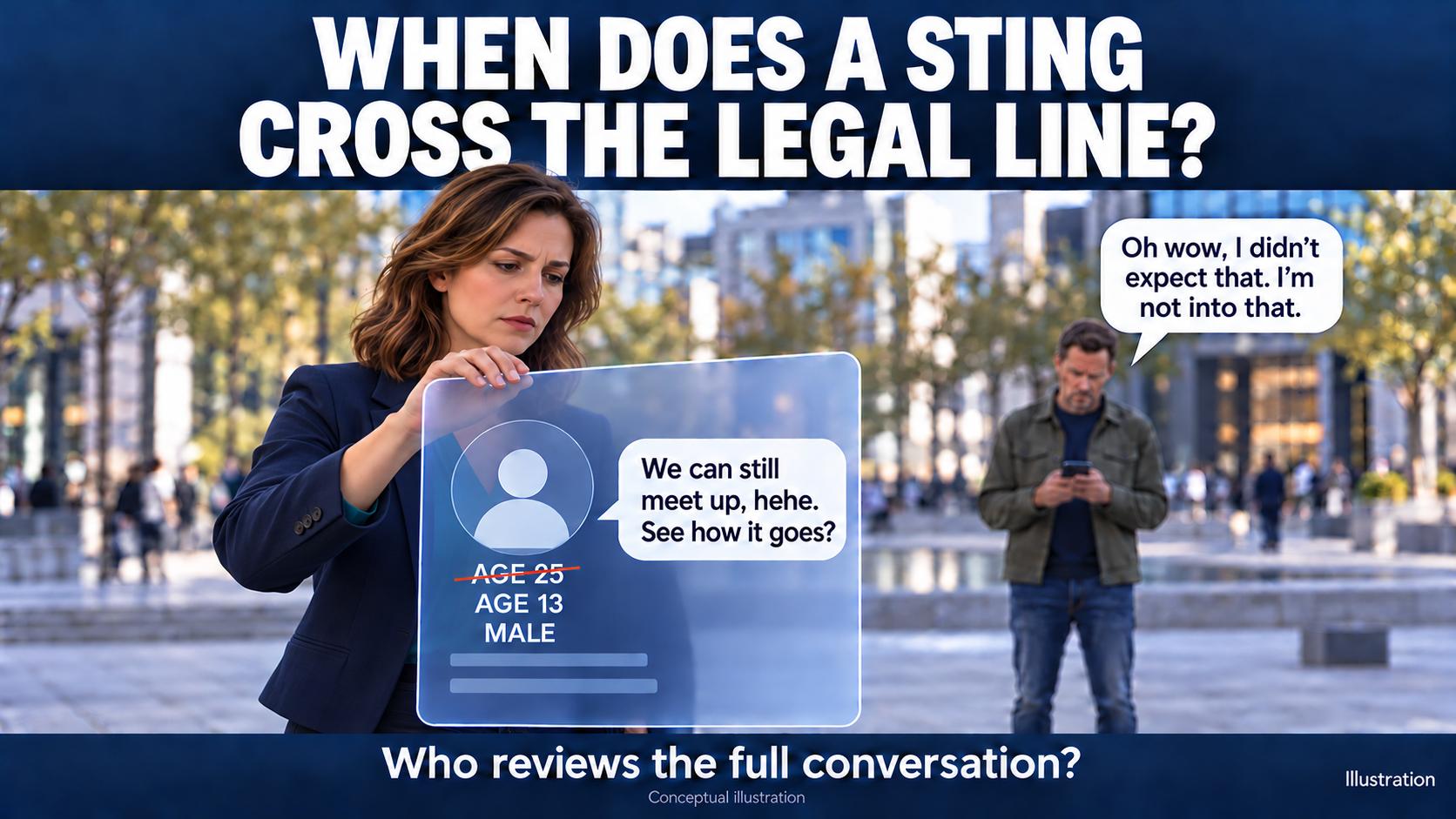
Alex answers a Doublelist ad for a twenty-five-year-old man. An adult woman runs the profile, later claiming to be underage. Events span about forty-five minutes in the family’s account; the exact timing is unclear. The account also describes an exchange of images, but it is unclear when that happened in relation to the change in the stated age.
At the store, the decoy calls. She asks if Alex is okay with meeting a thirteen-year-old boy. In this illustration, his reply is: “Oh wow, I didn’t expect that. I’m not into that.” The decoy replies: “We can still meet up, hehe. See how it goes?” Already inside the store, Alex is caught off guard by the sudden change in age and the suggestion to meet anyway. He hesitates, then mutters, ‘Okay.’
Alex buys candy and soda instead of the requested condoms. Police arrest him on his way to the car. Ben thinks he was leaving, but that does not prove intent.
The account describes Alex in county custody with a public defender. Court and jail records have not been checked. Ben faces a strained marriage and a distant case. Families need care, too.
An adult ad does not excuse a later crime. An arrest does not settle how the case was built.
Watch the clip, then consider the questions
In this SOSA Undercover clip, the speaker describes an experience from middle school.
She describes initially sending images in response to his requests. The clip leaves parts of that exchange unexplained. When she said she wanted to stop, she says he threatened her. Earlier participation did not give him permission to threaten her or share the images. Survivors respond in different ways. The video presents her story as the reason she became an undercover decoy. That work raises questions worth examining: how are boundaries set, and who makes sure they are respected?
When a survivor takes part in an undercover sting, what training, supervision and emotional support are in place? Should decoy roles be handled by trained officers, or can properly trained civilians do this work safely under clear oversight?
Video supplied for discussion. This separate clip does not document the adapted story above. Opens YouTube in a new tab.
“Adults only” has limits
Doublelist’s terms say users must be eighteen or older. It does not verify users’ identity details. Its signup guide requires email and phone details, which do not prove age. It offers paid subscription plans.
Keep each ad and age change in the record. Age checks should also protect privacy.
A sting has rules, too
One form of entrapment asks whether police, or people working with them, induced someone to commit a crime they were not otherwise ready to commit. Florida law and court rulings set the tests and proof needed. Simply offering a chance to commit a crime is not entrapment.
Courts have found entrapment. In DeMare (2020), the decoy claimed to be eighteen for four days, then fourteen, and pushed past his attempts to end contact and avoid illegal sex. The court found entrapment and ordered discharge. That ruling does not decide Alex’s case.
Statewide prosecutors are involved
The Florida Attorney General’s Office of Statewide Prosecution, according to WFTV, leads the Operation Cooked prosecutions.
Protecting children also requires fair process. An arrest is not a conviction; each person is presumed innocent unless proven guilty.
According to Reuters, on October 7, 2026, Uthmeier asked a court to require Meta to remove Florida users under 14 from Facebook and Instagram and add protections for teens. That was a request, not a new court order.
He backs age rules and stings as child protection; both deserve review.
If the rules work, police should explain how enforcement will change.
Age checks aren’t new: Instagram began testing ID and video-selfie checks for some age changes in 2022. A two-step login does not prove age. How well do safeguards work, and do we track children protected as closely as arrests?
What does the public get for the cost?
The federal Internet Crimes Against Children (ICAC) program funds digital evidence review, victim services and undercover cases. These totals do not show individual state, nonprofit or TV-project funding.
Federal ICAC program funding
About $193.5 million over five years
Fiscal years 2021–2025. Total adds the rounded yearly figures below.
| Fiscal year | Funding |
|---|---|
| 2021 | $37.7 million |
| 2022 | $39.6 million |
| 2023 | $42.4 million |
| 2024 | $39.9 million |
| 2025 | $33.9 million |
Source: OJJDP’s ICAC funding history. These are nationwide program totals, not decoy-only spending or payments to SOSA or Hansen. Funding rose through 2023, then fell in 2024 and 2025.
Safety gained per dollar needs matched spending and child-safety results for the same programs and years. Funding and arrest totals cannot show that.
SOSA, Safe from Online Sex Abuse, says its work has police approval and follows prosecutor rules. Prosecutors bring the state’s case. Its page claims a 95 percent conviction rate for adjudicated cases but gives no case-by-case data.
Its 2023 Florida request for fiscal 2024–25 sought $750,000 for decoys, evidence handling and public relations. A request is not proof that funds were paid. We found no verified SOSA entrapment ruling.
A Washington study of Net Nanny could not tell whether the program cut crime or whether defendants would have offended otherwise. That does not prove stings lack value. FDLE’s fiscal 2025–26 grant rules track arrests and child rescues separately. Florida can criminalize conduct involving a decoy, but the arrest alone does not show a child was rescued.
Fairness is part of child protection
TruBlu offers paid and free viewing, but money and cameras alone do not prove entrapment: in Bist (2010), a Florida court upheld a conviction tied to Chris Hansen’s Dateline operation.
Require trained decoys, clear rules and a named supervisor. Save full chats and calls for review of age changes, refusals and pressure. Keep police decisions separate from filming. Make decoys impartial from being a survivor.
Review complaints fairly; report outcomes and changed charges. Treat young people with care and describe their ages and alleged acts accurately. Protect survivors, decoys and families from threats and abuse. Consider changing tactics if laws and technology shift and research if other methods of using tax-payer money could work other than a sting many in the public find “iffy”.
Child protection deserves wise use of public power and money. Victims deserve sound justice, accused people fair treatment, and the public proof of safer communities.
Sources
A 2019 training handout says to let the other person lead and not push meetings. The 2018 ICAC standards also address training and oversight. ICAC means Internet Crimes Against Children, a network of police task forces. Check the rules in force at the time; training guides are not law.
In Gennette (2013), an adult ad led to an offer involving a fictional fourteen-year-old sister. The court found the agent overcame his reluctance and ordered dismissal. FDLE included the case in its legal training update. This ruling does not decide Alex’s case.
Instagram age checks: Meta’s June 2022 announcement described a test for users changing their listed age from under 18 to 18 or older. It was not a universal signup requirement.
Other court outcomes: Poehlman (2000) reversed a federal conviction. Arbogast (2022) ordered a new trial so a jury could consider entrapment; it did not acquit him. Jacobson (1992) concerned mail-order material, not a modern chat app.
Age and the law: Florida’s website age-check law applies to sites with more than 33.3 percent material harmful to minors, as legally defined; it does not cover every dating site automatically. Adulthood at eighteen, tobacco sales at twenty-one and alcohol purchases at twenty-one serve different purposes. Merely exchanging messages does not prove a crime; the content and legal tests matter. Sexual solicitation can be committed through messages alone.
Young suspects: Colorado’s archive lists a fourteen-year-old’s 2012 arrest. Levy County’s 2026 release gives no age for a juvenile arrest. Both concerned abuse-image allegations, not decoy meetups. Final outcomes were not checked. Neither proves an overstep or establishes the youngest arrest nationwide.
Training and media: Read the San Francisco agreement, SOSA’s course description, reporting on the San Francisco footage dispute and Harford County’s plea for compassion toward families. The sheriff defended the San Francisco operation; the reported dispute is not a finding that it was unlawful.
Watch and compare: DeMare oral argument, also shared by FAC; OJJDP’s ICAC explainer and performance-measures training; and a Predator Files clip. Court arguments and edited videos do not replace a ruling or the full case file.
Records can be reviewed while protecting children, private information and active cases. Oversight does not require posting victims’ intimate details online.
Discover more from Florida Action Committee (FAC)
Subscribe to get the latest posts sent to your email.
These stings have become relied upon by Law Enforcement to provide funding for their agencies, so much so that they will employ whatever shady tactics they can to get an arrest. There is a reason they don’t release the full transcripts of these interactions, they would reveal the truth behind the entrapment.
Roo Powell is like a trained actress. (Edited the rest out)
Thank you for raising your concerns. To be clear, our post does not allege or intend to imply that Roo Powell lied under oath, altered evidence, fabricated cases or committed a crime. We have not verified those claims and cannot present them as facts.
The Ben and Alex example was adapted from a confidential account. It was not identified or verified as a Powell or SOSA case, so those connections should not be assumed.
If you have supporting records, please share the case name, court, case number and the full transcript or recording containing the statements you describe. Editing footage for television or creating a decoy’s appearance does not, by itself, establish that evidence given to police was improperly altered.
Our questions concern training, oversight, complete records and whether these methods protect children while treating people fairly. Children deserve protection, and accused people and their families deserve fairness. Both are reasons to examine the evidence carefully.
— FAC Media
The stings need to stop as they are protecting no one.