Sunday Lookout: Care, Hope and a Way to Help
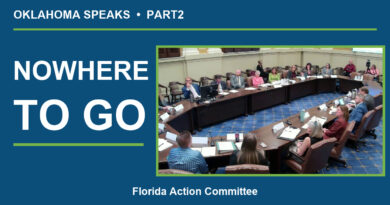
Oklahoma Speaks · Part 3
PREMIERES SUNDAY AT 10 A.M. EASTERN
Nowhere to Go:
When Care Cannot Wait
When people grow older, they need care—not closed doors.
Look at each person’s care needs and risk, not just a label. Keep people safe while helping them get the care they need.
Thank you, Dr. Stephanie Jerstad, for talking with FAC and being willing to help us reach these goals.
Can Florida lawmakers at least have this discussion?
Reader submission
Trying to Understand Florida
A reader asks for the full story behind Florida’s sting operations.
Reader opinion · full text
Read the full submission
Beyond the Veil · Full original article · 2,232 words
Reader-submitted opinion. First-person statements belong to the writer, not FAC. Claims have not been independently verified.
BEYOND THE VEIL
The Truth Behind Florida’s Sex Sting Operations: Who Is Really Being Protected?
Why don’t we start telling the truth about these highly publicized busts that everyone is so quick to celebrate as heroic?
Let’s start with the accusations that these men are predators, prowling the internet looking for children while the rest of the world sleeps, and that law enforcement is tirelessly protecting innocent kids from these monsters.
Then come the warnings to parents about Roblox, Discord, Snapchat, and other platforms where children may be vulnerable.
And parents absolutely SHOULD be watching what their children are doing online.
But here’s the problem: What does that have to do with an investigation conducted on an adult-oriented website?
Why do these press conferences so often leave out where the investigations actually began?
Why don’t they tell the public when the website was intended for adults, when users were required to affirm they were at least 18, when undercover advertisements listed adult ages, or when the supposed minor’s age was introduced only after conversations had already begun?
Why don’t they explain when officers themselves introduced sexual innuendos, initiated sexual discussions, or supplied photographs depicting someone who appeared considerably older than the age being claimed?
And why don’t they talk about what happens when someone expresses discomfort, hesitation, or an unwillingness to get involved with a minor?
What happens when the officer pushes past that reluctance with persuasion, reassurance, or continued encouragement?
I’ve read arrest affidavits describing some of these interactions, and I believe the public is being given a dangerously incomplete picture.
People are quick to say, “Well, if someone told me they were underage, I’d immediately stop talking.”
That’s easy to say when you’re reading a headline.
But how many people know what the actual conversations looked like? How many know what was said before and after the age disclosure? How many know whether an officer continued encouraging someone after that person expressed reluctance?
Those details matter.
And if they don’t matter, why are they being left out?
Let me make one thing absolutely clear.
I am a survivor of childhood sexual molestation and rape.
I know firsthand that sexual abuse is real. I know the damage it causes, and I stand firmly against anyone who deliberately targets children for sexual exploitation.
I do not support child pornography or child sexual abuse material. I do not support internet luring, grooming, trafficking, or any form of sexual abuse involving minors.
I never have, and I never will.
But I also do not support law enforcement luring men into situations, manipulating conversations, and then presenting the resulting arrests as though these men were actively searching for children.
I do not support undercover officers entering adult-oriented spaces and deliberately redirecting encounters between apparent adults into scenarios involving supposed minors.
I do not support officers attempting to overcome someone’s expressed hesitation and then treating the eventual outcome as proof that the person was always looking for a child.
And I certainly do not support selectively presenting facts to the public to create the most inflammatory narrative possible.
At what point does law enforcement stop discovering criminal behavior and start creating it?
That is the question people should be asking.
Entrapment laws exist because government power has limits. Yet, in my opinion, the legal protections surrounding undercover operations have become so broad that officers are given extraordinary latitude to influence situations while defendants face an uphill battle challenging their methods.
Just because something can survive an entrapment challenge doesn’t automatically make it ethical.
Just because an officer can legally say or do something doesn’t mean they should.
And just because a prosecutor can obtain a conviction doesn’t mean every investigative decision leading to that conviction was morally justified.
There is a difference between identifying someone who is actively seeking to exploit a child and creating an opportunity involving a fictional child, then attempting to persuade someone to pursue it.
I believe that difference deserves far more public scrutiny than it’s receiving.
Let’s talk about the undercover officers themselves.
These operations involve adults role-playing children in sexualized conversations.
Think about that for a moment.
Adults are assuming the identities of teenage girls, teenage boys, and sometimes even younger children. They are engaging in conversations that may involve sexual suggestions, requests, reassurance, and manipulation.
How are those conversations supervised?
What psychological training do these officers receive?
What limits are placed on what they can say?
Are they supposed to let the other person lead the conversation?
What happens when someone says they aren’t interested in a minor?
Is the officer supposed to respect that reluctance, or can they continue finding ways to make the encounter seem more appealing or less risky?
In my opinion, the ability to repeatedly engage in this kind of role-playing without meaningful public scrutiny raises serious ethical questions.
I am not claiming every undercover officer is acting improperly. I am questioning a system that permits officers to sexualize fictional children as an investigative technique while asking the public not to examine how those interactions are conducted.
When an officer’s behavior begins to resemble persuasion, manipulation, or grooming tactics, why shouldn’t that officer’s conduct be examined just as critically?
Before everybody grabs their pitchforks and wood chippers, think about something.
How do you know this couldn’t happen to your brother, your father, your husband, your son, or someone you love?
I’m not saying every man arrested in these operations is innocent.
I’m saying you should know what actually happened before deciding every person arrested fits the same predatory narrative.
Look at the press conferences.
Look at the news releases.
Listen to the language being used.
How often do officials say officers “posed as minors” without explaining whether the interaction began on an adult website?
How often do they explain when the purported age was disclosed?
How often do they discuss who initiated sexual topics or what an officer said when a suspect expressed hesitation?
And why do discussions about Roblox, Discord, and children being targeted on social media sometimes accompany investigations that originated somewhere entirely different?
I believe those presentations encourage the public to imagine men prowling children’s online spaces, even when the facts of a particular operation may tell a more complicated story.
You don’t have to take my word for it.
Florida makes many arrest affidavits available through public court records. Read them. Pay attention to where the contact began, how the conversations developed, who introduced specific topics, and what statements were attributed to the accused.
Then ask yourself whether the press release communicated those details fairly.
An arrest affidavit is written to establish probable cause. It is not a complete, neutral transcript of every interaction.
That distinction matters.
Now look at what happens when defendants challenge these operations.
Read the entrapment cases.
Read the appeals.
Look at the arguments that have been rejected and the extent of discretion courts have allowed law enforcement.
I believe the boundaries have become far too permissive.
When police can create an undercover scenario, introduce a minor’s identity, engage in sexually suggestive communications, provide reassurance, and still argue they merely offered an opportunity, we need to seriously examine where the limits actually are.
And beyond what the law technically permits, I want to know what the departmental policies say.
What are the investigative standards?
Who reviews the communications?
Who determines whether an officer went too far?
What happens when procedures are violated?
What independent oversight exists?
A rule that is never enforced is hardly a safeguard at all.
And let’s talk about money, publicity, and incentives.
Florida has had its share of public corruption, fraud, embezzlement, and misuse-of-funds allegations over the years.
I believe it is entirely appropriate to question how grant funding, arrest statistics, publicity, and political incentives influence law-enforcement priorities.
When an agency produces a dramatic operation, announces dozens of arrests, holds a press conference, and receives widespread praise, who is examining the incentives behind that operation?
How much funding supports these stings?
How is success measured?
By the number of arrests? Convictions? Actual children identified and rescued? Repeat offenders stopped? Victims protected?
Are we genuinely measuring child safety, or are we celebrating numbers and headlines?
I worry that a system financially and politically rewarded for producing arrests can become more concerned with generating results than examining whether its methods are ethical.
That is my concern, my opinion, and a question I believe deserves independent investigation.
Florida counts on the emotional reaction.
I believe law enforcement benefits from knowing how deeply the public despises crimes involving children.
People hear the words “child predator,” and the discussion is often over before it begins.
Nobody wants to appear sympathetic.
Nobody wants to ask uncomfortable questions.
Nobody wants to be accused of defending a sex offender.
And that creates a dangerous environment where authorities can face less scrutiny precisely because the accusations are so disturbing.
I used to be one of those people who wouldn’t have given these operations a second glance.
Then someone close to me became involved in one, and I was forced to look more closely.
That experience didn’t change my opposition to child sexual abuse.
It changed my willingness to accept a press conference as the entire truth.
There are children being hurt by these investigations, too.
And I want to talk about them because nobody seems interested in telling their stories.
The children of the people arrested.
Their sons, daughters, grandchildren, nieces, nephews, and younger siblings.
Children who wake up one morning with their father or another loved one in their lives, and suddenly that person is gone.
Depending on the court’s restrictions, families may face sweeping prohibitions on contact with minors before there has ever been a conviction.
Imagine trying to explain to a little child why Daddy can’t come home.
Why they can’t talk to him.
Why they can’t see him.
Why someone they love has seemingly disappeared overnight.
Imagine the emotional confusion, fear, instability, and grief that can create.
Are those children somehow less deserving of compassion?
Do their emotional needs stop mattering because a family member has been accused of a terrible crime?
If protecting children is truly the mission, then the consequences for every child affected should matter.
Of course genuine child victims must be protected. But why does concern for one group of children require us to ignore another?
Meanwhile, what is happening to the children who are actually being targeted online?
I want to know how many investigations involve actual victims on platforms where children communicate.
How many reports involving real children are being investigated?
How many predators who are actively seeking minors on social media are being identified?
How much time, manpower, and funding go toward fictional undercover encounters compared with investigations involving actual victims?
I worry that while agencies celebrate arrests generated through adult-oriented websites, real offenders may be exploiting platforms where children actually spend their time.
And I wonder how many of those offenders watch the publicity surrounding these operations and adjust their behavior accordingly.
Are we making children safer, or are we teaching offenders where the police are concentrating their resources?
Where are the independent studies measuring the results?
Where are the comparisons?
Where is the transparency?
I believe Florida’s law enforcement practices deserve independent federal scrutiny.
Not because every officer is corrupt.
Not because everyone arrested is innocent.
And certainly not because crimes against children should be treated lightly.
But because I believe the authority exercised in these operations is substantial enough to require serious, independent examination.
I want to see meaningful oversight of investigative standards, undercover communications, evidence preservation, prosecutorial conduct, and the relationship between funding, publicity, and arrest statistics.
Where agencies have crossed ethical or constitutional boundaries, there should be consequences.
Where policies are inadequate, they should be rewritten.
Where oversight has failed, it should be strengthened or replaced.
And where law enforcement has acted appropriately, the complete evidence should be able to withstand honest scrutiny.
We need to stop confusing accusations with evidence and publicity with justice.
It should never be controversial to demand honesty from the people entrusted to enforce our laws.
It should never be controversial to question the government’s conduct.
It should never be controversial to insist that an accused person receive a fair trial, regardless of how disturbing the charge may be.
And it should never be controversial to recognize that families and children suffer when lives are turned upside down by an arrest.
I believe some of these operations have become more focused on creating the appearance of heroic rescues than demonstrating the full truth about how the encounters actually unfolded.
That’s my opinion.
You’re welcome to disagree with it.
But disagreement is not a substitute for answering the questions.
Protecting children does not require protecting law enforcement from accountability.
Supporting victims does not require abandoning due process.
And standing against sexual abuse does not mean surrendering our right to question government power.
Before you celebrate another headline, look at the evidence.
Before you condemn an entire family, consider the children.
Before you call someone a predator, understand what has actually been established.
And before you decide that questioning these operations makes someone part of the problem, ask yourself why the questions make you so uncomfortable.
Not everything is as it appears.
Truth requires courage. Justice requires integrity. And accountability must apply to everyone.
Look deeper. Question the narrative. Demand the whole truth.
Hope worth sharing
Eight People Get a Fresh Start in Texas
From earlier this year · NARSOL, January 16, 2026 · Not breaking news
Eight people in Texas got off the registry after a legal review. NARSOL reported the news on January 16, 2026. Its Legal Committee reviewed two cases. Lawyer Scott Smith then took them to the state agency. The agency removed both people, then six more.
The report concerns a small group with older deferred-adjudication cases, where the court puts a finding of guilt on hold. They may qualify if they entered the process before September 1, 1999, and completed probation.
Keep in mind: This is not automatic removal or a change in Florida law. Each case needs review.
Sign the U.N. petition
Sign and share FAC’s petition. Help more people see how public registries affect families.
Support FAC’s work
Your gift helps FAC’s legal work, public education, and outreach.
Discover more from Florida Action Committee (FAC)
Subscribe to get the latest posts sent to your email.

Comment Policy