Florida Registry Laws: Behind the Headlines, Beyond the Labels
FLORIDA ACTION COMMITTEE • MEDIA & ACTION
Florida Registry Laws: Behind the Headlines, Beyond the Labels
Real Lives, Real Consequences—and the Courage to Keep Going
📺 Video Premiere
Join us on FAC’s YouTube channel and share the video with someone
who needs to hear the full story.
💬 WORD OF THE WEEK
Targeted
Selected as the focus of attention or action.
In the context of this week’s video, the word invites us to look closely at who is singled out, how enforcement operations are described, and what the announced results actually show.
When officials announce an operation targeting people on the registry,
the public deserves clear answers: What conduct is alleged? Which charges involve registration requirements? Which involve allegations of a new sexual offense? What do the numbers establish—and what
remains unproven?
For people and families affected, being the focus of repeated scrutiny can feel deeply personal. Our video asks viewers to examine the evidence and consider the consequences beyond the headline.
A label should never replace the facts. Every person’s dignity still matters.
🎬 Florida Registry Laws: Looking Beyond the Headlines
Florida registry laws affect housing, travel, family relationships, and everyday community life. Our new video examines those consequences through real footage, public officials’ own words, and research
presented on screen.
Florida’s registry enforcement operations often begin with a press conference, a dramatic operation name, and an arrest total. But what do those headlines tell us—and what remains unexplained?
The video examines the language used to describe people on the registry, public safety claims, and the consequences for individuals and families trying to build stable lives.
The film explores the difference between an arrest for a registration violation and an allegation of a new sexual offense. It places claims about repeat offending and “stranger danger” alongside research for
viewers to consider. It asks whether the public receives enough context to understand an operation’s numbers.
Behind every label is a person. Around that person may be a spouse, children, parents, friends, and others who also live with the consequences.
How is someone supposed to move forward when access to housing, family support, and everyday community life keeps narrowing? What does a meaningful opportunity to succeed actually look like?
These are questions about public policy, accountability, and whether the measures promoted in the name of safety deliver the results communities deserve.
Our goal is to encourage viewers to listen carefully, examine the evidence, and recognize the human consequences that a brief news report may leave out.
📣 Join the premiere Friday, September 25, at 10:00 a.m. Eastern—and
help bring this conversation to people who have never heard the full story.
Sharing the video with a friend, a journalist, a community leader,
or an elected official can open a conversation. Your own experience
can also support another important part of this work: helping FAC document the effects of the laws it is challenging.
✍️ Your Story Matters: Complete Declaration Versions 1 and 2
FAC is gathering declarations for FAC v. Glass, its federal challenge to Florida’s registry laws and local restrictions.
These declarations help attorneys explain how the challenged requirements affect people’s actual lives. FAC has urgently asked affected registered citizens to participate.
A statute can describe a restriction in a few sentences. It cannot, by itself, explain what it feels like to lose a housing opportunity, miss time with family, or avoid a place because you are afraid of
violating an unfamiliar rule.
Your declaration can help make those consequences visible.
📍 Do You Live In—or Visit—One of These Communities?
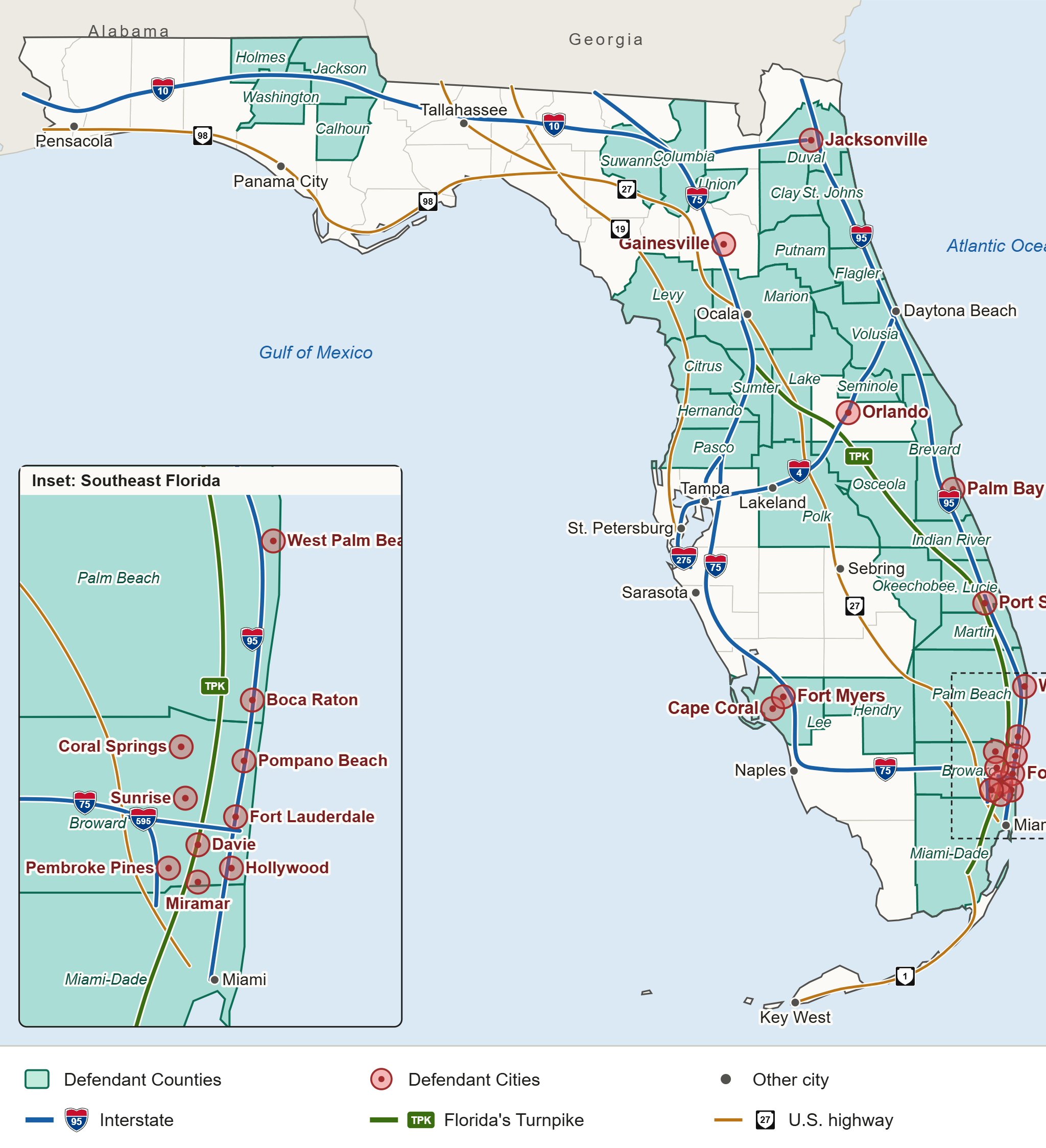
The map below identifies county and municipal defendants named in
FAC v. Glass. Shaded areas indicate defendant counties; red circles mark defendant cities.
The impact of these restrictions can extend beyond where you live.
Consider the places where you visit family, stay with friends, or would like to spend time but avoid because of local restrictions.
📝 Version 1: How the Laws Affect You Where You Live
The original declaration form covers the effects of Florida’s registration requirements and applicable local restrictions. It includes experiences involving housing, overnight visits with family or friends, public spaces, travel reporting, identification markings, and residence checks.
Read the statements carefully, select only those that are true
for you, and review the completed declaration before signing. The form requires you to confirm that you are an adult FAC member
and that your declaration is truthful.
📝 Version 2: How Other Counties and Cities Affect You
The effects of these restrictions do not necessarily end at the boundary of the county where you live.
Perhaps you cannot stay with relatives in another community.
Perhaps you avoid visiting friends, traveling to certain places, or entering public spaces because you do not know whether a local
proximity ordinance applies.
FAC prepared Version 2 to address the effects of restrictions in
other counties and cities.
If you have already submitted a declaration about your own county,
you can also submit a second declaration about other places
that affect you.
Please complete both versions if both apply to your circumstances.
Each serves a purpose: explaining the impact where you live and
explaining the impact of restrictions elsewhere. Please describe
only experiences that are true for you.
You do not need to have the most dramatic story for your experience
to matter. An ordinary family visit you cannot make, a place you avoid, or a housing choice you cannot pursue can help explain how these rules operate in daily life.
🌎 Add Your Voice: Sign FAC’s Human Rights Petition
FAC’s petition asks the United Nations High Commissioner for Human Rights to investigate public sex offender registration in the United States as a violation of the Universal Declaration of Human Rights.
The petition describes harms that extend beyond the person listed, including effects on housing, employment, personal safety, spouses, children, and other family members. It asks for investigation and
action on those human rights concerns.
Human dignity should remain part of every discussion about public safety, punishment, and rehabilitation.
Signing the petition is another way to support that message. Sharing it gives others an opportunity to learn about the issue and decide to add their voices.
🌎 Sign and Share the Human Rights Petition
If you have already signed, please share the link with someone who has not. Explain why this issue matters to you. Personal conversations can reach people who might otherwise scroll past.
💙 Help FAC Continue This Work
Research, public education, outreach, and sustained legal action require people willing to contribute their time, their experiences,and their support.
76% of the goal
As of September 17, 2026, FAC had reached 76% of its fundraising
goal for this lawsuit.
Help support the effort by making a donation.
FAC’s General Legal Fund supports existing and future legal challenges,
including expenses such as attorneys’ fees, court filings, records
requests, and litigation research.
💙 Donate to FAC’s Legal Efforts
For information about making a
tax-deductible donation to Florida Action Foundation, Inc.,
a 501(c)(3) organization,
contact:
[email protected]
If you cannot donate, you can still contribute. Complete the declarations that apply to you. Sign and share the petition. Share FAC’s reporting and videos. Help someone else find the information they need to participate.
Your involvement matters.
💪 Keep Going—Even When Progress Feels Slow
“Success is how high you bounce when you hit bottom.”
— Commonly attributed to General George S. Patton
There are days when another headline, another restriction, or another closed door can make progress feel far away. Those feelings are understandable. They do not erase the value of the work already
done—or the possibilities still ahead.
Every person who speaks honestly about their experience helps others understand. Every volunteer who follows through helps the work continue. Every declaration, shared resource, and contribution
represents someone choosing to stay involved.
We cannot promise that change will come quickly. We can keep showing up, documenting the facts, supporting one another, and asking the questions that deserve answers.
Never give up on your dignity, your family, or the possibility of change.
📺
Visit FAC’s YouTube channel for the September 25 premiere
at 10:00 a.m. Eastern.
✍️
Complete
Version 1
and
Version 2
if both apply to you.
With unity comes change.
Discover more from Florida Action Committee (FAC)
Subscribe to get the latest posts sent to your email.

I’m a little perplexed Bay County or some cities in it were not included in the lawsuit. The city I live in hasn’t recently passed any new restrictions, but they already have a blanket ‘no sex offender can move anywhere in our city’ restriction no matter how far from schools, parks, etc. I was grandfathered in since I lived here prior to my conviction.
A win in the named counties may establish a precedent for other counties.
I rarely go outside my own county since some of the other counties are 10X worse on enforcement and harassment. Having said that, there are some cities in my county that I also avoid. There is one police department that has only about 10 cops and the road that passes through only takes about 2 minutes to be out of the city depending on the two traffic lights they have. It is a department you do not want to get pulled over for even if not a registrant.
Ten years ago, you could visit friends and relatives you had living in other parts of florida with very little concern of being tracked and your vehicle scanned by LPRs. NOW? Haha, thanks to Flock, they know what grocery store you shop at, what bank you viist and other mundane places you travel. So if you leave the county and go to Daytona beack or where ever, don’t be surprised if they ask next time you go in: “Did you take a vacation recently” or other foolish questions fishing for information!