Saturday News Lookout: Registry News Across Borders
FLORIDA ACTION COMMITTEE
SATURDAY NEWS LOOKOUT
Now for a Wider Look: Registry News Across Borders
By FAC Media | Opinion & Research
October 17, 2026 | Selected U.S. and international developments

Now for a wider look. This Saturday’s News Lookout brings together stories from across the United States and beyond, with a focus on public safety, fair treatment and families living with registry laws. Read the summaries, then open each dropdown for details and sources.
At a glance
This roundup looks at two Nebraska court cases, California’s public-listing exclusions, the Seneca Nation’s territorial ban and developments in South Africa, Ecuador and Northern Ireland. Earlier Canadian rules and Australian surveillance results provide context. Together, they raise questions about safety, housing, fair treatment and public exposure.
Every place has different laws. These cases are not interchangeable. But one question travels well: Does the policy protect people, and what does it cost the families living with it?
Nebraska: An arrest involving a man listed as transient
A man described as transient faces a registration charge. The report also identifies earlier registration convictions.
Read the story and sources
In an October 15 report, Justin S. Lucas was charged with a registration violation after accompanying a woman to the sheriff’s office while she sought help with a protection order. Court documents described him as transient. The report also identifies earlier registration convictions.
We do not know whether unstable housing caused this alleged violation. Still, it raises a familiar question: How can people meet reporting duties when they lack a stable home?
Nebraska: A separate case ends in a plea
A separate Nebraska case reached a reduced-charge guilty plea. Sentencing was scheduled for November 23.
Read the story and sources
Another October 15 report describes Larry Montgomery’s guilty plea to a reduced felony charge in a registration case. Sentencing was scheduled for November 23.
The report lists several allegations at arrest, including weapons allegations, but says only a registration count was initially filed. Arrest allegations, filed charges and the final conviction are different things. Readers deserve to know which is being reported.
California: Registered does not always mean publicly listed
California allows some people to be excluded from its public website while still requiring police registration.
Read the story and sources
An October 14 article highlights exclusions from California’s public registry website. California DOJ confirms that people granted website exclusion must still register with authorities.
That distinction matters: police registration and public exposure are separate policy choices. The article’s population figures still need direct verification against the dated state data.
Seneca Nation: A wide territorial ban
The Seneca Nation published a territorial exclusion policy with narrow health-care access and penalties for some who assist violations.
Read the story and sources
The Nation’s October 16 newsletter publishes a resolution adopted September 29 barring Level 3 registrants from its territory. A narrow exception allows enrolled members preapproved, escorted access to health care.
The resolution also provides penalties for certain people who help someone remain or return in violation of the ban. What happens to family support when helping someone stay can itself bring penalties?
South Africa: A push for public access
A political campaign is seeking wider public access to the register. That demand is not itself a new law.
Read the story and sources
On October 14, the political party BOSA delivered a petition seeking wider public access to the National Register for Sex Offenders, according to Sunday World. This is a campaign demand, not proof that a new public-access law has taken effect.
Before expanding disclosure, what evidence and safeguards should lawmakers require?
Ecuador: A proposed register and work restrictions
Lawmakers began debating a child-safety proposal that includes a register and work restrictions.
Read the story and sources
The National Assembly reported a first debate on October 15 on a child-safety bill. It proposes a register for qualifying final convictions involving child sexual abuse material, restrictions on work involving direct contact with children and prevention measures.
This is a proposal, not an enacted law. Protecting children is essential; the details of scope, review and implementation deserve close attention.
Northern Ireland: A decoy case moves toward sentencing
Guilty pleas in an adult-decoy sting case were followed by continued conditional bail pending sentencing.
Read the story and sources
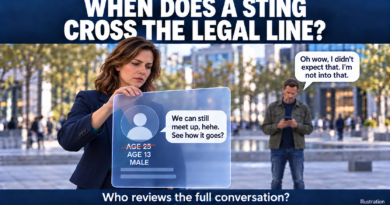
An October 14 report describes guilty pleas in an adult-decoy sting case. Ian Stanley Boyd remained on conditional bail, with sentencing scheduled for December 9.
The short report does not establish entrapment or explain the complete exchanges. A decoy case still requires careful attention to the evidence, not assumptions in either direction.
Recent background worth keeping in view
Canada: Database review deadlines
Regulations published October 7 set decision and review timelines for a specific public database.
Read the background and source
New regulations, effective September 25, set deadlines for decisions and annual reviews within the public High Risk Child Sex Offender Database. This is a specific database, not a rule making every Canadian registrant public.
Western Australia: Facial-recognition contacts
An October 6 update reports police contacts with 114 registrants. Contacts are not the same as arrests.
Read the background and sources
Police reported 114 registrants identified and engaged during a facial-recognition trial. That is not a count of 114 arrests. FAC has already examined the risks of relying on facial recognition in Florida.
Already covered by FAC: Read our October 14 Fresno housing report for another part of this discussion.
Children deserve safety. Survivors deserve support. Families deserve fair treatment. Public policy should be judged by what it achieves, not just how tough it sounds.
Please watch: Fran’s Story
I know the creator behind The Overlooked and appreciate his work. Fran’s Story, A Mother’s Love is heartbreaking and may hit close to home for some of our members and families. Thank you for helping these stories be seen and heard.
Watch the original video on YouTube · The Overlooked channel
Sources and scope
Sources are linked within each section. This is a selected roundup, not a complete survey of every country. Publication dates and action dates differ. Earlier background is labeled separately.
The Nebraska and Northern Ireland case summaries rely on the linked reporting; FAC Media has not reviewed their complete court records. Proposed measures are identified as proposals. The examples do not establish that different countries’ legal systems or risk categories are equivalent.
Discover more from Florida Action Committee (FAC)
Subscribe to get the latest posts sent to your email.


Comment Policy