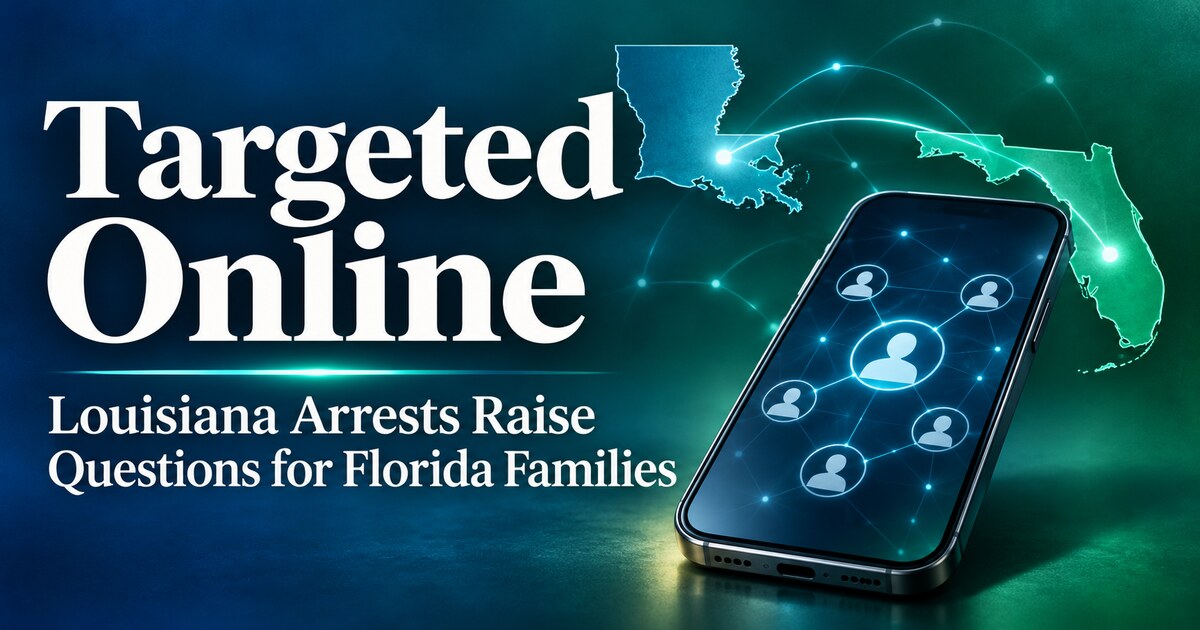
Targeted Online: Louisiana Arrests Raise Questions for Florida Families
An email address. A gaming name. A dating profile. These are ordinary parts of life for millions of Americans. An app can sign you up in just a few clicks. For nearly a million people required to register, those clicks can carry devastating consequences.
On November 12, Louisiana Attorney General Liz Murrill joined law-enforcement partners in Kenner to announce 35 arrests in Operation Safe Networks. The attorney general’s announcement says the operation focused on people with qualifying convictions who allegedly used prohibited social-networking sites.
There is that word again: targeting. The written announcement’s headline uses the phrase “Targeting Child Predators on Social Media.” But what did each person actually do? The announcement describes different allegations and names a range of platforms. The public deserves more than a single label for every person arrested.
What did officials say?
At the announcement, Murrill said: “These are people who are in the business of being deceptive and manipulative.” In the same FOX 8 video, she spoke about “expanding our network and expanding our partners.”
That is the attorney general’s characterization. Does it fairly describe every person arrested? Each case should be judged on its own facts.
FOX 8 reports that some suspects allegedly used platforms to communicate with children or undercover agents. Those are serious allegations. But the available announcement does not give a case-by-case breakdown or a verified count of new victims. We cannot say there were no new victims, or assume there were new victims in every case.
Accounts named in Louisiana
The state named these platforms. It did not say every person arrested used every platform.
These examples give insight for us in Florida about what could come under scrutiny. Should this information come from FDLE as we asked, and not be gathered from headlines?
Louisiana law restricts certain people with qualifying convictions from using covered social-networking sites. That is different from Florida’s reporting requirements. Officials also described other alleged offenses, so the 35 cases should not all be called reporting violations.
FAC has seen this before
We have reported on separate cases and operations involving online accounts:
- Match.com and other dating accounts: Operation Matchmaker examined allegedly unreported dating accounts.
- OnlyFans: Operation Not a Fan involved allegedly unreported accounts and other registration information.
- YouTube and Google Drive: FAC’s request for clarification said members were arrested over these accounts. FAC questioned how the law applied.
- Roblox and Telegram: Our “Targeted Again” article discussed Roblox in St. Johns records and Telegram in a separate Leesburg case.
- Craigslist: A Pennsylvania case involved a Craigslist-generated email address. That ruling did not decide Florida law.
- Fortnite and Discord: FAC covered a separate Louisiana operation.
These are different cases, with different facts and laws. Together, they raise questions about what information is collected and how it is used.
How are accounts found?
St. Johns records reviewed by FAC describe registered email addresses being compared with Roblox account information. Louisiana has a law providing for social-network sites to compare certain registry identifiers with their user databases.
Louisiana’s announcement does not say whether that method was used in Operation Safe Networks. Were names or email addresses given to companies? What legal process was used? How did officers confirm who controlled an account? We should ask, not guess.
Florida law and Judge Hinkle’s order
Florida Statute 943.0435 requires people covered by that section to report email addresses and internet identifiers, along with the related website or app name. Generally, they must do so within 48 hours after use. People under Department of Corrections or Juvenile Justice supervision must report to that agency before use.
Judge Hinkle’s 2018 order, available through FAC, upheld much of the law as the court interpreted it. It also explained limits on which internet identifiers must be reported, including the role of direct communication with another user. Finding an account does not, by itself, prove its identifier had to be reported. The order did not end email or qualifying identifier reporting. Read FAC’s guide.
Members deserve answers
What if an account was created automatically? What if someone never used it to communicate? What about a gaming name or dating profile?
FAC asked FDLE for clear answers in December 2025. FDLE denied the request in March 2026, and FAC announced an appeal in April. FAC said the denial did not provide the clarification members needed. Read FAC’s update.
In November, FAC returned to those questions. People are left looking through laws, court orders and headlines to work out what applies to them. That is frightening when a mistake can lead to a felony charge.
No one under the American legal system should have to guess what the law requires while facing a possible felony for getting it wrong.
Members can review their email addresses and qualifying usernames, screen names and gaming names, along with the related site or app. The examples in this article are not a complete list. Ask your registration office or supervising officer about your own requirements.
Who are the partners?
Louisiana’s operation included local and state agencies, Homeland Security Investigations and the U.S. Marshals Service. The national Internet Crimes Against Children program provides training and tools across agencies.
Murrill spoke about expanding the network. Which partners will be added? Will agencies seek help from units that have won awards and been praised for similar operations? What methods and information will they share?
FDLE said other agencies expressed interest in similar efforts after Matchmaker. That does not prove Louisiana copied Florida, but the operations show similar tactics. Their laws and allegations are not the same in every case.
Other states, different cases
In West Virginia, federal prosecutors announced a 14-month prison sentence for a registration violation after a man moved between states. Their release did not allege a new sexual offense. Read the DOJ announcement.
In California, Crime Voice reported that an audit found an allegedly missed annual update, followed by an arrest at the man’s registered home. We have not independently reviewed the sheriff’s records.
These are separate cases, not one national operation. Behind every arrest is a person and a family. An arrest total does not, by itself, tell us how much safer anyone became.
Discover more from Florida Action Committee (FAC)
Subscribe to get the latest posts sent to your email.
I have ZERO social media. No facebook or any of that. What I need to remember is, next year my license plate renews (Florida every 10 years) and I need to remember to register it. I will go directly from the drivers license department to the registry department. Oh joy.
I do not do any registration updates online, only in person so I get a receipt of Proof. Might cost time and gas but better getting that paper confirmation in hand.
Why not just do updates on line and print the confirmation?
Jacob
I am old fashion and stubborn as a mule, that is why LOL
Fair enough 😂👍
I always take screenshots of my online changes.