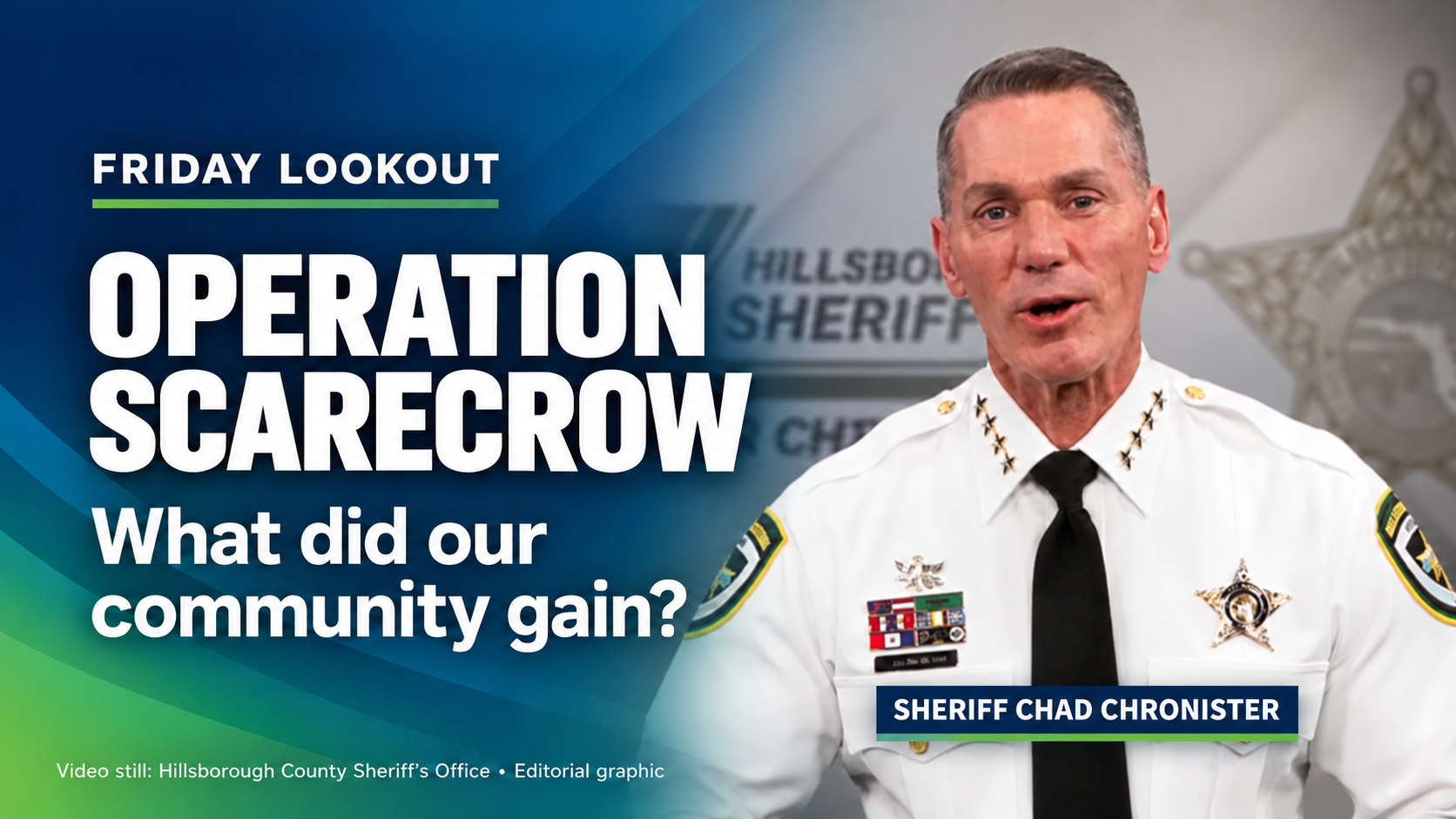
Friday Lookout: Operation Scarecrow—What Did Our Community Gain?
FLORIDA ACTION COMMITTEE MEDIA
 Opinion & Analysis
Yet again, another Halloween operation. Another round of Halloween hysteria.
This Friday, instead of sharing the week’s headlines, the Florida Action Committee Media Committee took a closer look at Operation Scarecrow. What did it achieve, what did it cost, and how did it help the community?
For our members, families, and supporters, these questions are personal. A knock can leave a spouse shaken or a child scared. We shared that concern in A Spot Check Should Not Leave a Family Afraid.
The Hillsborough County Sheriff’s Office reported checking 1,202 people in unincorporated Hillsborough. FDLE and Florida Department of Corrections staff joined during the final week.
Our October 18 community-file count found 1,968 people forced to register reported as living in Hillsborough County communities. The checks equal roughly 61% of that countywide count, although the operation covered unincorporated areas.
HCSO described the work as compliance checks to confirm addresses and enforce registration and probation rules.
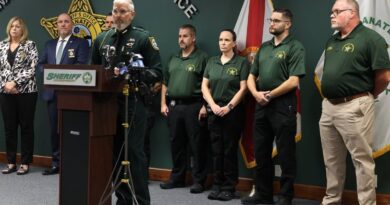
Even Sheriff Chad Chronister went door to door. His office highlighted his role while promoting the operation. Did the results deliver the safety benefits the agency hoped for?
The operation produced 30 arrests—about 2.5% of those checked.
Our review of the published arrest list found:
- 24 people faced registration or reporting allegations: about 2% of those checked, or one person for every 50 checks.
- 16 faced probation-violation allegations. Eleven were also among those 24, so the groups overlap.
- One person faced a residency-restriction allegation without registration or probation charges.
Many allegations involved reporting vehicles, phones, online accounts, addresses, or identification changes. Some people also faced firearm, drug, or altered-ID allegations. Arrests are not convictions.
The list does not identify a separate new sexual-battery or molestation charge. In the highlighted AI-chat case, HCSO reported no access to victims and no evidence of unreported offenses.
Those facing probation allegations were already under supervision. What extra protection did this sweep provide beyond their existing monitoring?
And why “Scarecrow”? Was it a Halloween theme, a way to draw viewers, or a joke? How does that name feel to families already afraid? As we wrote in It’s Halloween Hysteria Time Again, words matter.
The Florida Action Committee has also shared coverage of a teen indicted after reportedly admitting to killing a registrant. Related court reporting described an alleged attacker choosing someone he found online.
That does not prove a headline caused violence. But could repeated warnings, labels, and videos showing this group under watch feed hostility or encourage someone to act as a vigilante?
People on the registry are our neighbors. Their spouses and children live with the public response, too. Officials and reporters should consider that impact.
An arrest total measures activity. It does not show whether a child was protected, whether a reporting error was fixed, or whether the same result could have been reached with fewer staff and less fear. Those are fair questions about public service.
Public money also deserves a closer look.
Our coverage of the rules, records, and money behind Florida’s registry follows the staff, systems, and funding involved.
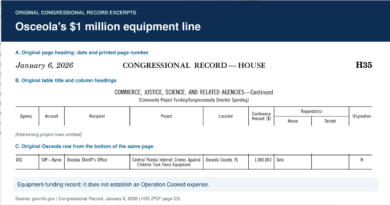
Hillsborough’s county audit reports $515,774 in federal JAG spending for fiscal year 2025. That is broader justice funding, not a verified Scarecrow cost. We have not established that a particular grant paid for this operation.
Grants are public money. How many staff took part? How many work hours and overtime hours were used? What did vehicles, booking, and jail stays cost? How did the cases end?
Without those records, we cannot fairly judge whether the results justified the expense.
One always wonders: was this late Halloween push meant to gain likes, views, or subscribers? Do arrest totals influence requests for future grants? We do not know the agency’s motives or have evidence that arrests were required for funding.
Families and taxpayers deserve answers. Helping the community should include clear rules, housing, jobs, and mental health care.
Support should not end when officers leave. Families may need help keeping a home, getting to work, understanding a rule, or finding care for an older parent. We should ask how public spending meets those needs, too.
We can seek safety while treating people humanely.
Children deserve safety. Survivors deserve care. Families living with registry rules deserve dignity and peace.
About the numbers: The community figure comes from a retained FDLE-derived file analyzed with an October 18 reference date. It is a reported-residence record count, not a certified live census. The countywide count and the operation’s unincorporated-area scope differ; 61% is a numerical comparison, not an independently matched coverage rate. Arrest figures come from HCSO’s October 29 release and linked roster. The JAG figure appears on page 10 of the county’s FY2025 Single Audit and is not an operation-specific cost.
Discover more from Florida Action Committee (FAC)
Subscribe to get the latest posts sent to your email.

Wait, what? I thought they did the stings ON Halloween to make sure we are complying. What is the purpose of doing it in advance, or maybe not at all?
Got to love those mean, scary prisoners that are in for a registry violation. Now that is sum great
po-lice-in yall!
That guy with the walker in the video is seriously the scariest one of them all! 😱🏃♂️💀 #video #man #walker
Notice unincorporated areas where they can live now PFR too
First part meant as sarcasm to readers
I found this quote from the great Thomas Sowell. I think this fits perfectly with the fallacies many law enforcement, citizens and others have decided to believe.
“Some things are believed because they are demonstrably true. But many other things are believed simply because they have been asserted repeatedly-and repetition has been accepted as a substitute for evidence.”
~ Thomas Sowell, Economic Facts and Fallacies (2008)