Media Tuesday The Buzz #5: Families, Fresh Perspectives and Reasons for Hope
FLORIDA ACTION COMMITTEE MEDIA
Tuesday’s Media Buzz
Families, Fresh Perspectives and Reasons for Hope
October 13, 2026 • News, context and community
Behind the headlines, people are still living their lives.
A court decision, a proposed restriction or an enforcement announcement can change how people move through the world. This week’s stories invite us to look beyond the headline: what happened, what the evidence supports and what it means for families. Protecting children and treating people with dignity both deserve serious attention.
THIS WEEK’S VIDEO FEATURE
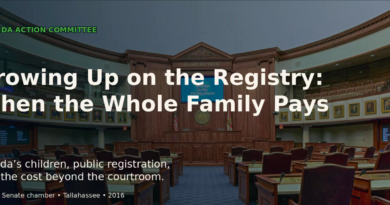
Growing Up on the Registry:
When the Whole Family Pays
Our compassionate look at youth registration and its effects on families asks viewers to remember the children and everyday lives behind the labels. The full video premieres Tuesday, October 13 at 10 a.m. Eastern. Its YouTube premiere page is available now; playback begins at the scheduled time. The companion Short is planned for 5 p.m. Eastern that afternoon.

Fresh stories worth your attention
Six developments, with links to the reporting and court decisions.
HAWAII • OCTOBER 7
A court draws a line around registration authority
A Hawaii appeals court rejected a registration condition imposed through a judge’s general probation authority when the conviction did not fall within the registration law’s covered categories. The decision separates the power to order treatment from the power to require registration.
Why it matters: Even a condition presented as protective needs a legal foundation. This ruling concerns the registration condition in a 2024 sentence; a later 2025 resentencing was outside the appeal. It does not establish the person’s current registration status or change Florida law.
DELAWARE • OCTOBER 9
GPS requirements can follow a later registry case
Delaware’s Supreme Court upheld GPS monitoring during probation for a later failure-to-report conviction involving a person classified as Tier III. The court concluded that the requirement was not limited to probation imposed for the original sexual offense.
Why it matters: A registration case can bring consequences extending well beyond paperwork. This is also a reminder to read the full outcome: his probation ended during the appeal, and the GPS monitoring stopped. The decision upheld the challenged requirement; it was not a ruling that monitoring must continue forever.
OHIO • REPORTED OCTOBER 8
A proposed ban reaches everyday community spaces
The Portager reported that Streetsboro was considering excluding people on the registry from many city-owned facilities, including parks and recreation spaces. Its October 8 report described a proposal and a planned October 12 discussion, not a confirmed final ordinance.
The question for readers: How should a community weigh safety, access and the effects on families before drawing new boundaries? A proposed rule deserves careful public examination, including what conduct it addresses and how it would operate. Adoption and the final wording still need confirmation.
NORTH CAROLINA • REPORTED OCTOBER 8
266 checks: what the enforcement numbers actually say
WSPA reported that a Buncombe County operation with the U.S. Marshals Service conducted 266 compliance checks on September 23–24. Officials identified 11 alleged address or other registration violations, with charges forthcoming in the account.
Keep the categories clear: Compliance checks, alleged reporting violations, new sexual offenses and convictions measure different things. This report does not establish 11 new sexual crimes or 11 convictions. The totals describe enforcement activity; by themselves, they do not show how much harm was prevented.
IOWA • OCTOBER 7
An appeal shows why the underlying facts matter
Iowa’s Court of Appeals affirmed four registry-related convictions and a child-endangerment conviction in the Vulich case. The evidence involved an unregistered second residence, a childcare buffer, a Quora identifier and unsupervised access to a minor.
A careful reading matters: This was not simply a prosecution for visiting a friend. Reducing a case to a headline can leave readers with the wrong impression of both the rules and the evidence. The decision is a concrete example of how several requirements can be examined in one case.
UGANDA • OFFICIAL UPDATE OCTOBER 8
Investing in treatment and a chance to rebuild
Uganda Prisons Service has highlighted a new Sex Offenders Treatment Manual, launched in September, to guide assessment, treatment and rehabilitation for prisoners convicted of sexual offenses. Eagle Online reported that the planned rollout covers 270 prison units and aims to support reintegration while keeping victims’ rights and safety central.
There is hope in making room for change. Structured treatment can be part of a serious conversation about accountability and life after custody. This announcement describes a program and its goals; it does not yet establish reduced reoffending or a change to registry laws. The next question is how it works in practice.
Our hope: It is encouraging to see an investment in treatment and the possibility of change. We hope this effort receives the qualified professionals, training and ongoing support needed to help people rebuild their lives while protecting others.
Sources reviewed October 12, 2026. Court summaries describe the cited decisions and are not individual legal advice. Proposed measures may change.
AROUND THE WORLD
Safety, Accountability and Life Beyond the Label
These four stories show different countries wrestling with disclosure, restrictions, review and family life. Their laws differ, but the shared question is familiar: how do we protect people while checking whether a policy works and recognizing everyone affected by it?
AUSTRALIA • OCTOBER 5
Tasmania: would a disclosure scheme make children safer?
A Tasmanian parliamentary inquiry recommended withdrawing and substantially rewriting the proposed “Daniel’s Law,” according to Australian Associated Press reporting. The proposal would let parents and carers ask police whether someone with regular, unsupervised access to a child was registered.
The inquiry raised concerns about survivor privacy, false reassurance when someone is not listed, and the effects of isolation, unemployment, vigilantism and unstable housing. Supporters, including the police minister and Daniel Morcombe’s parents, continued to argue for stronger protections.
This was a recommendation to rethink a proposed law, not a repeal. It puts an important question in front of lawmakers: could a measure intended to protect children create additional risks, and how should those concerns be addressed?
UNITED KINGDOM • OCTOBER 5
Researchers ask whether restrictions prevent harm
Leeds Beckett University announced government-funded research into Sexual Harm Prevention Orders, which can restrict activities such as internet access. Researchers from Leeds Beckett and the University of Lancashire will interview officers from five police forces and examine orders and case files.
The aim is to understand how the orders work in practice and whether they help prevent further sexual harm. Findings are expected to reach the Cabinet and Home Office by March 2027.
The study has been announced; its results are not yet available. For families, survivors and the wider public, the value lies in asking for evidence about outcomes. The existence of a restriction alone cannot tell us whether it achieves its purpose.
CANADA • PUBLISHED OCTOBER 7
Annual review, with an important limit on removal
Canada published regulations setting timelines for its existing public database of people convicted of sexual offenses against children who are considered high risk. The rules require a review by December 31 of the year they take effect, followed by review at least once in each calendar year.
There is a separate rule for removal applications: if no decision is made within 30 days after receipt, the application is treated as refused. Silence does not mean automatic removal.
The official explanation says these deadlines reflect existing Royal Canadian Mounted Police practice. This is not the launch of a new database. It is a useful reminder to examine both a review requirement and what happens when a person asks to leave a public list.
INDIA • REPORTED OCTOBER 8
A visa decision reaches into family life
The Delhi High Court upheld the denial of an Indian visa to a U.S. citizen seeking to join his Indian spouse. Bar & Bench reported that the court considered his sexual-offense conviction and the government’s authority over entry. The record also involved a passport endorsement and his failure to disclose earlier unsuccessful litigation over entry and cancellation of an e-visa.
This is a case-specific decision, not an announcement of a new blanket entry ban. Family connections do not by themselves settle a visa application.
For readers with loved ones abroad, the case shows why travel questions require careful attention to the destination’s rules and the person’s own record. Border decisions can affect relationships long after a criminal sentence.
Children need protection. Survivors deserve care, privacy and a voice. Families also need stability and understandable rules. Looking closely at the evidence is part of taking all of those needs seriously.
In case you missed it
Traffic Stops and Registry Questions: Know Your Rights
A recorded Missouri encounter brings reporting questions and the effects on a family into focus.
Operation Cooked: Who Teaches the Tactics?
A closer look at the training behind undercover operations and the questions that deserve scrutiny.
Florida’s Registry: Public Safety or Overenforcement?
Registry numbers, requirements and public spending, with attention to the people behind the totals.
Help carry the legal work forward
FAC’s General Legal Fund supports existing legal challenges and future lawsuits, including attorney fees, court filings, records requests and litigation research.
FAC v. Glass litigation fundraising
$135,149 raised toward $170,000
$34,851 remains toward that target.
FAC’s published update is dated October 9, 2026 and includes funds raised and earmarked by partner associations. This is the litigation campaign’s fundraising total, not the General Legal Fund’s available balance.
Help sustain this work
Research, public education and legal advocacy take sustained support. If you’re able to give, please consider a contribution to the Florida Action Foundation, a 501(c)(3) organization. Donations to the Foundation are tax-deductible to the extent allowed by law.
Visit the Florida Action Foundation
For a tax-deductible gift directed toward FAC’s General Legal efforts, contact the Foundation. Questions? [email protected]
If giving isn’t possible right now, reading and sharing these stories still helps. Thank you for being part of this work.
A free way to help: 313 more voices
9,687 verified signatures
That leaves 313 more signatures to reach 10,000. FAC’s petition asks the United Nations High Commissioner for Human Rights to investigate the harms of public sex-offender registration and take appropriate action.
If you haven’t signed, please consider adding your voice. If you have, sharing the petition is another way to help. Signing is free. This is an advocacy petition asking for action, not a United Nations ruling or endorsement.
Read, sign and share the petition
Count checked directly on Change.org October 12, 2026 at 7:29 p.m. Eastern. The live total may change.
Progress takes attention, persistence and people willing to keep showing up. Thank you for staying informed and helping others feel less alone.
Discover more from Florida Action Committee (FAC)
Subscribe to get the latest posts sent to your email.
Comment Policy