“Get the Hell Out”: Life on Florida’s Registry After the Sentence Ends
Florida officials in their own words, and what families hear when they’re trying to rebuild.
Author’s note: Most of the quotes in this piece are from the past two months. Older quotes are dated in the text, including the 2025 Highlands County quote, which is included for comparison.
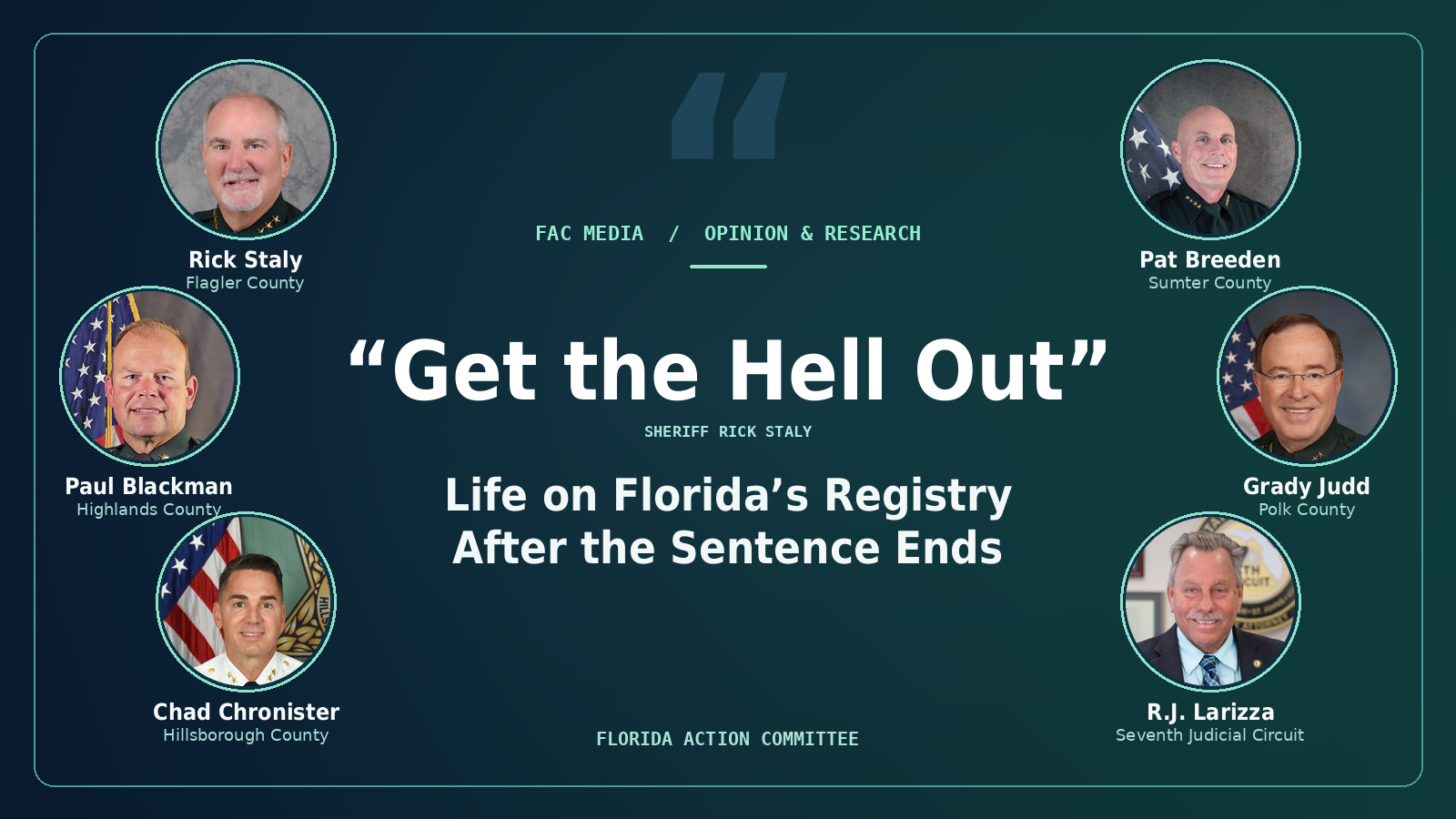
“My advice to perverts: get fixed or get the hell out of Flagler County.” That’s what Sheriff Rick Staly said in October 2026, after new charges involving abuse images. He also repeated his mother’s view that people convicted of sex offenses cannot be rehabilitated. A month earlier, Staly called another man a “pervert” and said he should “go directly to prison.” The new charges in that case were for failing to register. One case involved abuse images. The other involved reporting rules. Both got the same insult.
We’ve heard this kind of talk before, and we’ve covered it in past FAC posts and YouTube videos.
Highlands County: Two Halloweens, the same question
After Operation No Treats in 2025, the Highlands County Sheriff’s Office reported 34 arrests. Sheriff Paul Blackman said his office explains the rules in detail. Then he said, “If you’re not going to follow the rules, Highlands County is not the place for you.” What if you’re trying to follow a rule you don’t understand? That question keeps coming up with internet identifiers.
In October 2026, Highlands 104.3 reported 36 arrests in Operation No Treats Two, a sweep of two different registries. The station also reported separate claims involving child sexual abuse images. An arrest total doesn’t tell us how many people missed a report or whether the sweep made anyone safer.
Then, in a November 6, 2026 address-change notice, the sheriff’s office said its unit “closely monitors the sexual offenders and predators in our county.” Those were the office’s words, not Blackman’s. The notice shows how public the process can be even when people report where they live.
A signature doesn’t mean the rules were clear
In St. Johns, FDLE’s Melissa Bujeda said people “sign a form stating they understand.” The form tells us they signed. It doesn’t tell us what they understood. If a missed report can bring a felony charge, people deserve clear examples and a place to get answers before they make a mistake.
“Operation Gotcha” FAC post states that investigators used email addresses people had already reported to find other accounts. Some people said they had never used those accounts or didn’t know they existed. The state’s reporting guide refers to names used to talk with people online. If an account is linked to your email, does that mean you knew about it or used it to talk to anyone? FDLE dismissed FAC’s request for clarity without answering those questions.
If these rules affect you, would you be willing to follow the steps in FAC’s Internet Identifiers: Request Guidance From FDLE? I want to highlight this part:
And before anyone asks in the comments “will FDLE retaliate against me if I file this?”. We’d like to think no, they obviously shouldn’t. But only do what you’re comfortable doing.
A reader of the weekly update asked, “Does LE want to ensure compliance, or arrests?” It’s a fair question: Are we helping people follow the rules, or just counting arrests?
The whole family hears it
Before Halloween, the Jacksonville Sheriff’s Office posted, “Sex offenders and predators don’t get to celebrate.” In Clay County, Detective Colton Harris said, “we’re watching them, we’re monitoring them.” On decorations, he added, “Anything can be misconstrued as decorations, OK?” I think about the child who just wants to put a pumpkin on the porch. Their family hears those words, too.
Florida Corrections Secretary Richard Comerford said, “Protecting Florida’s communities remains our highest priority.” His agency announced more than 5,000 home checks for people under felony supervision. What did those checks find, and how much did they cost taxpayers?
What did the arrests tell us?
Hillsborough Sheriff Chad Chronister said that “those who were in violation went back to jail.” His office reported 30 arrests. FAC’s review found that 24 faced claims they broke registration or reporting rules, sometimes alongside other claims. In Sumter, Sheriff Pat Breeden spoke of “accountability” and “the safety of our community.” Two reported cases involved a PlayStation app and unreported license plates. Neither account described new sexual conduct.
Polk Sheriff Grady Judd said, “We do not tolerate any violation of sex offender registration laws or probation requirements.” Readers deserve that same clarity in arrest totals. In St. Johns, State Attorney R.J. Larizza said, “These folks don’t quit, and neither do we.” He meant the undercover sting. Yet one announcement led with 38 arrests: 15 from the sting and 23 from registry enforcement.
The same word keeps showing up. FAC’s published review found that Florida’s Department of Law Enforcement used “targeted” in releases about 10 registry or probation sweeps in 2025 and 2026. The count left out a county-only release and a wider immigration sweep. FDLE used it in two more releases: St. Johns County’s Operation Final Match and Kissimmee’s Operation K-Town. That’s at least 12 sweeps. To the agency, the word may just say who was checked. It can feel different if you’re the one trying to keep a job and a home.
And a home is where rebuilding starts. Miami-Dade Homeless Trust chair Ron Book told The Miami Times, “What has led these individuals into homelessness is their own sexually deviant behavior and nothing else.” What does “nothing else” leave out? Rules limit where people can rent. Landlords can turn them down. Their families still need a place to live. We still haven’t heard back from the Miami-Dade Homeless Trust about where people on the registry can go for shelter.
When officials say a sweep worked, show us what it cost, what people were charged with, and how the cases ended. Do arrest totals help keep funding or win grants? Is there pressure to “use it or lose it”? I haven’t seen proof of arrest quotas or that funding depends on these arrests. That’s why I’m asking for records.
Children deserve safety, and survivors deserve care. People who have served their sentences deserve a fair chance to follow the law, keep a home, and care for their families. If we expect people to rebuild, give them rules they can understand and speak about them as people who can change.
Discover more from Florida Action Committee (FAC)
Subscribe to get the latest posts sent to your email.


Comment Policy